

Source : THE AGE NEWS
There’s a screaming cognitive dissonance created by BHP’s slowness in investing in renewables and carbon reduction when only seven years ago its chief executive declared climate change an existential crisis.
Was the miner’s then CEO Andrew Mackenzie just virtue signalling when he declared in 2019 to a London room packed with politicians and captains of industry that his company would lead the capitalist pack on greening the world?
Probably not. But Mackenzie’s passion looks to have been replaced by the apparent mindset of today’s BHP leaders, for whom capitalism trumps climate and environmental protection takes a back seat to profit.
As one of Australia’s largest and most recognisable companies, the modern era of BHP’s senior management has been acutely aware of the mining giant’s image and the associated social licence to dig up the country’s natural resources.
But, as it turns out, it’s even more conscious of the need to maximise return on capital. And like at any large company, there is competition between divisions or projects about where investment is spent. That is the backbone of the capitalist corporate model.
Was the miner’s then CEO Andrew Mackenzie just virtue signalling when he declared in 2019 that his company would lead the capitalist pack on greening the world?
Publicly, The Big Australian is very protective of its ESG (environmental, social, governance) bona fides.
So the public outing by the ABC and The Guardian of BHP’s abandonment of its bolder ambitions to cut carbon emissions at its iron ore operations in Western Australia is hugely embarrassing – presenting like an about-face on promises made to Australia and to its shareholders, who had robustly supported more aggressive emissions reduction goals.
And it’s surely no coincidence that days before the media was to run this BHP climate exposé, the company ran large newspaper advertisements promoting its strides around carbon emissions reduction.
The media outlets accessed a series of internal communications to evidence how BHP’s early ambitious plans to build out renewables had been abandoned, put on ice or slowed.
Interestingly, among the various BHP documents uncovered in this trove were warnings of the risks of taking the pedal off driving towards net zero targets.
The obvious risk around the optics of putting climate change in the back seat was reputation.
The potentially larger risk is that doing less carries a financial sting of more expensive carbon credits if companies like BHP aren’t addressing the climate needs with sufficient velocity.
And that’s where the government plays a crucial role – employing both carrot and stick policy to influence company behaviour.
For carbon reduction, there are two government schemes that are of major importance. The first is the Safeguard Mechanism, which creates a baseline level of carbon emissions and requires companies that exceed this cap to effectively buy credits to offset the surplus.
Leaked internal company documents from May 2025 show that BHP’s Western Australian mining division paid $8 million in such offsets for the preceding financial year. Managing risk is a key job for any company, and so is allocating capital.
As financial sticks go, the Safeguard Mechanism doesn’t even rise to the rating of a twig. In policy terms, this is an epic failure.
The fact that BHP supports the government scheme is because it works in the miner’s favour – much like the watered-down mining super tax that BHP endorsed 15 years ago.
Even more significantly, the government’s diesel rebate provides a disincentive for the company to migrate its energy sources away from fossil fuels to renewables.
BHP is the mining industry’s largest diesel user. According to media reports, it received an estimated $622 million in fuel tax credits from the federal government last financial year, including $379 million for its WA iron ore mines.
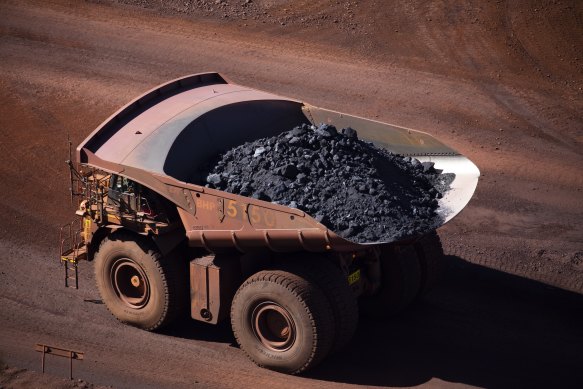
You can understand why management would put replacing the miner’s diesel trucks with electric vehicles at the back of the queue for investment dollars.
When BHP touts its progress towards net zero in its ads, it should be noted that the heavy lifting on reducing carbon emissions was done at its operations in Chile, whose government aims to have 90 per cent renewable electricity used in mining by 2030.
While the company can find cover behind its global climate credentials, this doesn’t help Australia and our government’s report card on tackling emissions.
The Market Recap newsletter is a wrap of the day’s trading. Get it each weekday afternoon.


