

Source : INDIA TODAY NEWS
India’s lunar ambitions have scored another scientific milestone. Scientists analysing data from India’s second Moon mission, Indian Space Research Organisation’s Chandrayaan-2, have identified strong evidence suggesting the presence of subsurface water-ice beneath craters near the Moon’s South Pole, one of the coldest and most mysterious regions in the solar system.
The discovery was made using the Dual Frequency Synthetic Aperture Radar (DFSAR) onboard the Chandrayaan-2 orbiter.
advertisement
Developed to study the lunar surface and subsurface using microwave imaging, the instrument operates in both L-band and S-band frequencies and is the first fully polarimetric synthetic aperture radar sent to the Moon.
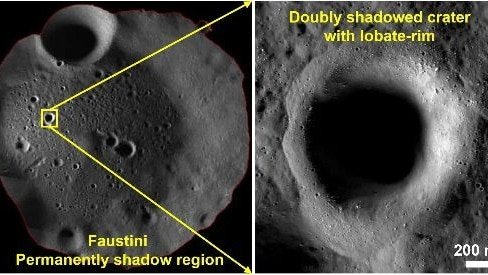
The new study was conducted by scientists from Physical Research Laboratory in Ahmedabad and focused on a rare category of “doubly shadowed craters” located inside permanently shadowed regions (PSRs) of the lunar South Pole.
These craters never receive sunlight and remain shielded from thermal radiation, causing temperatures to plunge to nearly 25 Kelvin, or around minus 248 degrees Celsius.
Such ultra-cold conditions make these regions prime locations for preserving water-ice over billions of years.
Using advanced radar polarimetric analysis, researchers found radar signatures consistent with possible subsurface ice beneath the floors of four doubly shadowed craters.
The scientists developed a refined radar-based method to distinguish genuine ice deposits from rough rocky terrain, a major challenge in previous lunar studies.
The technique combines two radar parameters — Circular Polarization Ratio (CPR) and Degree of Polarization (DOP).
According to the researchers, regions with CPR values greater than one and DOP values lower than 0.13 likely indicate “volumetric scattering,” a radar effect associated with subsurface ice deposits rather than surface rocks.
Among the examined locations, one small crater measuring about 1.1 kilometres in diameter inside the larger Faustini crater emerged as the strongest candidate for hidden ice reserves.
The crater not only showed compelling radar evidence but also possessed distinctive “lobate-rim” features, flow-like structures that scientists believe may have formed when an impact penetrated an ice-rich subsurface layer.
The findings could have major implications for the future of lunar exploration.
Water on the Moon is considered a critical resource for long-duration human missions. It can potentially be converted into drinking water, breathable oxygen and even rocket fuel through chemical processing. Scientists say locating accessible lunar ice deposits is essential for future in-situ resource utilisation (ISRU), a strategy aimed at reducing dependence on supplies carried from Earth.
The South Pole has become a focal point of global lunar exploration in recent years because of its potential ice reserves.
India’s Chandrayaan-3 mission had already demonstrated a successful landing near the polar region in 2023. The latest Chandrayaan-2 findings now strengthen India’s scientific contribution to understanding lunar water distribution.
The discovery also highlights the continuing value of the Chandrayaan-2 orbiter, which has remained operational years after the mission’s launch. While the mission’s lander failed during its descent in 2019, the orbiter has continued delivering high-quality scientific data, helping India deepen humanity’s understanding of the Moon’s hidden polar world.
– Ends
SOURCE :- TIMES OF INDIA