

Source :- PERTH NOW NEWS
East Fremantle Football Club will permanently fence its home ground East Fremantle Community Park so it can host WAFL and WAFLW matches, despite the ground being developed with the understanding it would be unfenced.
The East Fremantle council voted at its meeting last week to provide “in-principle” support for a permanent perimeter fence, subject to strict conditions.
The Sharks have been permitted to play on the unfenced oval for the past two seasons, but WA Football said in February perimeter fencing was now needed during WAFL games to meet safety requirements.
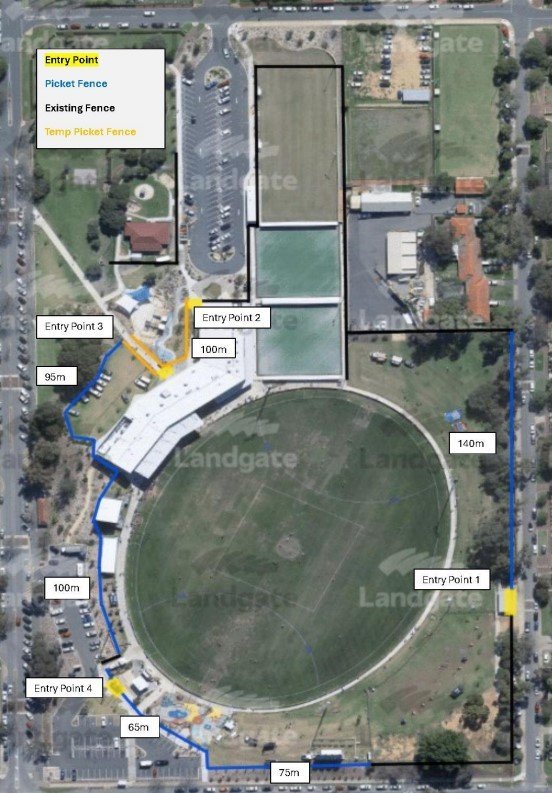
The Sharks erected temporary fencing as an interim measure, while waiting on a council decision on its proposal for permanent picket-style fencing to create controlled entry and exit points at the ground.
This would include four sections of fencing at least 1.1m high each, spanning from 110m to 140m along Allen Street, Marmion Street, the oval’s northwest boundary and Moss Street.
It is expected to cost $316,533. The club would seek State Government funding for the fence, via the local council.
Councillors voted in March to release the picket fence proposal for community consultation. The results of the consultation were presented at last week’s meeting.
Of the 140 submissions received, about 50 to 55 per cent opposed the fence, 40 to 45 per cent indicated they supported it and 5 to 10 per cent were neutral.
Cr Antony Brockmann said this represents about 2 per cent of the total 8600 East Fremantle residents.
“The numbers were pretty evenly split, but we still don’t know what 98 per cent of the community thinks,” he said.
Many opponents argued that “no fencing” was a core promise of the oval’s redevelopment and the physical barrier would restrict the shared community space.
Supporters said without fencing, the Sharks would not be allowed to play home games, which wouldn’t be fair on the club and its supporters.
Many also suggested it would allow the club to charge entry fees, but town CEO Jonathan Throssell said this was “misinformation” as the fence was for safety reasons, not ticketing.
“It’s clear through the consultation that we’re going to have to do more work in conjunction with the club to explain that having the fence doesn’t equal entry fees. There is an alternative model in place for the club to gain revenue, other than through gate revenue,” he said.
“(The fence) is articulated by the Football Commission to meet their venue regulations … in terms of player and spectator safety and being able to control access into a facility, rather than it being an ability to charge an entry fee.”
There was also strong consensus that the cost should not be covered by ratepayers, which the town included in its conditions for installing the permanent fence.
“The conditions detailed in the report are critical, including the fact that no town funding and ratepayer money goes towards the construction of this, and also that we stick to those conditions and there is no scope creep,” Cr Lucinda Maywood said.
But Cr Jenny Harrington raised concerns over ongoing maintenance costs.
“Although the commission will pay for the fence, the operating costs of maintaining it will be our cost, which will be disappointing for us to have to foot that,” she said.
The council voted 6-1 to support the permanent fence, but mayor Tony Natale said its installation would not progress until the town’s conditions were met.
“We want to make sure any changes to the park continue to reflect the needs and expectations of our community,” he said.

“These include some important safeguards around preserving community access, identifying who will pay for it, and confirmed compliance with WAFL requirements.”
The town is seeking written assurance from WA Football that the low picket-style fence meets its requirements for all game fixtures, including finals, and no additional height will be required.
Other conditions include confirmation of funding to construct the fence, emphasising the town will not contribute to the capital cost, and a formal variation to the licence between the town and the football club.
The town also wants to approve the final alignment and gate openings to maintain community access to the park outside match days.
Cr Brockmann said maintaining access and upholding these conditions was vital.
“As long as we can ensure the public has easy access to the community park outside of the games and it’s immediately opened afterwards, that will be a lot more palatable for those who are dead against the fence,” he said.
Mr Natale said the town had to respond to the external compliance requirement and move forward on the issue.
“This decision balances principle and pragmatism, with council carefully considering the park’s open and welcoming design, alongside the need to respond to requirements set by an external sporting body,” he said.
“We will continue working with the club and WA Football to understand whether the conditions can be met, and what this might look like for the community.”