

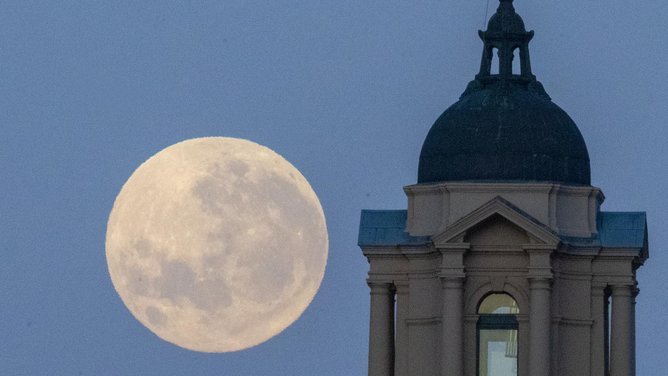
Source : Perth Now news
A rare lunar event is set to light up the sky this weekend, as a blue micromoon becomes visible on Sunday night.
The event is not something skywatchers get to see very often, as it combines two astronomical phenomena, a blue moon and a micromoon.
Laura Driessen, a postdoctoral researcher at the Sydney Institute for Astronomy, said it will be “incredibly bright” and visible anywhere in Australia.
“It’s tens of thousands of times brighter than the brightest star in the night sky,” she told SBS News.

A blue moon doesn’t mean the moon will actually turn blue – rather it’s the second full moon to appear in the sky in the month of May.
This is because the lunar cycle of the moon doesn’t line up perfectly with our calendar, which occasionally allows two full moons to appear in one month.
Sunday’s blue moon also happens to coincide with a micromoon – when the moon is at its farthest from Earth.
Micromoons can appear about 6 per cent smaller than an average full moon and over 12 per cent smaller than a super moon, according to Time and Date.
“At one point in its orbit, the moon is closer to the Earth, and that closest point is called the perigee. And another point in its orbit, it’s a little bit further away from Earth, and that’s called the apogee,” Ms Driessen told SBS News.
“A micromoon is when the full moon happens close to that apogee point. So the moon is just a touch farther away than it is in other parts of its orbit, so it looks a little bit smaller.”


The best time to see the celestial event is anytime on Sunday (May 31) when the sky is clear and dark.
In NSW, Queensland, Victoria, the ACT and Tasmania, the moon will reach peak fullness at 6.45pm AEST.
In South Australia and the Northern Territory, the micromoon will peak at 6.15pm ACST and in Western Australia it will peak at 4.45pm AWST.
If you look towards an open eastern horizon, the moon may glow golden-orange near the horizon at moonrise or after sunset.
No telescope will be required to see the moon but binoculars may help make the moon’s surface appear sharper.
Ms Driessen said human eyes can’t tell the difference in the size of the micromoon.
“You can only tell the difference if you have a photo of an average moon next to a photo of a micromoon,” Ms Driessen told SBS News.
“It will look like a beautiful full moon to us.”
The next blue moon won’t be until December 31, 2028.