

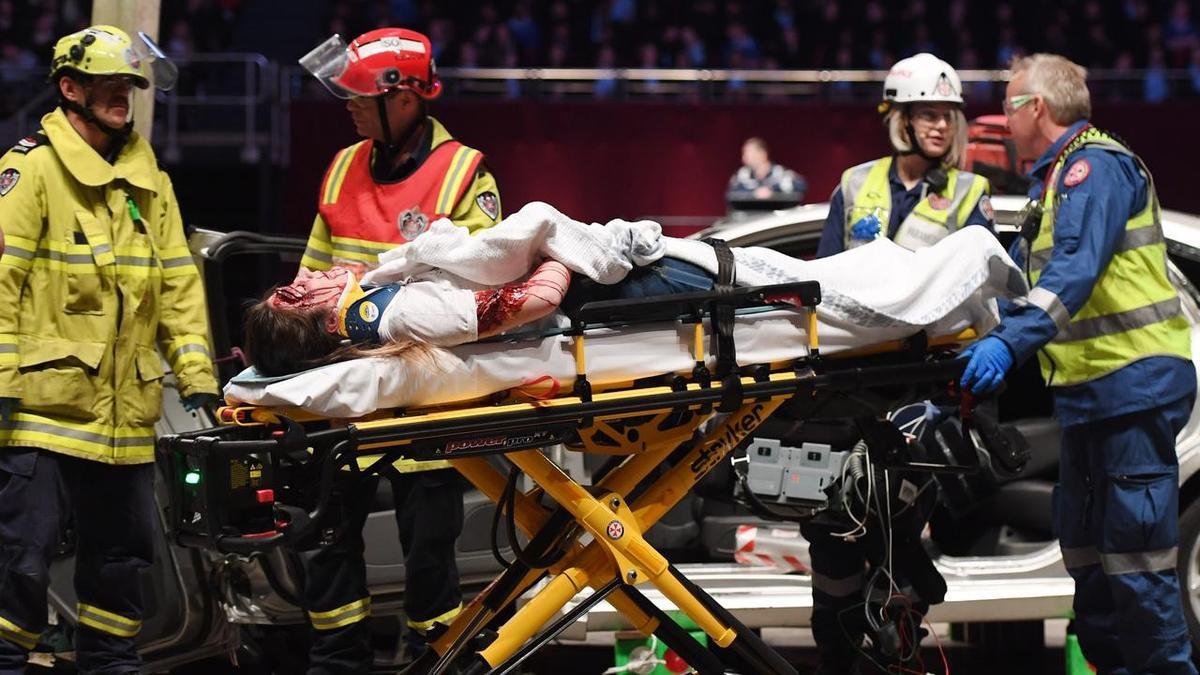
Source : Perth Now news
For most Australians, calling Triple Zero is one of the worst moments of their lives.
A loved one has stopped breathing. A bushfire is encroaching on their home. Someone is trapped, injured or dying.
For the people who answer those calls, however, those worst days are not isolated moments. They are repeated over and over again, shift after shift, year after year.
“Nobody calls an emergency service because they’re having a great day,” volunteer firefighter Elisabeth Goh says.
“It’s usually the worst day of their life or one of the worst.”
Across Australia, first responders step into those moments – walking towards car wrecks, fires, violence, medical emergencies and natural disasters as others desperately try to escape them.
With more than 14 million Triple Zero calls across Australia in 2025 alone, the emotional burden on frontline workers continues to grow.
Research shows one in three first responders experience high or very high psychological distress linked to trauma on the job.
For Ms Goh, who worked in counter-terrorism before volunteering through the Black Summer bushfires, the accumulation of trauma was gradual enough that she didn’t initially recognise it in herself.
After years working alongside victims in law enforcement and coronial investigations, she deployed during one of the worst fire seasons in Australian history, often balancing frontline firefighting with a full-time job.
“I actually ended up burning out from that,” she says.
Years later, she was diagnosed with complex PTSD.
But the people drawn to frontline work, she says, are often exactly the kind of people willing to absorb more than they realise.
“Some people have that intrinsic altruism to want to do good in every domain that they do,” she says.
“And I think some people are much more comfortable with chaos than others.
“But I also think there’s, you know, for a lot of people, there’s a really strong drive for service and serving community.”
That willingness to serve can make it difficult for first responders to step away, even when exhausted.
During the Black Summer fires, Ms Goh says one of the hardest moments was sometimes not being deployed.
Listening to radio calls while fatigued off shift, hearing about homes lost and communities devastated, she felt guilty being on the sidelines.
“I’m sitting here filling out a spreadsheet when I could be firefighting and helping people,” she says.
The psychological effects of emergency work are rarely tied to a single traumatic event, according to Mick Willing, chief executive of Fortem Australia and a former NSW police officer with 32 years of service.
“What happens is … the public and all of us move on once those sort of headlines fade and the crisis is over but the impact on those first responders doesn’t stop,” Mr Willing says.
“They take that home and they live with that.”
He says it is repeated exposure to crisis – not just one horrific incident – that wears people down over time.
“It’s the cumulative exposure to trauma, shift-after-shift that takes that toll,” he says.
While uniforms can create an image of strength and control, both Ms Goh and Mr Willing say the public often forgets the people wearing them are absorbing those experiences too.
“First responders are normal people,” he says.
“They’re the same people you stand next to in the line at the shopping centre. They’re the same people who drop their kids to school in the car in front of you.
“They just do an extraordinary job.”
The emotional strain also extends well beyond the frontline workers themselves.
“There’s a bit of a vicarious impact on family members as well because they live with first responders and they’re there, they see what they go through,” Mr Willing says.
For much of his policing career, he says, workers simply carried those experiences home in silence.
“Most of the time, I’d come home, you just would not talk about what you did.”
Fortem Australia was established to independently support first responders and their families, including counselling, peer connection and wellbeing programs.
Since 2019, more than 25,000 people have accessed its services.
Mr Willing says many frontline workers are more comfortable seeking support outside their own organisations.
“There is certainly a cohort of people that, for whatever reason, legitimate or not, want to deal with an external service provider and somebody independent,” he says.
As Thank a First Responder Day approaches on June 10, both Mr Willing and Ms Goh hope Australians think beyond symbolic gestures and remember the people behind the uniforms long after emergencies disappear from the headlines.
For Ms Goh, support does not always need to be grand.
Sometimes it is checking in on the family whose partner is away on deployment.
Sometimes it’s offering to watch the children for a few hours, sometimes it’s dropping off dinner after a long shift.
“The first responder family is not just the person,” she says.
“It’s actually the children, it’s the parents, it’s the husbands and wives and partners.”
On the worst days of strangers’ lives, first responders show up without hesitation.
Ms Goh says Australians should remember them on the ordinary days too.
“Maybe cook a meal for them,” she says.
“You can mind the kids for a few hours while they go to the gym.
“Just being a really good neighbour and a really good mate.”
Lifeline 13 11 14
beyondblue 1300 22 4636