

source : the age
Hello and welcome to our national news live blog for Monday, June 1. My name is Emily Kaine, and I’ll be helming our coverage for the first part of the day. Here’s what is making news today.
- Price growth across the national property market has ground to a halt, new research shows, with steep falls in Melbourne and Sydney as higher interest rates, stretched affordability and the federal government’s overhaul of tax incentives combine to suppress values.
- One Nation leader Pauline Hanson has declared she has the “ability” to be prime minister. Speaking to Sky News Sunday Agenda, she said: “I won’t knock the job … I’m not going to underestimate myself or say ‘No, I can’t do it’, because you know, have a look at what we’ve got now … And that’s why we’re in a mess.”
- Significant amounts of Russian timber are entering Australia after being laundered through China and other countries, evading tariffs imposed after Russia’s invasion of Ukraine and sparking demands for government action. The phenomenon – similar to the flow of Russian “blood oil” into Australia after being processed overseas – means that thousands of Australian home builders could be inadvertently aiding Putin’s war effort.
- The number of confirmed Ebola cases in the Democratic Republic of the Congo has climbed to 260 as officials updated their estimates of the outbreak’s size and international health organisations warned of the risk of further spread. Aid groups have said that without urgent intervention, this could be the world’s deadliest Ebola outbreak ever.
- And US President Donald Trump has toughened the conditions of a proposed peace deal to end the war with Iran, and sent his updated conditions to the country for consideration, three officials told The New York Times.
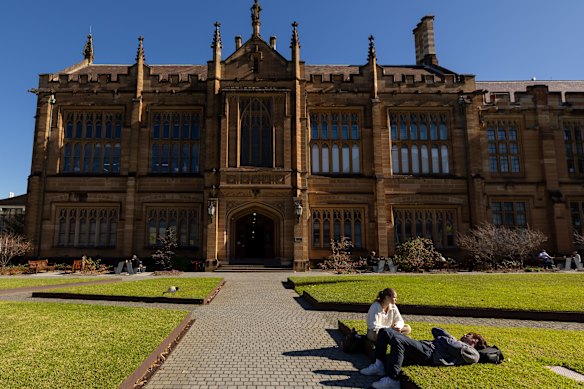
More than half of Australia’s universities have plummeted in global rankings thanks to years of inadequate funding and “the devaluation of science and education as public goods” harming the country as a whole, says the Centre for World University Rankings.
The University of NSW and the University of Melbourne maintained their positions at the top of the heap, ranking No.52 and No.64 two years in a row. The Australian National University dropped from 90 to 93, the University of Sydney fell from 94 to 100 and the University of Queensland rounded out the top five at 103 for the second year running.
World rankings are a major factor for many international students’ choice about where to study, and those students are a major funding source for Australia’s tertiary institutions.
The rankings come as Australian universities face a reckoning, with major changes coming to domestic students’ funding, huge reliance on international students as the government seeks to curb their numbers, the changing role of AI for teaching and learning and revelations this week about a class size crisis.
Failures to prevent excluded patrons entering the casino, letting others gamble too long without breaks and systemic risk failures have led to a $10 million fine for the embattled Star Sydney casino.
The NSW Independent Casino Commission also ordered the casino to keep a further $5 million aside to strengthen its financial crime risk management operations.
The most serious breaches of the time play thresholds – when gamblers are allowed to play for more than 12 hours in a 24-hour period – involved patrons being allowed to gamble for more than 36 hours straight.
But Chief Commissioner Philip Crawford said the casino has made “considerable progress” under new leadership.
Many of the breaches were identified as part of the casino’s ongoing remediation work following two damaging inquiries, while other breaches were self reported by Star, the commission said in a statement today.
Victorian Premier Jacinta Allan is due to hold a press conference.
Allan is expected to reveal a plan to boost the coercive powers and reach of the state’s Independent Broad-based Anti-corruption Commission to investigate the misuse of public funds on the state’s Big Build construction sites.
Watch it live here.
The US says an attack on Iranian radar and drone control sites has eliminated air defences, a ground control station, and two one-way attack drones posing threats to ships transiting in regional waters.
The US military’s Central Command said it carried out the strikes in Iran on Saturday and Sunday around the city of Geruk and on Qeshm Island.
“The measured, and deliberate strikes occurred … in response to aggressive Iranian actions that included the shoot-down of a US MQ-1 drone that was operating over international waters,” Central Command said. No American troops were hurt in the attacks.
Kuwait, meanwhile, said its air defences had opened fire today to intercept incoming drone and missile fire.
A so-called ISIS bride tried to indoctrinate her own children into radical views and encouraged other Australians to travel to Syria, but she has since renounced violent jihad, a court has heard.
However, Rayann El Houli, 34, has not completed any anti-terror programs in the eight months she has been back in Australia because it was “a bit much” for her, Melbourne Magistrates’ Court was told.
El Houli, of Broadmeadows in Melbourne’s north, appeared in court on Monday charged with terrorism offences.
She is accused of travelling to Syria and entering or remaining in declared areas, and being a member of a terrorist organisation. Police oppose her bid for bail.
The US military says it has launched airstrikes on Iranian radar and drone sites after Tehran shot down an MQ-1 Predator drone, an American remotely piloted aircraft.
Kuwait says its air defences have opened fire to intercept drones and missiles.
With AP
Staying with the treasurer, Chalmers has pointed to legitimate concerns about the economy and a “scare campaign full of lies” by the right as the driving force behind recent polling showing One Nation as the most popular party.
Chalmers said the budget was about achieving the right outcomes, not about scoring political points, and he said he would be surprised if any government “got a bounce” out of a budget in the current political context.
“We’re doing this to boost first home ownership, not to boost our primary vote, and we understand that these changes are contentious,” the treasurer said.
“We understand that there’s a big scare campaign, a lot of lies being told about it, and so in that context it’s not especially surprising to see the sorts of polls that we’ve seen overnight.”
Chalmers accused the right of wanting to benefit from people’s legitimate concerns about the economy and ongoing financial pressures driven by world events like the war in the Middle East.
“The difference between us and the three-ring circus on the right of politics is that we are doing something about those legitimate concerns that people have, including whether or not our kids and grandkids will have the same sorts of opportunities that we have had,” Chalmers said.
Federal Treasurer Jim Chalmers has defended the government’s tax and housing reforms, claiming they will help to unlock housing for younger Australians and put more cash in the pockets of the average worker.
Speaking during a press conference in Brisbane, Chalmers said the tax reforms, due to be debated in Parliament this week, were “calibrated” to increase housing while continuing to incentivise supply.
“It’s about recognising that there is an intergenerational injustice that we are addressing in the budget,” Chalmers said.
“We know that’s contentious, we know there are people who would prefer the current arrangements to stay in place. We know that there are people who’d rather cling to a broken status flow, which locks too many young people out of housing.”
Chalmers said average workers could benefit from up to $2800 a year when all five tax cuts are in place and urged the Coalition to refrain from voting against the policy.
“In the first term, [the Coalition] voted against housing, they voted against tax cuts,” Chalmers said. “They’re showing every sign of having not learned a thing or changed a bit since the first term, when they made those mistakes, saying that they will vote against housing and vote against tax cuts.”
Treasurer Jim Chalmers held a press conference in Brisbane on the government’s tax and housing policies. Watch it below.
Israeli troops have captured a strategic mountain topped with a Crusader-built castle in southern Lebanon, in the deepest incursion into the country in more than a quarter-century, Israel’s military said.
The taking of Beaufort Castle, near the city of Nabatiyeh, on Sunday (Lebanon time) followed days of airstrikes and intense fighting in nearby villages between Israeli troops and Hezbollah militants.
The capture marked a major Israeli advance in the latest Israel-Hezbollah war, which began on March 2 when Hezbollah fired rockets into northern Israel two days after the US and Israel attacked its main backer, Iran.
Since then, Israel has launched a ground invasion, capturing dozens of Lebanese villages and towns close to the border. Hezbollah has launched thousands of missiles and drones at Israeli soldiers in southern Lebanon and northern Israel.
The Israeli push came despite a nominal ceasefire that has been in place since April 17, and just days before Lebanon and Israel hold their next round of direct talks in Washington, starting on Tuesday.
Read the full story here.


