

Source : THE AGE NEWS
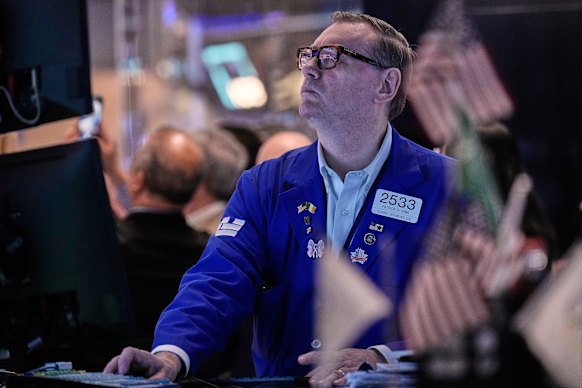
Oil prices are rising following the latest fighting to threaten the US-Iran ceasefire, but Wall Street isn’t very worried, and US stocks are hanging near their records.
The S&P 500 added 0.3 per cent to its all-time high set on Friday. The Dow Jones was down 108 points, or 0.2 per cent, in mid-afternoon trade, and the Nasdaq composite was 0.5 per cent higher. Both are also coming off records.
The Australian sharemarket is set to slip, with futures at 4.57am AEST pointing to a fall of 15 points, or 0.2 per cent, at the open. The ASX closed flat on Monday. The Australian dollar was trading lower at US71.63¢.
Artificial intelligence company Anthropic is moving toward going public on Wall Street, the latest chapter in its meteoric rise from a little-known research laboratory to one of the leading AI companies valued at $US965 billion ($1.4 trillion).
Anthropic said Monday it has submitted a confidential filing with the US Securities and Exchange Commission for a proposed initial public offering of its common stock.
“This gives us the option to go public after the SEC completes its review,” Anthropic said in a brief statement. “The proposed initial public offering will depend on market conditions and other factors.”
The majority of US stocks fell, and some of the worst performers were companies with big fuel bills hurt by the rise in oil prices. United Airlines lost 2.4 per cent, and Alaska Air Group fell 2.6 per cent after the price for a barrel of Brent crude oil climbed 5.2 per cent to $US95.86. That clawed back a chunk of Brent’s loss from last week and means it’s still well above its price of roughly $US70 from before the war.
Expensive oil has already sent inflation higher, which not only increases bills for households but also pushes up bond yields. High yields worldwide recently have threatened to slow economies and undercut prices for stocks and all kinds of other investments.
Some of the hardest hit by high interest rates are smaller companies, which have a tougher time borrowing to grow when loans are more expensive to repay. The Russell 2000 index of the smallest US stocks fell 0.4 per cent and lagged the rest of the market.
But hope seems to remain that the United States and Iran will ultimately reach an agreement to reopen the Strait of Hormuz, allowing deliveries of oil to resume from the Persian Gulf and ease the upward pressure on inflation.
Strength from several market heavyweights also helped to keep the market steady.
Nvidia was the strongest force lifting the market and rose 5.3 per cent after CEO Jensen Huang announced several product updates at a conference. What Nvidia does matters immensely for the US stock market because it’s the biggest in terms of overall market value. That means the movements for its stock carry more weight on the S&P 500 than any other’s.
And Wall Street’s biggest companies have been growing so much that they’re dominating the market. The top 10 stocks control nearly half the S&P 500’s total market value, a 40-year high, according to Thomas Carroll, equity market strategist at Stifel.
That worked well as Big Tech stocks shot higher thanks to exuberance around artificial intelligence. But it could also weigh on the index if the market’s leadership broadens, Carroll warns. Even if most stocks end up rising in such a rotation, stagnation or declines for Big Tech heavyweights could drag on S&P 500 index funds.
And a key indicator Carroll follows about market breadth “is signalling a rotation is coming,” he wrote in a report.
Elsewhere on Wall Street, Science Applications International Corp. jumped 16.9 per cent after becoming the latest US company to report bigger profit for the latest quarter than analysts expected. SAIC also raised forecasts for upcoming financial results after winning several contracts from the US Department of Homeland Security, army and other agencies.
A cavalcade of such profit reports has helped the US stock market push to records despite the uncertainty created by the war with Iran.
Berkshire Hathaway fell 1.1 per cent after saying it would buy homebuilder Taylor Morrison Home for $US6.8 billion. It’s one of the first big acquisitions announced by the company since Greg Abel took over its leadership from famed investor Warren Buffett. Taylor Morrison Home jumped 22.5 per cent.
MGM Resorts International leaped 15.9 per cent after People Inc., Barry Diller’s business that was formerly known as IAC, offered to buy the rest of the company it doesn’t already own for $US48.30 per share in cash.
In the bond market, Treasury yields rose with oil prices and after a report said growth in US manufacturing accelerated by more last month than economists expected. The yield for the 10-year Treasury climbed to 4.48 per cent from 4.45 per cent late Friday.
High yields have already forced the average long-term US mortgage rate to its most expensive level in nine months, and they could curtail companies’ borrowing to build the AI data centres that have supported the US economy’s growth recently.
In stock markets abroad, indexes fell in Europe following a stronger finish in Asia.
Tokyo’s Nikkei 225 rose 0.9 per cent to an all-time high. SoftBank Group, the investment company that focuses heavily on AI, soared 21.2 per cent and surpassed Toyota to become Japan’s most valuable listed company.
In South Korea, the Kospi index jumped 3.7 per cent to a record after Samsung Electronics, its biggest company, leaped 10.1 per cent. Official data on Monday showed that South Korea’s exports surged 53 per cent in May from a year earlier, buoyed by global demand for semiconductors.
AP
The Market Recap newsletter is a wrap of the day’s trading. Get it each weekday afternoon.


