

source : the age
Hello and welcome to our national news live blog for Tuesday, June 2. Here’s what is making headlines today.
- Reserve Bank officials judged that Labor’s first-term housing agenda did little to improve supply and possibly raised prices, according to internal notes from the bank’s policy experts.
- Opposition frontbencher Andrew Hastie said yesterday Australia was getting the short end of the stick in a downgraded version of the AUKUS deal, and told the ABC the US does not take Australia seriously because “our defence policy lacks seriousness”. A public inquiry into AUKUS is set to kick off today in federal parliament.
- Health Minister Mark Butler says Australia is not considering any travel restrictions for visitors from the African nations at the centre of the Ebola outbreak, and will not be quarantining people on arrival.
- Donald Trump said Israel was halting planned attacks on the Lebanese capital Beirut, which were threatening to derail the ceasefire between the US and Iran, after he spoke with Israeli Prime Minister Benjamin Netanyahu. The US president also claimed Hezbollah had agreed to a total ceasefire and insisted talks with Iran were continuing “at a rapid pace” – despite reports from Iran’s state-affiliated media that suggested Tehran was suspending negotiations.
- New polling places One Nation as the most popular party in Australia. In the poll, published by The Australian Financial Review on Sunday, One Nation received primary support of 31 per cent, above Labor at 28 and the Coalition at 20. The polls bolstered the confidence of party leader Pauline Hanson, who said she believed she could lead the country.
Brazil has cleared two suspected cases of Ebola after both patients tested negative for the virus, local authorities said.
The suspected cases emerged at the weekend in patients with related symptoms who had recently been in the Democratic Republic of the Congo, where the current Ebola outbreak is centred, and in neighbouring Uganda, which has also reported cases.
The patients in Brazil had tested positive for other diseases, but local authorities waited for Ebola test results to rule out the cases.
Brazil’s state of Sao Paulo said no genetic material of Ebola was found in the testing of a 37-year-old man who came from the DR Congo, and who had already tested positive for meningitis.
In Rio de Janeiro, a patient who had recently travelled to Uganda also tested negative for Ebola, health research institute Fiocruz and the city hall said in separate statements. The patient had tested positive for malaria.
Reuters
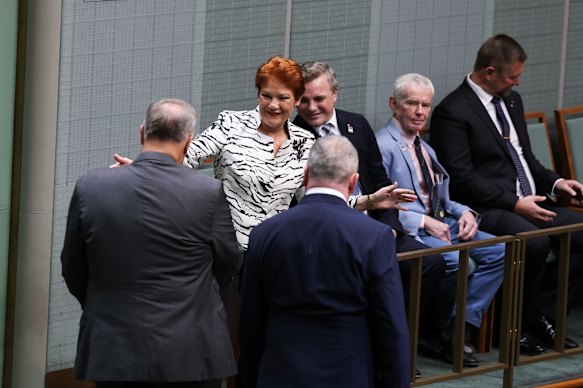
Pauline Hanson and her fellow One Nation senators Malcolm Roberts, Sean Bell and Tyron Whitten were guests in the House just after noon to watch David Farley get sworn in as the party’s member for Farrer, the first directly elected lower house member of her party.
Farley was ushered to the Speaker’s chair by his party colleague Barnaby Joyce to swear his oath to King Charles III before taking his seat on the cross bench. He exchanged cursory handshakes with some of the teal crossbench, solid handshakes with several Coalition MPs and gave Sydney independent Dai Le a kiss on the cheek as she stood, beaming, to applaud him.
Hanson hugged him warmly – that internal party debate about flags all water under the bridge – as he stood surrounded by his fellow One Nation politicians.
You can read more about Farley’s lengthy and circuitous journey to One Nation here, from our National Affairs Correspondent Rob Harris.
The Australian government should be rethinking its participation in the AUKUS pact, Labor MP Ed Husic said this afternoon.
Husic’s comments come after the revelation over the weekend that Australia would not be receiving a third new Virginia-class submarine from the US, as originally promised, but a second-hand vessel.
“The reality is, this deal has changed. It’s not the deal that we agreed to way back when, and the reason the deal is changing is because the US, they cannot produce at the rate that they want to, and at the rate we need them to. That’s the reality. They’re producing at a lot slower rate, the amount of Virginia class submarines,” he told Sky News.
“I think, based on reality, this is going to be forced on us. So, we should be rethinking.”
During the press conference, Treasurer Jim Chalmers was asked about recent changes to AUKUS, following an announcement by Defence Minister Richard Marles at the weekend that the last of three Virginia-class submarines Australia plans to buy from the US would now be second-hand, rather than new, as originally planned.
When he was asked about the change, Chalmers refused to comment.
“We support the AUKUS arrangements, and I don’t get into the details of discussions in the parliamentary party,” he told reporters.
Chalmers has lauded his government’s record on increasing wages for Australian workers, and said in the past four years in office, Labor had delivered more than a 30 per cent increase to the minimum wage.
“We see decent pay as part of the solution, not part of the problem,” he said.
“Because of this decision and because of this government, more Australians will be keeping more of what they earn. Earning more and keeping more of what you earn is a really important way to respond to some of these cost-of-living pressures that we’re seeing in the economy.”
Chalmers said it was a “welcome outcome” given the extraordinary pressures on everyday workers caused by an environment of unusual global instability.
Treasurer Jim Chalmers is speaking to the media now, alongside Minister for Employment and Workplace Services Amanda Rishworth.
Rishworth said the government welcomed the FWC’s decision.
“This represents a real wage increase supporting workers with cost of living pressures … Many of these workers are low paid, predominantly women, work casually, in industries like retail, healthcare, accommodation, and food services. Now, in addition to the 4.75 per cent increase for the modern award workers, the commission has determined to lift the floor of the lowest paid workers that rely on the minimum wage, by delivering the lowest classifications a 6 per cent wage increase.
“In handing down their decision, the commission emphasised that these workers required a higher increase because they were the lowest paid workers and have been hit hardest by the war in the Middle East and the resulting inflationary pressures,” she told reporters.
Rishworth said this marked the first time the nation’s lowest paid workers would be paid over $1000 a week.
Treasurer Jim Chalmers and Minister for Employment and Workplace Relations Amanda Rishworth held a press conference following the Fair Work Commission’s decision to lift minimum wages by 4.75 per cent. Watch what he said here.
Former SAS soldier Ben Roberts-Smith will not know of the full suite of war crimes allegations against him for months due to classified information included in the case.
The 47-year-old was arrested in April and charged with murdering or ordering the murders of five unarmed detainees while deployed in Afghanistan between 2009 and 2012.
But the case against him is mired in delays stretching to September due to national security issues, Sydney’s Downing Centre Local Court was told today.
Crown prosecutor Chelsea Brain said Roberts-Smith could not be given the full brief of evidence against him until certain orders protecting sensitive information were made by the court.
The unions have welcomed the Fair Work Commission’s latest ruling which gave a 4.75 per cent pay rise to three million Australians.
Speaking outside the Fair Work Commission building in Sydney, Australian Council of Trade Unions secretary Sally McManus said it was also “very welcomed” that the arbiter had awarded a 6 per cent pay increase to 100,000 of the lowest-paid Australians.
“This will allow them to not just pay their bills, but start making up some of what they’ve lost since 2021,” she said.
Asked about the 4.75 per cent wage increase still falling short of making up for inflation since the pandemic, McManus said the commission had taken steps towards making up the difference over several years and that the latest decision made sense given the unpredictability of inflation.
“[The commission] do want to get there,” she said, referring to catching wages up with inflation. “They just don’t want to get there as fast as we would like to get there.”
Leader of the Nationals Matt Canavan has again dismissed the suggestion – in softer terms than previously – the Coalition should join with One Nation to fight against Labor at the next election, amid polling this week showing primary support for Pauline Hanson’s party overtaking both the Coalition and the government.
During an interview with Sky News earlier this morning, Canavan was asked whether the conservative parties would have to “unite the right” to win back voters.
“I’m not sure exactly what that will look like, because I don’t think One Nation has any interest in serving in a coalition with us. We’ve said the same. We’ll have to be somewhat competing against each other in an election.”
Canavan said he was not sure whether One Nation’s appeal would endure until the next election.


