

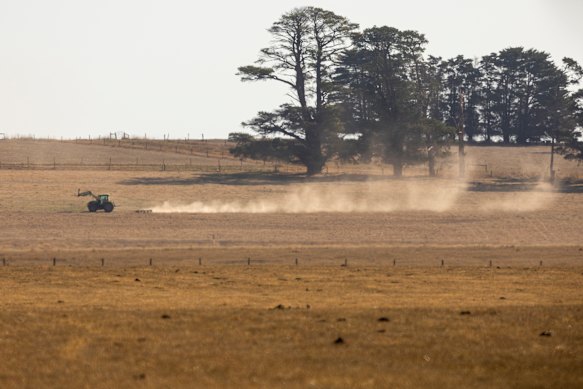
Source : the age
The world is on the cusp of an El Nino weather event that, in Australia, is likely to bring poor snow cover in peak skiing season, increased summer bushfire risks, drought, extreme heat and late agricultural harvests.
The Climate Council warned that climate change caused by rising carbon pollution was exacerbating the effects of the El Nino and La Nina weather events, producing data to show that La Nina “cold years” today are hotter than the El Nino “hot years” of last century.
The El Nino-Southern Oscillation (ENSO) is a global climatic pattern, based on the sea surface temperatures in the Pacific Ocean, that shifts between an El Nino, neutral, and La Nina. In Australia, an El Nino usually brings hotter and drier conditions, while La Nina is associated with rain, though this pattern can be disrupted by other weather systems.
Adjunct Professor Dr Andrew Watkins, from Monash University’s School of Earth, Atmosphere and Environment, said Australian meteorologists adopted a threshold for global weather systems hitting the El Nino threshold when Pacific Ocean temperatures in the central and eastern tropical Pacific reached .8 degrees or warmer than normal.
Those temperatures are sitting at .7 degrees warmer than normal.
“We’re currently in neutral, but we’re on the cusp,” Watkins said. “And remember how I said Australia uses .8 [degrees as the threshold for El Nino]? The US uses .5.”
Climate change would increasingly amplify the effects of El Nino weather patterns, Watkins said.
“It boosts the chance of more time in drought, it boosts the chance of extreme heat and heatwaves, it boosts the chance of fire weather, and also reduces the amount of snow, and [leads to] marine heat waves and coral bleaching, and unfortunately … the chances of all those things are also boosted by El Nino. ”
“We’re starting with one and a half degrees of climate change already, and the El Nino typically boosts global temperatures, so you’re starting everything 1.5 degrees hotter … and then you add something that also amplifies that.”
During autumn, the detection of Kelvin waves – typically plotted on maps of the Pacific as a red plume extending along the equator like a spear – suggested an El Nino was rapidly developing. The system typically causes floods in parts of the Americas and droughts, heat and fire in parts of Australia and Asia, and cuts crucial crop yields.
The World Meteorological Organisation is due to make its consensus declaration on El Nino within days, while the United States’ National Oceanic and Atmospheric Administration (NOAA) predicted last month that El Nino was likely to emerge by July, and could cause particular damage to coastal communities there.
The Bureau of Meteorology last week said, “all models indicate El Nino is likely to develop this winter”, but cautioned that no two El Nino weather events were the same.
It predicted lower winter rainfall averages across much of Victoria, NSW, the ACT and Queensland’s southern and central areas, Western Australia and parts of Tasmania.
In Australia, the Climate Council predicts an El Nino declaration could also bring emerging drought and frost damage in southern cropping regions in September, extreme heat beginning and late harvests in October, and marine heatwaves, water storage depletion and mass coral bleaching from January onwards.
Get to the heart of what’s happening with climate change and the environment. Sign up for our fortnightly Environment newsletter.
 Bianca Hall is The Age’s environment and climate reporter, and has worked in a range of roles including as a senior writer, city editor, and in the federal politics bureau in Canberra.Connect via X, Facebook or email.