

Source : THE AGE NEWS
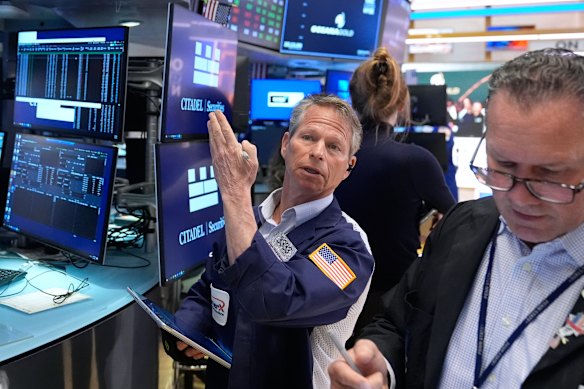
Oil prices are rising following the latest flare-up in fighting to threaten the US-Iran ceasefire, and US stocks are retreating from their records.
The S&P 500 fell 0.6 per cent from its all-time high. The Dow Jones was down 445 points, or 0.9 per cent, in mid-afternoon trade, and the Nasdaq composite was 1 per cent lower.
The Australian sharemarket is set to decline, with futures at 4.57am AEST pointing to a fall of 57 points, or 0.6 per cent, at the open. The ASX added 0.7 per cent on Wednesday, after a report showed the nation’s economy grew less than expected last quarter, boosting optimism for an interest rate reprieve from the Reserve Bank. The Australian dollar was trading lower at US71.30¢.
Weighing on markets was a climb of 2.1 per cent for the price of a barrel of Brent crude oil, the international standard, which brought it back to $US98.04. It rose after both the United States and Iran said they launched retaliations for earlier attacks or attempted ones.
The war with Iran has already sent oil prices and inflation higher, cranking up the pressure on the global economy. But oil prices remain below their peaks from earlier in the fighting, and hope seems to be remaining on Wall Street that the United States and Iran will ultimately agree to reopen the Strait of Hormuz to oil tankers. That would improve the global flow of crude and hopefully lower its price.
Such hopes, along with strong profit reports from US companies, have helped launch the US stock market on a tremendous rally. If the S&P 500 can turn around and finish the day with a gain, it would be the 10th straight for the index, which would be its longest such streak in three decades.
Medtronic climbed 5.1 per cent after reporting a stronger profit for the latest quarter than analysts expected. It also increased its dividend payout going to investors.
GameStop jumped 6.3 per cent after the video-game retailer said its revenue in the latest quarter grew 14 per cent from a year earlier. It also announced a program to send up to $US2 billion ($2.8 billion) to its investors by buying back its own stock.
Macy’s swung between gains and losses and was most recently down 0.9 per cent after the iconic New York department store reported profit for the latest quarter that blew past analysts’ forecasts. The retailer said an overhaul of its merchandise and better customer service is resonating with customers.
Meanwhile, Elon Musk’s SpaceX plans to price its IPO at $US135 a share, ahead of a roadshow, to raise a record $US75 billion, a source familiar with the matter told Reuters on Tuesday. That would put Elon Musk’s net worth at $988 billion, according to calculations by the Bloomberg Billionaires Index.
On the losing side of Wall Street was Palo Alto Networks, which fell 6.3 per cent despite topping analysts’ expectations for profit in the latest quarter. Investors may have been looking for even more after its stock came into the day with a surge of 61.3 per cent for the year so far, more than quintuple the S&P 500’s already big 11.2 per cent rise.
In the bond market, Treasury yields rose with the price of oil, which put downward pressure on the stock market. The yield on the 10-year Treasury climbed to 4.5 per cent from 4.46 per cent late Tuesday and from just 3.97 per cent before the war began.
High yields worldwide recently have threatened to slow economies and undercut prices for stocks and all kinds of other investments. They have already forced the average long-term US mortgage rate to its most expensive level in nine months, and they could curtail companies’ borrowing to build the AI data centres that have supported the US economy’s growth recently.
More expensive loans can hurt smaller companies in particular because many need to borrow to grow. The Russell 2000 index of the smallest US stocks fell 1.4 per cent, more than the rest of the market.
Reports on the US economy came in mixed. One from the Institute for Supply Management said that growth for US construction, agricultural and other services businesses accelerated by more last month than economists expected.
That’s an encouraging signal for the economy, but the survey also showed businesses are feeling the pinch of higher prices caused by tariffs and more expensive oil. “This is the definition of inflationary pressure starting to affect us,” one company in the accommodation and food services industry said in the survey.
In stock markets abroad, European indexes fell following a mixed finish in Asia.
Hong Kong’s Hang Seng dropped 1.6 per cent, but Japan’s Nikkei 225 jumped 2.5 per cent to another record.
Excitement around the boom created by artificial-intelligence technology has been a huge engine for stock markets worldwide. On Wall Street, Marvell Technology rose another 5.3 per cent following its best day on record, a surge of 32.5 per cent, after Nvidia CEO Jensen Huang suggested at a conference in Taiwan that Marvell could be “the next trillion-dollar company.”
The last company to enter the expanding club of behemoths was Micron Technology, which is likewise riding the AI wave.
AP
The Market Recap newsletter is a wrap of the day’s trading. Get it each weekday afternoon.


