

SOURCE :- THE AGE NEWS
What a difference a year makes.
It was almost exactly 12 months ago that the Pentagon launched an ominous “review” into AUKUS, the defence pact with Australia and the UK signed in 2021 by president Joe Biden. With a declared AUKUS sceptic, Elbridge Colby, at the helm, and recently re-elected US President Donald Trump’s position unknown, it seemed like the US was on the brink of backtracking on the deal.
Now, after Trump declared it was “full steam ahead”, the Americans are lock-stock behind AUKUS (strategically, at least), and it is Australia where the political commitment is being tested.
For now, the hubbub Down Under – a “public inquiry” into AUKUS led by Peter Garrett, some grumblings from Labor MPs and a media mini-frenzy over whether the Virginia-class submarines will be new or “second hand” – has barely registered in Washington.
But it feeds into a disquiet in the AUKUS community – and a concern among some officials and policymakers – that Australia has not done enough to sell AUKUS to the public, and that the political consensus around the agreement is still not strong enough.
“That’s been a concern here from the start … ‘if there’s a Labor government that comes in, are they going to scuttle this?’” says Bryan Clark, a navy specialist at the conservative Hudson Institute in Washington.
“Part of it is that the government in Australia has not done a very good job of explaining why they need the submarines because they don’t want to upset China.
“It makes it hard to make your sales pitch to the Australian people on why the submarines are important if you don’t want to talk about how you might actually use them.
“China says: if you’re worried so much about our economic relationship that you can’t even talk about how you might use your submarines, then I know that we can use our economic relationship as leverage against you.”
Concerns dismissed
This was one of the underlying concerns behind the Pentagon review: that, whatever assurances Canberra may give privately, its reluctance to state publicly that it would use the submarines in a regional conflict (against China) created doubt and weakened the deterrent effect.
Those concerns never fully dissipated, but they were shelved when Trump voiced his unambiguous support for AUKUS and instructed the Pentagon to make it happen faster, if anything.
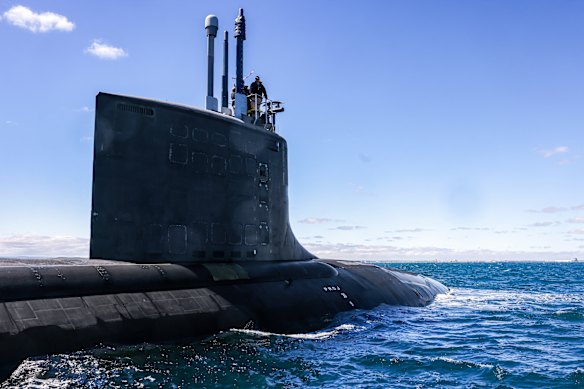
In Washington, most AUKUS experts say they always expected Australia’s Virginia-class submarines to be in service rather than brand-new.
“For me, it was no surprise – it was always going to be that,” says Brent Sadler at the right-wing Heritage Foundation. A new boat “might have sounded good, but the industry is just not there to do it”.
Clark said it made more sense for Australia to buy older, in-service Virginia-class subs rather than the newer, larger ones that would be slower and less nimble.
“We knew all along that these were going to be used submarines – I think people just forgot,” he said. “The government in Australia may have been a little coy. Here, that was all assumed.”
Abraham Denmark, who was instrumental in crafting AUKUS as a senior defence adviser under Biden, said the pejorative reporting about second-hand submarines was incorrect. “It is a world-class capability,” he said. “It’s not like Australia is getting something that’s sub-par.”
Denmark, now with the Asia Group consultancy, dismissed the concerns raised by Labor MP Ed Husic and the unofficial inquiry headed by Garrett, saying they wouldn’t amount to much in the long term.
But he said the current backlash underlined the need for Australia to do more to establish a social licence for AUKUS. “There can’t be any complacency.”
Denmark and others have made this point for a while. It was a topic of significant conversation at an AUKUS summit hosted by former defence minister-turned lobbyist Christopher Pyne in Washington in April, and at a Centre for Strategic and International Studies event last month.
Former prime minister Scott Morrison, who fathered AUKUS in 2021 with Biden and Boris Johnson, said much the same in remarks to this masthead yesterday.
Some US political figures who visited Australia recently expressed surprise at the level of scepticism regarding AUKUS – not at the senior levels of government, where the commitment is solid, but among local mayors or the media and the broader public.
Changing this would probably require more candour about the purpose of the pact and the strategic need for the submarines than has been forthcoming from Canberra to date.
Washington understands that Australia is in a difficult position, having been the victim of Chinese coercion for calling for an investigation into the origins of COVID-19.
But there is also a view that Australia needs to grow up. “They’re in a tight spot,” says Clark.
“But that’s really where leadership comes into play.”
Get a note directly from our foreign correspondents on what’s making headlines around the world. Sign up for our weekly What in the World newsletter.
 Michael Koziol is the North America correspondent for The Age and Sydney Morning Herald. He is a former Sydney editor, Sun-Herald deputy editor and a federal political reporter in Canberra.Connect via X or email.