

Source :- THE AGE NEWS
Oakland: Two years before he pulled on a Socceroos jersey for the first time, Tony Popovic was told his career was over.
He had just arrived at Japanese club Sanfrecce Hiroshima in 1997 when a rare and debilitating toe injury sidelined him for a season and a half. The cartilage in the joint of his big toe had worn away, creating painful bone-on-bone friction. A surgeon told him he would never play professionally again, because he didn’t think it could handle the loading required to train every day. He was 23.
Popovic’s father, Bratislav, raised him to believe in the value of hard work. His mother, Rada, was a bit of a deeper thinker. She believed that hard work was not enough; that sometimes, you need to think outside the square and search for other ways to solve a problem.
When it came to the toe injury, Popovic’s dad said he needed to work three or four times harder than anyone else to get back to playing.
“Mum would say, ‘Yes, you’ve got to do that – and you’ve got to do something different, because you’ve got to find a way,’” he says.
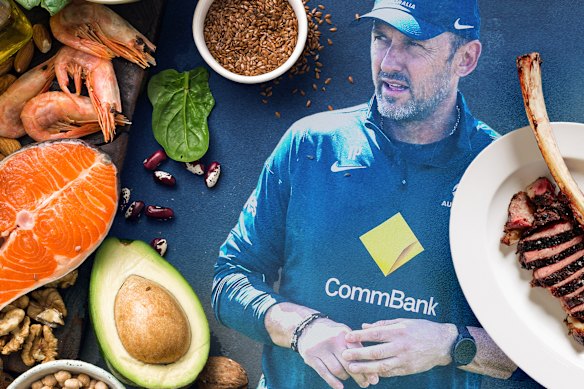
Popovic found a couple of ways. The injured toe was on his right foot, the one he pushed off when jumping, so he spent 18 months teaching himself how to launch off his left. On his mum’s advice, Popovic also looked into his diet, and whether changing it could improve his recovery, or change the way blood flowed around his foot, sparking a journey of discovery – one that has shaped how the Socceroos, under his guidance, have approached this World Cup.
Back then, footballers still largely followed old-school sporting wisdom: for example, eat a big plate of pasta the night before a game. But Popovic did his own research and became fascinated by alternative schools of thought, including theories connecting diet to ancestry and genetics.
His parents grew up in a part of Croatia where people had to hunt for food and store it for the year. They would eat some meat in the morning, and that would be their only meal; the “good fat” on it gave them enough energy to work through the rest of the day.
“If that could be done then, why am I eating pasta as my way of trying to fuel?” Popovic said. “When you see all the diets, the Atkins diet and all these things – back then they didn’t call it that, but it was something very similar that I did. I started studying all of that, and it started making more sense to me.”
Whatever he ate or drank obviously worked on his toe, because the best days of Popovic’s playing career were all ahead of him. But the experience sparked a personal obsession with finding every possible competitive edge, an outlook that now shapes almost every aspect of Popovic’s footballing model.
“The injury forced me to think that way a lot earlier,” he said. “And then going to coaching, I’ve tried to educate. How do you get an extra percentage out of a player? I believe that’s the part that they control.”
Popovic’s Socceroos are in the business of stacking one-percenters – from the most incremental changes to how defenders position themselves, to the type of pillows players are given for long-haul flights to combat the brutal travel demands of being an Australian international, to the blood analysis used to map out how players recover, re-fuel and perform.
In a game of fine margins, and in one of the tightest World Cup groups the Socceroos have ever been in, these small factors could prove the difference – and Popovic is famously obsessed with controlling every possible variable.
“The amount of travel that we do … it’s hard for the public to understand that they play [for their club] on a Sunday, and they’re expected to produce on Thursday night in a World Cup qualifier. Yet they’ve arrived on Tuesday night to Sydney,” Popovic said.
“This isn’t to give excuses. We can cry about it in the press and say, ‘We’re struggling because of A, B and C.’ But we look at everything and say, well, what’s the solution? The solution is we can help by giving them expertise in nutrition.”
From the moment Popovic made his first staff appointments after taking over the national team in late 2024, it was clear this would become an important lever for him: in the same announcement confirming his assistant coaches, Julie Meek was named as team dietician, the first to ever work with the Socceroos.
Popovic and Meek, who is based in Perth, were introduced by a mutual friend when he began as Perth Glory coach in 2018.
“I could see his vision immediately,” she said.
Meek then followed Popovic to Melbourne Victory (where she still works, and remains the only sports dietician in the A-League), and then to the national team. She’d previously worked with the Fremantle Dockers, Perth Wildcats and within the WA Institute of Sport across ironman, triathlon and gymnastics.
“He’s easily the best coach I’ve worked with,” Meek said.
The Socceroos have had the same chef – Vini Capovilla, a cult figure among players and staff alike – for the past decade. But Vini is a biologist by trade, and not a dietician; Meek’s arrival added a much-needed new layer to the team’s hospitality operations. Together, they plan menus for the players months in advance, sourcing the cleanest possible ingredients from wherever they happen to be.
For a World Cup in the United States, where even the oxygen feels needlessly calorie-rich, that’s particularly critical.
At meal times, Meek hovers around the room helping players build plates suited to their individual needs, workloads and recovery requirements. Some need more carbohydrates, others need more protein. Some might be trying to address deficiencies: every player underwent blood testing before the tournament to help map out personalised nutrition strategies and flag any unexpected issues in their bodies.
When players leave camp, they take tailored meal plans back to their clubs with them.
Nutrition advice is surprisingly rare at football’s highest levels; Meek isn’t sure how many of the 48 World Cup teams have someone like her on their staff, but she doesn’t think it would be a lot based on how players have spoken about what happens at their clubs.
“But I think that’s one of our weapons, is that we do pay attention to all the details,” she said. “Some of the players who were not necessarily brought up in Australia have not had that background at all … now they’re definitely on board, they’ve tried what I’ve asked them to do and it’s made a massive difference.
“Whether you’re talking about endurance during a game or at training, or being able to string those training sessions together over a week, or a few weeks – that’s where the wins are.”
Popovic makes no apologies for his laser focus in this department, and especially not now. Football is becoming increasingly physical at the highest level, and this World Cup will be more physical than ever. There’s not only the American summer heat to put up with, but rule changes that will demand more repeat efforts and reduce rest: goal kicks and throw-ins must be taken within five seconds of a referee’s signal, while substitutes have just 10 seconds to get off the field once their number is shown on the fourth official’s board.
Popovic’s reputation as a disciplinarian was partly established because of stories about forbidden foods (bacon, even pasta sauce), skinfold testing and hyper-controlled environments ever since his coaching career began at Western Sydney Wanderers. Meek insists the reality is more nuanced than that.
Yes, there were jars of lollies in the team’s meeting rooms that suddenly disappeared when Popovic took on the job. But prohibition, she said, is not effective; if you ban something, a certain kind of player will just want it even more.
“The players understand that when they’re in camp, this is serious. We’re here to play games and we’re here to win,” she said.
The better approach is education. Give a player dinner, and you’ll feed him for a day – but teach a player what they should eat for dinner and why, and they’ll be elite for a lifetime.
Healthier habits could help them avoid injury and extend their careers, Popovic said.
“I always say: the greatest players in the world, why is it that they don’t play? It’s because of an injury,” he said. “If their body didn’t matter, when Lionel Messi has a hamstring injury, he’d keep playing – but he can’t. He stops. With that injury, he’s not the greatest player; he has to sit on the sideline. So that tells you something: your body is your tool. Get that right, and then with your talent, you can showcase it more often and let it be more repetitive.”
News, results and expert analysis from the weekend of sport sent every Monday. Sign up for our Sport newsletter.