

Source : INDIA TODAY NEWS
The Cockroach Janta Party is marching on Jantar Mantar. Its founder, Abhijeet Dipke, flying in from the United States, plans to go straight from the airport to Parliament Street police station to seek permission for a protest demanding the resignation of Education Minister Dharmendra Pradhan. Sonam Wangchuk has also pledged to join, saying he believes Dipke’s intentions are genuine and that he deeply cares about the younger generation. The students are restive. The streets are restless. The slogans are ready. Lakhs of exam takers, robbed of a fair shot at a medical seat, want a head. A political head, preferably on a silver platter, preferably Dharmendra Pradhan’s.
advertisement
The Cockroach Janata Party was born in a courtroom. The manifesto and all else came later. The Chief Justice of India, in a moment of judicial exasperation, described some particularly persistent lawyers as cockroaches. He did not mean ultimate survivors or ancient creatures of biological distinction. He meant nuisances. Pests. Things that scuttle about where they are not wanted and refuse to leave. The lawyers in question wondered what was that about when an AAP-adjacent boy in Boston owned it. The cockroach went from insult to identity. The pest became the party.
June 6 is the battle day. And it is, if you step back to a sufficient height, a collision between two entirely different species of cockroach. One claiming oppression and the other in-charge of the suppression.
When the noise about NEET was too loud to bear, the government covered its ears with both hands. When the CBSE scandal broke, it opened its eyes. The mounting criticism over the on-screen marking system and the re-evaluation portal fiasco was not a pleasing sight. CBSE chairman Rahul Singh and secretary Himanshu Gupta were transferred. Not sacked. Not sent home to contemplate their sins. Transferred. Moved from one branch of the mango tree to another.
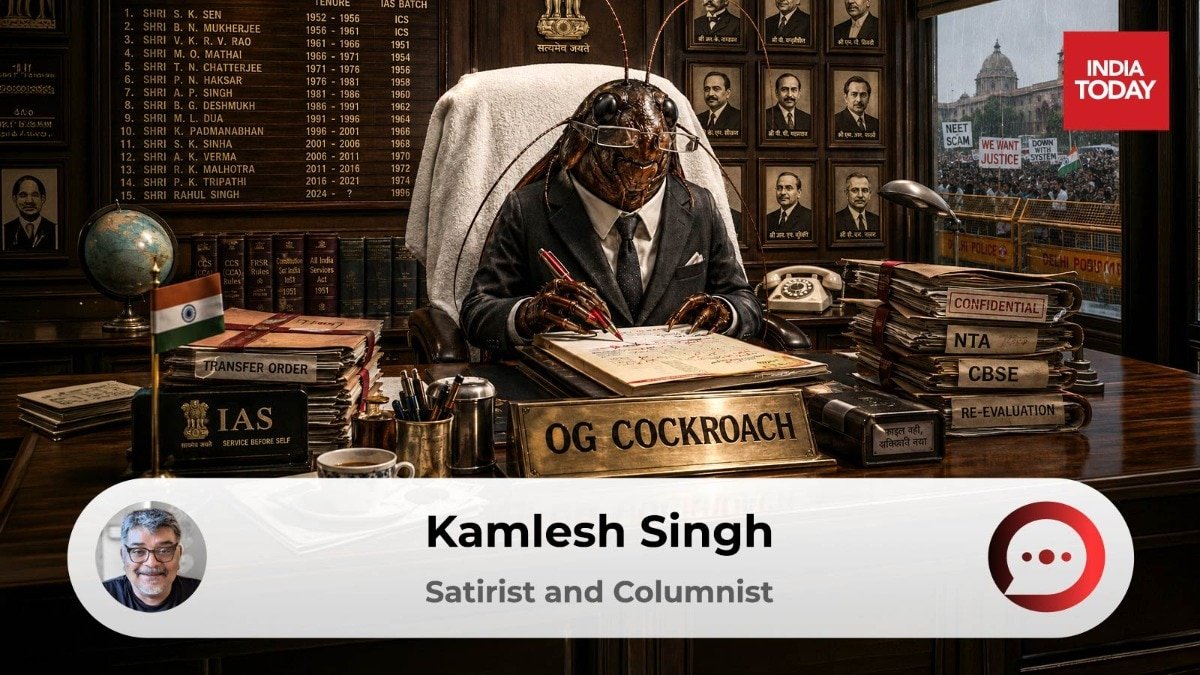
The students marching on Jantar Mantar are the nuisance cockroach, swarming in protest, loud, visible, irritating to power. The IAS officer is the other kind entirely. The original kind. The survivor.
The cockroach, Blatta orientalis, is approximately 300 million years old. It was alive before the dinosaurs. It watched the dinosaurs arrive, flourish, and disappear, and then went back to eating whatever was available. It has survived five mass extinction events, ice ages, continental drift, the entire project of vertebrate evolution, and, in Hiroshima, a nuclear bomb that evaporated birds mid-flight.
Its biology is a masterwork of institutional self-preservation: a distributed nervous system that lets it survive for weeks without its head, an immune system of extraordinary adaptability, and the ability to flatten itself to a thickness that renders almost any obstacle theoretical. When scientists were asked what species would inherit the earth after a nuclear war, the answer was: the cockroach. The cockroach does not win battles. It outlives them.
The IAS officer is this cockroach. The survivor cockroach. The OG. Not the novel novice nuisance cockroach.
This is the central irony that the Cockroach Janata Party, despite its wonderful etymology, has not fully appreciated. A political head-hunt has a political end. The system remains. You may, if you can, draw a political scalp, the bureaucratic head sits unbothered.
Dharmendra Pradhan, if he goes, goes badly. Ignominy sticks to politicians the way paan stain sticks to white kurtas. You become your scandal. You become the NEET minister. You become the train accident minister because you resigned as a consequence. You become the Chara of the Ghotala. Your political career enters a tunnel and you are not sure there is light at the other end. Because voters remember. Voters, unlike the Appointments Committee of the Government, are OG re-evaluators. OSM or not.
Rahul Singh, IAS, 1996 batch, Bihar cadre, late of the Department of Personnel and Training, will be fine. He was appointed CBSE chairman in 2024. He will be appointed something else in 2026. The file will move. The designation will change. The man will remain. This is not a quirk of the system. This is the system. Not a bug, but a feature.
The Indian Administrative Service was built to survive everything. It survived the British. It survived Independence. It survived Indira Gandhi. It survived coalition politics, hung assemblies, midnight reshuffles, and every manner of prime ministerial temper.
It was called the “heaven-born service” under British rule, the elite administrative cadre of an empire. Then the empire left and the service simply stayed, rebranded, re-sworn, re-designated, but essentially undisturbed. Sardar Patel led the transition of the steel frame from the ICS to the IAS, preserving the architecture of control while the portraits on the wall changed from the Viceroy to the President of the Republic.
The politician is temporary. The babu is permanent.
It was in the teeth of vocal opposition, especially on the question of permanency of tenure, that Sardar Patel’s persuasion triumphed. He wanted the basic ladder frame intact even in times of political upheavals. The outcome was the All India Services Act of 1951. Permanency of tenure. Think about that phrase. India’s founding generation, fresh from a freedom struggle, designed a system where one category of citizens cannot be removed from employment by democratic will. The elected representative serves five years and, these days, spends a fortune getting re-elected. The selected one passes one examination and is set for life. The politician is reviewed by millions of voters every five years. The bureaucrat is peer-reviewed by, wink wink, other bureaucrats. Peer baba ki jai.
India and Pakistan were separated in 1947 by a cartographer named Cyril Radcliffe who had never been to the subcontinent and completed the job in five weeks. The Radcliffe Line divided people and territory between the Indian and Pakistani portions of Punjab and Bengal. Radcliffe was a lawyer. The actual implementation, the grinding daily work of Partition, was done by ICS officers on both sides of a line they themselves had helped draw.
The officer who filed papers for the Crown on a Tuesday filed papers for the Constituent Assembly on a Wednesday. Same desk. Same red ink. Different letterhead. They kept their jobs. They kept their power. They kept their bungalows, their cavalcades, and their institutional memory. Over time, Pakistan chose military rule with politicians as decoration. India chose bureaucratic rule with politicians as decoration. The difference is that India’s arrangement looks more democratic and, day to day, feels entirely similar.
The NTA, which conducts NEET, is a statutory body set up under the Ministry of Education. The NTA and CBSE both function under the same ministry, making internal accountability circular and self-referential. The ministry oversees the body that runs the exam that went wrong. The ministry also oversees the inquiry into how the exam went wrong. The cage parrot investigates the missing seed. This is not a scandal. It is a design choice.
The CBSE OSM system was a new on-screen marking system for Class 12 boards, awarded to a Hyderabad-based company, Coempt Edu Teck, that promptly did not work. Students who had spent two years preparing found their results held hostage to a glitching portal. A student hacked the system and showed the government their infrastructure was as secure as a student’s future in this fair country. The re-evaluation revealed absolute horrors. The marking system did not hit the mark. One word: fiasco.
Over on the NEET front, the Supreme Court observed that the NTA appeared not to have learnt its lesson from 2024, when the Radhakrishnan Committee had recommended migrating to computer-based testing to prevent exactly this kind of physical paper leak. The committee’s central recommendation was quietly filed. The leak repeated at greater scale. Another committee will now be constituted. Its recommendations will be filed with the same admirable efficiency.
So when the nuisance cockroaches march on Jantar Mantar, they are not wrong. A political sacrifice is appropriate. Pradhan should feel the heat, and he does. But the nuisance cockroach, for all its visibility and vigour, operates on a limited timeline. It makes noise, it disrupts, it forces a response. Then the cycle turns, the semester starts, the coaching classes resume, and the cockroaching stops. The nuisance cockroach is mortal in the way that all political moments are mortal.
The survivor cockroach has no such problem. It is linear in a land that taught the world how everything is cyclical. The babu cockroach does not need public sympathy. It does not need to be right. It only needs to continue, and continuing is what it does better than any organism in the history of this planet.
Rahul Singh is not sitting in his new office, chair draped in a white towel, worrying about the CJP. He is reading files and signing them in red ink with his comments in green, on the margins.
When the nuisance cockroach and the survivor cockroach meet on June 6, only one of them has 300 million years of practice. The protest will be loud, possibly moving, certainly photogenic. Sonam Wangchuk will play Rancho. Abhijeet Dipke will pretend to be Gen Z. The government will make stern noises. The Delhi Police may use the PVC batons and water cannon. In some office in North Block or Kartavya Path, a very senior IAS officer will sign a transfer order and go home for dinner.
The students of India deserve better. Twenty-two lakh of them sat for NEET. They studied 16 hours a day. They moved to Kota, Sikar, Patna, or Hyderabad and gave years of their youth to a system that repaid them with a leaked paper from a coaching mafia and a re-evaluation portal that crashed on the first morning. Their anger is legitimate. Their demand for accountability is legitimate. Their march is legitimate.
But they are marching toward a minister. What they need is a conversation about the system behind the minister. A system designed, by serious and patriotic men in 1951, to be resistant to exactly the kind of democratic pressure they are now applying. The nuisance cockroach disrupts. The survivor cockroach endures. All it takes is passing a test of which the paper can leak from the system they would manage in future. This Inception-level drama is beyond Christopher Nolan.
The real Cockroach Janata Party has been in power since 1947. It has no manifesto, holds no rallies, and contests no elections. It just continues. Generation after generation. Crisis after crisis. Transfer after transfer.
Blatta orientalis. The insect that shuns the light.
– Ends
SOURCE :- TIMES OF INDIA


