

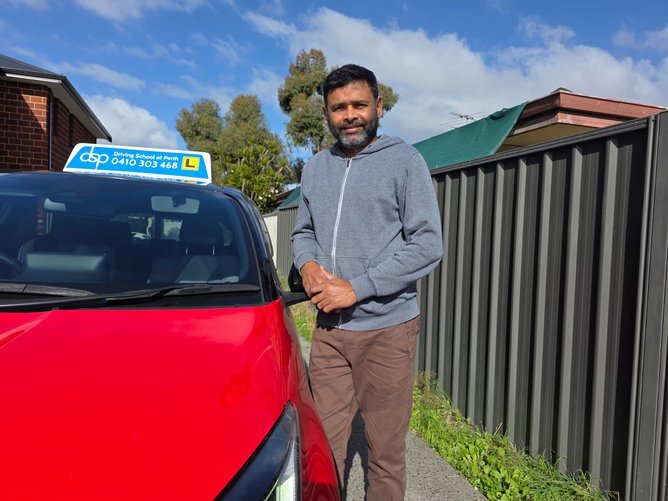
Source : Perth Now news
New data has revealed WA is among Australia’s quickest and cheapest States to get a driver’s licence, but local instructors don’t believe this is necessarily a good thing.
Australian driving lesson booking platform EzLicence conducted a study into the total cost and time taken to achieve a full licence across Australia.
WA was revealed as the joint quickest State to gain a full licence at just 2 1/2 years, alongside the Northern Territory.
Learners must log at least 50 hours, including five hours of night driving. They must also complete a minimum of six months’ supervised driving, and 24 months total on their provisional licence.
Eastern States’ models are significantly stricter, with Victoria taking a minimum five years and every other State taking four years.
Comparatively, Victoria requires 120 supervised hours of driving, including 20 hours at night. It requires a minimum 12 months’ supervised driving, and 48 months on a provisional licence.
“Fifty hours is not enough. If you count, it’s only two days and two hours … it’s not enough experience on the road as a learner,” he said.
“I would like to see WA going for 120 or 150 hours. The more experience, the better it gets. As a learner driver, you’re new on the road and you don’t have a lot of life experience.”
Mr Ismalage said the time difference requirements could increase the danger for WA’s newest drivers, given P-Platers have more vehicle crashes than any other road users and account for about 25 per cent of road fatalities each year.
The State Government announced a major overhaul of WA’s learner system in April.
The minimum learner period will increase to one year, with the minimum supervised driving time set to increase from 50 to 80 hours, including 10 hours at night. Drivers will then need to display red P-plates for one year, and green P-Plates for the next two years.
A new online theory and hazard perception test will also be required, in addition to the in-centre test.
Mr Ismalage said while this was a step in the right direction, stronger learner processes were needed to improve safety.
“(Learners) can write down anything in the book. If you write down something you didn’t do, instructors know, but we can’t do anything,” he said.
“People try their luck going to easy centres and waiting for more lenient assessors, so as an instructor, I’m facing a very difficult time because everyone wants to go somewhere fast and easy.
“The question is money over safety. I think safety should come first, and we should encourage parents to do proper driving lessons.”
A fellow driving instructor based in Canning also questioned the effectiveness of WA’s proposed learner reforms.
“All kids learn at a different rate, so changing the learning hours will make no difference. They shouldn’t go for a (practical driving assessment) until they are ready and can drive independently,” the instructor said.
“Maybe the quality of instructors should be looked at – make cert four instructors do a driving test every three years, the same as the Department of Transport approved instructors do. Kids also probably learn bad habits from their parents.”
The Canning-based instructor suggested extending the practical assessment from 35 minutes to one hour, to allow a more thorough assessment of the learner’s abilities.
The EzLicence study also completed a cost analysis of getting a licence in each State, which showed WA was on the cheaper side.
The total cost was worked out by including a minimum of six driving lessons and deducting the safe driver discount, which is available in every State and Territory except South Australia and Queensland.
Based on these calculations, a WA licence cost $774, just above Tasmania, the Northern Territory and Victoria.
South Australia was the most expensive State at $1356 a licence.
EzLicence head of marketing Amanda Butler said while WA’s upcoming learner reforms will improve road safety, they would likely increase licensing costs for new drivers.
“The upcoming changes will extend both the time and experience required before reaching a full licence, bringing WA more in line with stricter Eastern State models,” she said.
“While the reforms are designed to improve road safety, they will likely mean learners spend longer learning to drive and potentially more money on lessons, particularly if they want extra practice to stay confident, build experience and remain test-ready throughout the extended process.”