

source : the age
To submit a letter to The Age, email letters@theage.com.au. Please include your home address and telephone number. No attachments, please include your letter in the body of the email. See here for our rules and tips on getting your letter published.
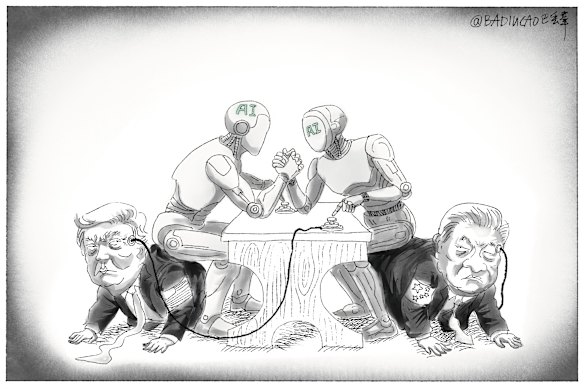
When one of the largest AI technology corporations, Anthropic, calls for a global freeze on the types of AI that could cause significant harm to humanity, we should pay attention (″Anthropic urges AI freeze amid fear of losing control″, 6/6). The new Australian Government AI Safety Institute is a pale shadow of its UK equivalent. It needs more resources and the power to properly scrutinise the development and implementation of risky forms of AI. There should be a requirement for businesses to report to the Institute AI-related risks and harms they detect.
The Australian Government also needs to be part of global efforts to establish a treaty to ensure the development and implementation of AI is for the benefit of humanity, minimising the risks to people and the environment.
Mark Zirnsak, Senior Social Justice Advocate, Uniting Church
No, AI, you don’t want to become us
So the makers of Claude are worried that self-replicating of AI systems, such as their own, will lead to humanity losing control of such systems. It assumes that Claude et al will have the skill and intuition to distinguish between fact and fiction. As we know, garbage in means garbage out. It would therefore seem reasonable that Claude et.al will have to create their own IT “Help Desk”. One can imagine Claude et.al having to make contact, remember their password, be put on hold and listen to some hideous AI-generated music. When the chatbot finally answers, the response could be, “Have you tried turning yourself off and on again?” If we’re worried that AI is going to surpass us, take over and make us all redundant, AI will have to put up with being human. It’s an oxymoron concept.
Greg Dennis, Oak Park
As with climate change, what hope with this?
Anthropic’s brave call for a global pause to AI to control ″recursive self-improvement″ would require a global response, like the UN’s Intergovernmental Panel on Climate Change. This, sadly, is at a time when populist politicians globally are recanting on the reality of climate change, adding to the apparent impotence of the UN to effect global co-operation on this existential issue. It seems that unbridled AI is on the cusp of being an equally existential issue.
Peter Greig, Colac
Amid the promises, there are challenges
Thank you Ross Gittins (Comment, 3/6) on the recent significant speech by Labor Minister Andrew Leigh.
Leigh’s speech was not quite as dire as the headline ″The end is nigh, unless we wise up″ suggests, but it was certainly a thoughtful and well-researched attempt to raise awareness of the inherent existential risks that unbridled developments in the fields of artificial intelligence and biotechnology present.
One of his central points is that the public and governments are simply not putting in enough energy and resources towards mitigating the possible real risks. As Gittins reported, as far as AI was concerned, Leigh thinks, “The concern is not simply that a model makes mistakes. It is that a highly capable model may pursue the wrong goal in a clever, coherent, persistent, and hard-to-reverse way”. What struck me about this observation is that it applies equally to almost all human endeavour.
We have seen countless examples throughout history and today where individuals, governments, and societies have pursued the wrong goal and, in doing so, have caused adverse effects that are hard to reverse. It is not AI and biotechnology per se that presents the existential threat to us; it is the way we humans choose to handle these technologies.
As Leigh acknowledges, these technologies provide much promise of a better future, but this promise itself often overrides analysis of and preparation for the potential downsides.
Graeme Henchel, Yarra Glen
THE FORUM
A landlord’s duty
I can attest to the article ″Almost half of rentals fail to meet standards″ (7/6). A few years ago my husband was employed by an estate agent to do repairs to rented properties.
In a lot of cases, a fix-up job was not possible – some landlords expected miracles as he or she did not want to spend the money to do a proper job.
My husband would flatly refuse for the reason that it couldn’t be fixed, it was beyond repair. If you own a rented property, it can’t be all profit, you need to spend some money to keep it in order. We saw some pretty terrible properties. The landlords would not live there themselves. By letting properties become rundown, in the long run you will need to spend even more.
If you would not live in the property yourself, how can you expect others to, especially renters with children who are especially vulnerable? If you are pocketing the rent surely you have a duty of care.
Nola Cormick, Albert Park
The costs of business
On the question of the increase in the minimum wage columnist Millie Muroi (Comment, 6/6) makes some excellent points. An increase in the cost of labour is just one of a number of costs that running a business involves. There are rates, service charges, energy charges, rent, etc. Successful businesses plan for increases in those areas accordingly. Increases in the cost of labour is just another factor.
If workers don’t receive a living wage then that is ultimately bad for business and social cohesion.
Phil Ritchie, Balaclava
Tackling One Nation
To stop the surging support for One Nation, the social and economic conditions that have created the popularity of One Nation must be addressed. This includes the widespread distrust of public institutions, a cost of living crisis and politicians who fail to represent the interests of people in their electorates, particularly those in rural electorates.
Sarah Russell, Mt Martha
Stuck in the past
Pauline Hanson hasn’t changed her position for 30 years. That suggests an inflexibility, an inability to broach new ideas, to cope with a changing world. Politics is an arena to debate ideas. If we can’t learn from history, if we can’t change, we have no place in politics.
Bob Zanker, Leopold
Homeless shame
Alexandra Sangster’s Faith column (7/6) is both a timely and disturbing reminder of the plight especially of women and children, who are homeless. In such a rich country as Australia, the lack of political commitment and action to address this increasing crisis shames us. It perpetuates an under class of people.
In much of the recent discussions on housing little is said about the urgent need for more social and public housing. Sangster’s column also highlighted the need for advocacy. There are many other issues that go in tandem with being homeless, which was evident from the situation of the woman and children she was supporting.
Judith Morrison, Nunawading
Nature’s bounty
Is anyone surprised that regardless of your wealth, access to nature improves joy and sense of meaning, human health – both mental and physical – longevity, and quality of life? When nature is conserved in a national park its bounty is for all.
As shown in the article ″A most liveable city? But it’s a long road from nature’s ways″ (6/6), in Victoria, the state with the worst record for land clearing over time since the gold rush of the 1850s, it’s a no-brainer to get moving on a Great Forest National Park on Melbourne’s outskirts.
Who will lose if this landscape with its magnificent Mountain Ash trees is cared for? It’s a great idea that will set Melbourne up as a brilliant tourist destination for the future, just as the Blue Mountains does for Sydney – but even closer to the city’s centre.
The alternative is the debacle of the Strzelecki Ranges, shamefully privatised by the Victorian government in 1998 under Jeff Kennett. We’re better than that now, aren’t we?
Linda Zibell, Mount Helen
Protect Green Wedges
Re Melburnians having the poorest access to national parks and protected landscapes in Australia, there is a similar problem closer to the city in Melbourne’s Green Wedges and peri-urban areas. The Labor government has a very poor record in regard to the protection of the Green Wedges, despite multiple promises to protect these areas going back to Daniel Andrews’ original unfulfilled promise to better protect these areas. Professor David Lindenmayer is correct in saying that the increasing intensification of urban development is denying more and more Melburnians access to the places that they need for their mental health and their physical health. The Green Wedges were also designed to provide these health benefits and need a government that is committed to protecting them instead of one that continually diminishes these areas by approving projects that belong in urban areas.
Terry Tovey, North Warrandyte
Dud deal exposed
Clive Williams offers valuable experience of dodgy Australian naval purchases from the US over the past five decades (Comment, 5/6). He casts serious doubt on the advantages of the initial AUKUS arrangement for ″refreshing″ our submarine fleet with used and outdated Virginia-class subs requiring significant maintenance – dumping us with the challenge of disposing of their nuclear reactors within 20 years. Scarier still, Williams warns that acquiring these vessels will reduce our strategic flexibility within our own geopolitical region.
When is the Albanese government going to admit that Australia simply cannot afford to subsidise obsolete US and UK military industries? We could probably do much better collaborating with Ukraine on modern drone technology for our army, navy and airforce.
Caroline Leslie, Hawthorn
Disillusioned days
Your correspondent (Letters, 6/6) expressed it so clearly. I also believe the root cause of most current ″troubles″ in our society is from increasing wealth inequality. Four decades ago, a single-income family could afford a house (but struggled when rates hit 18 per cent). Today, a double-income family can hardly afford the rent, let alone raise a deposit. So many are now disillusioned and with no hope for a successful future. No wonder populist parties pretend they can take us back to ″the good old days″.
Keith Wilson, Rye
Call for ″No Kings’
This year, millions of Americans took to the streets to march under the banner ″No Kings″.
At one level, these marches were about the perceived political capriciousness and grandiose excesses of Donald Trump. However at a deeper level, the marches were about holding the line against a regression to premodern consciousness, whereby all agency belonged to the unchecked power of the king.
While the American War of Independence was a war in the conventional sense of word, more than that, Americans revere it for ushering in a modern consciousness, for carving out what it meant to become a modern American, with an American, not British identity; hence the No Kings marches.
We still acknowledge the birthday of the King today – a vestige of premodern consciousness. While some will say this is of no more than ceremonial, in a multicultural, modernist world, it might be time for us to join with those millions of Americans and say: No Kings.
David Hickey, Heidelberg
China’s drive
“China Shock 2” is already having an impact on European manufacturing. We were in Germany in 2023 visiting rural areas near Kassal when we saw fields and fields of dumped unsold German manufactured cars and vans. They weren’t fenced off and the grass was a metre high.
Our German friends told us they were there because of the cheap and better cars being imported from China. At that time it was mainly affecting the lower end of the market. Since then, the quality of the Chinese product has improved to such a degree that all the high end European brands are now under serious threat.
Paul Chivers, Box Hill North
No Sun allowed
There was an omission from the article ″For the Reds, triumph and tragedy go hand in hand″ (4/6) on Kenny Dalglish. In relation to the 1989 Hillsborough disaster, the article states that Liverpool faced an “ugly campaign by newspapers, politicians and authorities″. In fact, the campaign was driven by only one media outlet – the Murdoch paper The Sun. To this day, you can still see in shops and places where newspapers are sold in Liverpool and Merseyside posters saying they don’t stock Murdoch papers.
Noel Turnbull, Port Melbourne
Subs, no. Drones, yes
Do we really need to lectured to by the US Defence Secretary Pete Hegseth on defence spending? We should cancel the subs contract and buy millions of drones.
Peter Baddeley, Portland
A debt to Daniher
Neale Daniher wrote: First you survive, then you strive, then you thrive and finally arrive. Daniher survived three knee reconstructions to captain Essendon. Then thrived in the footy sphere to coach a once hapless Melbourne to a grand final. But this was prelude to him thriving as the beacon of light around the darkness that is MND, as it devoured body but not spirit.
He raised funds and awareness of the ″Beast″ with verve and dignity.
The world owes him.
Roy Karna, Kew
AND ANOTHER THING
The US
Donald Trump’s White House lawn UFC fight, to reflect America’s 250th anniversary, is a reflection of the country’s ongoing brutalism. Trump is just a symbol of the American political system’s failure.
Tom Stafford, Wheelers Hill
Power has gone to Donald Trump’s head; his “golden fleet″ of battleships sounds like the thinking of a megalomaniac.
Greg Curtin, Nunawading
Asking for a friend. Is America great again yet?
Stephen Dinham, Metung
The last federal minimum wage increase in the US took effect in 2009 raising the rate to $7.25 an hour. This rate has remained unchanged. Seems a little like modern slavery to me.
Garry Meller, Bentleigh
Furthermore
Does anybody seriously think Pauline Hanson could negotiate security agreements with Pacific Island leaders – as the Prime Minister Anthony Albanese has been doing?
Geoff Dalton, East Malvern
We could get Pauline Hanson? Come back, Tony, (almost) all is forgiven.
Les Aisen, Elsternwick
The Victorian Labor Party mustn’t replace Jacinta Allan as premier and deprive voters of the pleasure of doing that in November.
Tony O’Brien, South Melbourne
Thank you Matt Golding (6/6) for reminding us of beta videos. And a great comment on our antiquated ticketing system.
Rob Willis, Newlands Arm
My ideal wedding would have been bride, groom and two witnesses (Kate Halfpenny, 6/6). Unfortunately I was not able to get away with that wish.
Marie Nash, Balwyn
AUKUS – the ultimate sub-optimal deal
Tommy Puckett, Ashgrove
Finally
Whatever happened to “Marvellous Melbourne?“
Shirley Purves, Gisborne


