

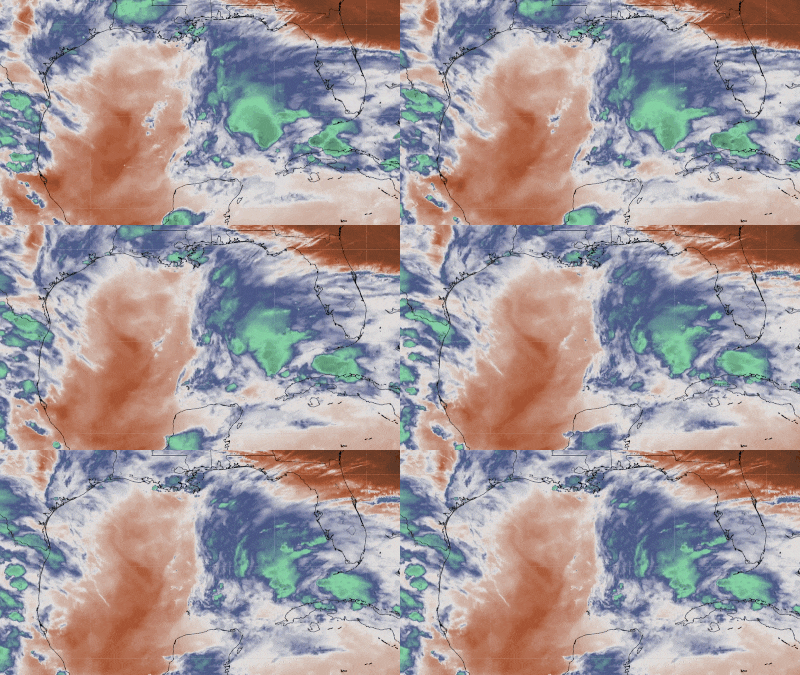
Source : INDIA TODAY NEWS
Something strange is happening to India’s sky this Monday. Look south, and it is dark and magnificent, full of rain and clouds and the particular electric charge that only the monsoon can carry. Look north, and it is a different country entirely: pale, metallic, burning.
On Monday, June 8, these two scenarios will exist at the same time, separated by a few degrees of latitude and an enormous difference in what the day will feel like.
advertisement
WHAT IS HAPPENING, AND WHERE
The India Meteorological Department (IMD) has confirmed that the southwest monsoon advanced further on Sunday, sweeping into parts of the west-central Bay of Bengal, all of Nagaland, Manipur, Mizoram, and parts of Tripura, Assam and Arunachal Pradesh.
The monsoon is India’s most important seasonal event, the annual arrival of moisture-laden winds from the Indian Ocean that bring most of the country’s annual rainfall. It moves northward like a slow tide.
On Monday, IMD expects it to push further still, into parts of the central Arabian Sea, more of Maharashtra, Karnataka, Andhra Pradesh, Telangana, remaining parts of Tamil Nadu, and more of the northeast.
The Northern Limit of Monsoon, the invisible line marking how far the rains have reached, currently runs through Devgad, Koppal, Ananthapuramu and Chennai.
Below that line, the rain is real and heavy. The IMD has forecast isolated extremely heavy rainfall over Coastal Karnataka on June 8, 9 and 10.
That means more than 204.4 mm of rain in a single day, which is enough water to trigger localised flooding, landslides in hilly areas, and waterlogging in cities.
Kerala and Lakshadweep will see widespread rainfall with very heavy spells. Fishermen have been warned against venturing into the Arabian Sea and the Bay of Bengal.
Above the monsoon’s current limit, however, the story is entirely different.
THE HEAT THAT IS BUILDING
Delhi will wake on Monday to a mainly clear sky and a maximum temperature between 40 and 42 degrees Celsius, above normal by one to three degrees.
By Tuesday and Wednesday, IMD expects temperatures to remain in the same range, with minimum temperatures also running above normal.
Across north India, the picture is harsher. IMD has issued heatwave warnings for Haryana, Chandigarh and Delhi from Monday to June 11, for Punjab from June 8 to 11, for West Rajasthan from June 7 to 11, and for East and West Uttar Pradesh from June 9 onwards.
A heatwave, by IMD’s definition, occurs when the maximum temperature for a plains station reaches at least 40 degrees Celsius and departs from the seasonal normal by more than 4.5 degrees Celsius.
What is driving this? Hot, dry air is flowing in from the northwest, from the Thar Desert and beyond. High pressure in the upper atmosphere is acting like an invisible lid, compressing and warming the air below it.
There is almost no moisture at the surface to absorb the Sun’s energy through evaporation, so everything goes straight into heating.
The highest maximum temperature recorded on Saturday was 44.3 degrees Celsius at Sriganganagar in Rajasthan, and temperatures are still climbing.
WHAT COMES NEXT
The IMD expects temperatures in northwest India to rise by two to three degrees Celsius until June 10, before a western disturbance arrives around June 11 to bring some relief through cloud cover and scattered rainfall.
A western disturbance is a weather system that travels from the Mediterranean and Central Asia into the Indian subcontinent, carrying moisture and cooler air.
The monsoon is expected to keep advancing, but not into the north yet.
Skymet and IMD both forecast below-normal overall seasonal rainfall this year, partly because El Nino conditions are developing in the Pacific Ocean.
El Nino is the unusual warming of the central and eastern Pacific that typically weakens the monsoon’s rainfall delivery over India, even as it can produce intense, concentrated downpours in some regions.
For now, Monday belongs to two different countries wearing the same name. One is drenched. The other is burning.
– Ends
SOURCE :- TIMES OF INDIA