

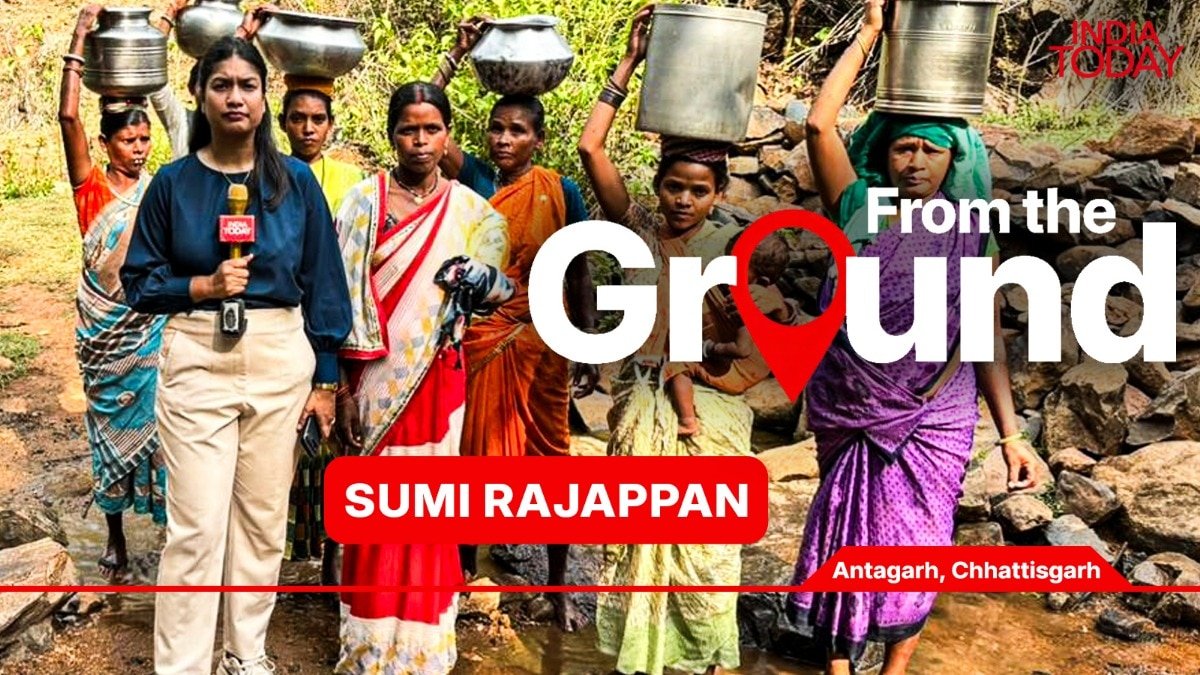
Source : INDIA TODAY NEWS
Recently, Prime Minister Narendra Modi advised his cabinet ministers to stay hydrated while working through the ongoing heatwave. It was a simple yet important message. But while the country’s leadership discusses ways to cope with extreme temperatures, there are corners of India where the struggle is not about staying hydrated but about finding clean water at all.
Over the last few weeks, disturbing visuals from different parts of rural India have surfaced. Women climbing into dangerous wells, villagers walking miles carrying empty containers, children spending hours every day searching for water. These images are a reminder that for millions of Indians, access to safe drinking water remains a daily battle.
advertisement
A similar story was unfolding near Antagarh in Chhattisgarh.
When reporter Gaurav Srivastava informed me about a small village called Maspur in Kanker district, we decided to travel there. What we discovered was not merely a water crisis. It was a story of neglect stretching back generations.
The journey to Maspur itself tells a story.
For years, this region remained affected by Naxal violence. Government officials rarely visited, and basic necessities did not reach the area.
As our vehicle moved through dense forests and rough terrain, the signs of isolation became increasingly visible. There were stretches where mobile connectivity disappeared completely. Small mud houses stood scattered among the trees. The nearest signs of any infrastructure seemed far away.
At one point, we had to abandon our vehicle altogether. The road simply ended. What followed was a journey that few outside this region would ever imagine making just to reach a village.
We switched to a local utility vehicle and navigated through the narrow interior tracks leading out of Antagarh. Even that could take us only so far.
Then came the real challenge: A seven-kilometre uphill trek. Not on a proper trail. Not on a road. But across a rugged path made almost entirely of large boulders, loose rocks and uneven terrain.
When we began the journey, we did not fully understand what we had signed up for. Every step demanded complete attention. One moment of carelessness could result in a serious injury. The scorching heat, the elevation and the unforgiving terrain made every kilometre feel longer than the last.
As journalists, we were carrying cameras, batteries and other equipment, and a few litres of water, as it would become an absolute luxury the moment we reached the village. Yet with every step, our stamina seemed to drain away. What appeared manageable at the start quickly turned into a test of endurance. The climb was relentless, and the mountain showed no signs of mercy.
About halfway through the trek, we met Sube Singh Husendi.
While our team paused to catch its breath, he stood before us seemingly unaffected by the climb. Curious, we asked him how people managed to travel this difficult route almost every day. His response was simple. “We are used to it.” For him, this was normal. For us, it felt anything but normal. Then he added something that immediately changed the tone of the conversation. “It becomes life threatening when we have to carry a patient. Last year, one of our relatives lost his life while battling to get to the hospital through this path.”
The terrain, the distance and the lack of accessibility had turned a medical emergency into a tragedy.
He added, “This same path becomes much more challenging when we have to carry 35 kilos of ration on our shoulders to the village.”
There was no anger in his voice. No attempt to dramatize his suffering. He narrated the incident with the quiet acceptance of someone who has learned to live with hardships that most people cannot even imagine.
Eons later, pun intended, we reached Maspur.
Even electricity remains a distant promise in Maspur. Villagers told us that the process of laying electricity poles itself took nearly eleven years. Today, the poles stand across the mountain like symbols of development that almost arrived but never quite did. The wires are in place, but electricity has yet to flow. More troubling is the uncertainty. Nobody in the village can say with confidence when the power will finally come.
The village carries an overwhelming sense of emptiness. There are no bustling markets, no signs of economic activity, and little to suggest that modern infrastructure has made its way here. Life moves slowly, dictated by the availability of water.
Shortly after we arrived, it was time for the evening water collection.
Women emerged from their homes carrying metal utensils, plastic containers and buckets. Without wasting time, they began descending the rocky terrain that leads to the village’s only reliable source of water. We followed them.
The descent was almost as challenging as the climb that had brought us to Maspur. Loose stones shifted beneath our feet, and every step required caution. After navigating the rugged path for several minutes, we finally reached a small stream nestled between large rocks.
This was it — The only source of water available to an entire village.
The women immediately began filling their containers while narrating the routine that has governed their lives for decades. They make this journey twice every day. The first trip begins around five or six in the morning. The second takes place around four in the evening so that enough water is available for cooking, washing and other household chores.
The stream itself presented a disturbing picture.
Between a cluster of rocks, a small pocket of relatively clear water had collected. At least to the naked eye, it appeared drinkable. Whether it would pass any scientific test for safety was a question I chose not to pursue at that moment. Some truths are difficult enough without laboratory confirmation.
Just a few feet away lay another section of stagnant, visibly contaminated water. It was murky, filled with debris and teeming with frogs. The contrast was startling. Yet both formed part of the same fragile ecosystem upon which the village depended for survival.
An elderly woman, speaking in broken Hindi, told me that her family had been drinking water from this source since 1975, the year they settled in Maspur.
“Since then nothing has changed,” she said.
Nearby, a young woman carrying an infant in her arms joined the conversation. “I give this water to my baby. The child keeps falling sick,” she said. Her words lingered long after the conversation ended.
Villagers explained that once the rains arrive, the relatively cleaner portion of the stream often turns muddy and contaminated. During those months, families are forced to depend largely on rainwater for drinking purposes.
They have developed their own collection system. Plastic sheets are tied to rooftops so that rainwater can be channelled into containers. The water is then stored and boiled before consumption. It is a survival mechanism born not from innovation but necessity.
By this point, our own water supplies were nearly exhausted. During the trek, we had rationed every sip because we knew finding safe drinking water in Maspur would be difficult. Eventually, necessity caught up with us too. Members of our team drank the same water being consumed by villagers. It was not a pleasant experience. But unlike us, the residents of Maspur do not have the luxury of leaving at the end of the day. For them, this water is not an emergency option. It is the only option.
According to villagers, they have repeatedly approached government officials over the years. They claim that representations were taken to the Chief Minister’s Office, to local authorities and to political representatives, including current BJP MP Vikram Usendi, who has been mostly representing the region in public life for 25 years.
“But only assurances have come,” one villager remarked. I asked Sube Singh Husendi why families continued to live in such difficult conditions. His answer reflected a reality that many policymakers often overlook.
“Where will we go?” he asked. “Our fields are here. Our livelihood depends on this land. Every election, leaders come asking for votes. They know where Maspur is then. Why do they forget the way after the elections are over?”
For them, democracy arrives on schedule every five years. Development does not. The contrast is impossible to ignore.
After a few more conversations, we began the long descent down the mountain. It took us nearly an hour to reach the spot where our vehicle was parked. We were eager to get there before sunset, as darkness would make the journey even more difficult. The woman we had met earlier sat in the vehicle and drank several bottles of clean water.
Watching her, I could not help but think about the people we were leaving behind. For them, access to something as basic as safe drinking water remains a daily struggle.
Of all the stories I have reported, this was by far the toughest. It was also one of the most challenging journeys I have ever undertaken. But more than anything else, it was a lesson in resilience, dignity and the harsh realities that continue to shape life in some of the most remote corners of our country.
– Ends
SOURCE :- TIMES OF INDIA