

Source : the age
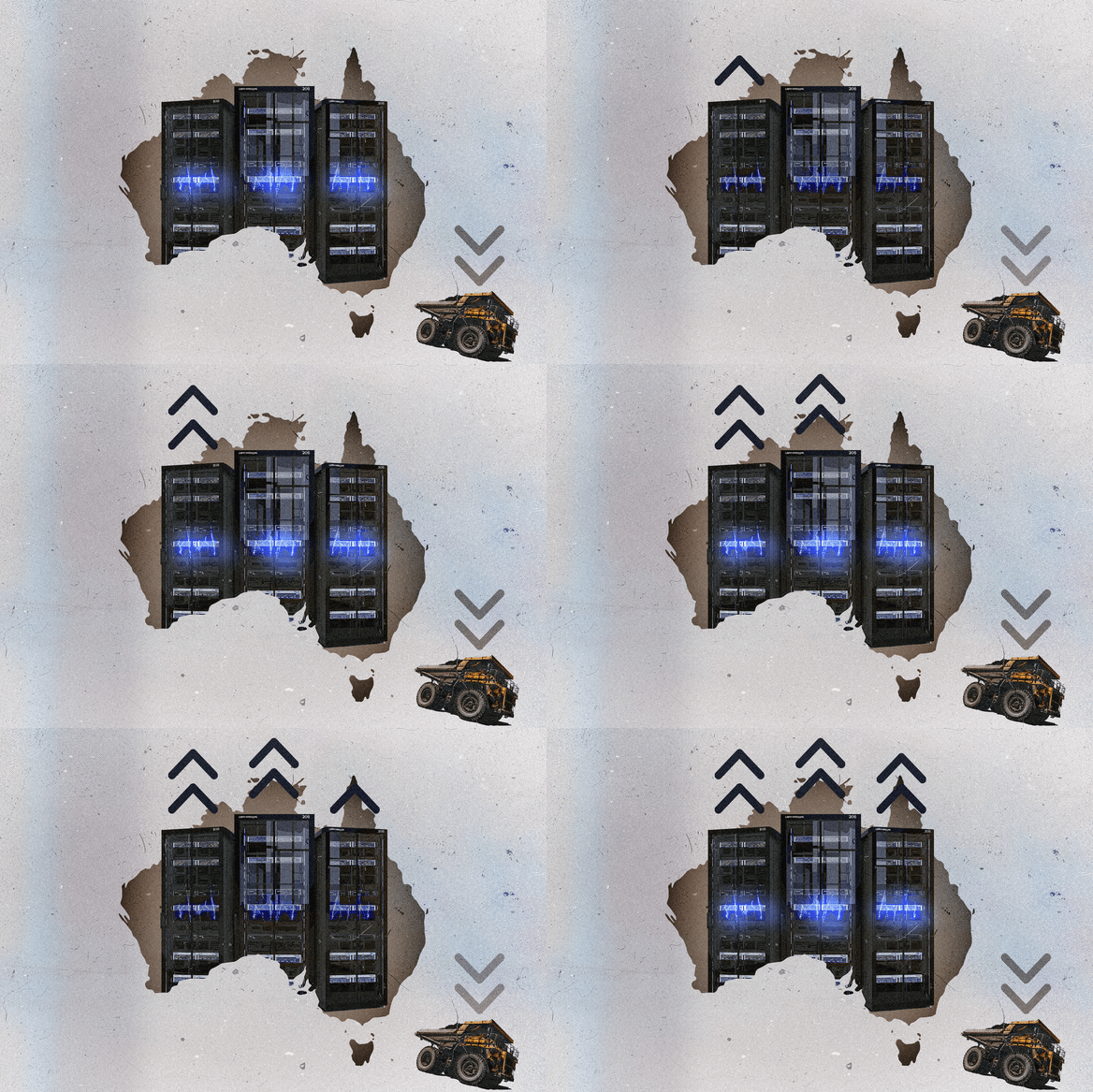
NSW and Victoria are in the midst of a data investment explosion that is now larger than last decade’s mining boom, injecting tens of billions of dollars into the country, but there are doubts whether the rapid expansion will deliver long-term gains to Australians and government coffers.
Figures from the Australian Bureau of Statistics show that the early 2010s mining boom, which transformed the economies of Western Australia and Queensland while boosting company tax collections, is being surpassed by the explosion in data centres based in NSW and Victoria.
Over the past 12 months, private companies and individuals have sunk almost $300 billion into new buildings, equipment, machinery and homes in the nation’s two most populous states. During the 2012-13 mining boom, capital spending in WA and Queensland peaked at around $250 billion.
Through the first three months of 2026, spending on equipment and machinery – most of which is destined for data centres – in NSW soared to a national record $12 billion while in Victoria it lifted to a state record of $9.1 billion.
Cabinet secretary and assistant minister for the digital economy, Andrew Charlton, said if not for the surge in data centre-related spending so far this year, economic growth would have flatlined or even gone backwards.
He said the global data centre boom was the single largest economic lift since the railroad construction boom of the 1880s and 1890s. Data centre construction was now around 2.4 per cent of global GDP compared to the 1950s highway construction surge (1.4 per cent) and electrification through the 1930s (2 per cent).
Charlton is bullish that data centres and the AI they enable will deliver an economic transformation for Australia that will ultimately boost productivity, create new businesses and lift overall living standards.
“That is the real prize. Not simply hosting the infrastructure of the AI age, but using it to build a more productive economy, create better jobs, lift living standards, and support a vibrant culture that helps create new Australian businesses,” he said.
Australia is already home to an estimated 278 data centres, ranking it among the top 10 nations in the world for such centres. More than 100 of them are based in Sydney while another 61 are in Melbourne. There are plans for more worth tens of billions of dollars.
Charlton said there had been pushback against the new technology, especially in the United States, where ordinary Americans were being asked to pay more for their electricity and water that is being used for new data centres.
He said governments in Australia were ensuring data centres had the “social licence” to operate, such as requirements to supply grid-scale renewable energy that ensured local communities were not financially hurt.
“We have to be able to look Australians in the eye and say their power bills won’t go up because of a data centre, that they won’t run out of water,” he said.
“I think in Australia, because we’ve had these discussions with companies at the start, we’re getting the social licence situation right.”
But like any boom, there are potential downsides.
The head of the nation’s banking sector regulator, John Lonsdale, on Friday warned a Senate committee that advances in artificial intelligence was creating enormous financial opportunities but also new vulnerabilities.
Many data centres are being financed by so-called private credit which is effectively out of non-bank sources. Analysts Morgan Stanley estimates that of the $US2.9 trillion expected to be spent on data centre construction by 2028, about $US800 billion will come from private sources.
“While exposures in Australia remain relatively contained, international developments have the potential to transmit risks into the domestic system, and we are maintaining a strong supervisory focus in this area,” Lonsdale said.
The data centre boom has caught central banks, and their interest rate settings, by surprise.
“As it turned out, through the second half of 2025 – and [it] continues now – the AI boom in the United States [has] absolutely supercharged everything,” Reserve Bank governor Michele Bullock said last week.
“We were seeing activity slow. The world was seeing activity slow. All of a sudden, everything reversed.”
Westpac chief economist Luci Ellis said the current data centre boom resembled the 2010s mining boom, noting they could be disruptive to the rest of the economy as they sucked in resources while they were largely impervious to interest rate settings.
“The current data centre boom is more of a wave than a bump, bearing a considerable resemblance to the mining investment boom of the first decade and a half of the century. They are fundamental drivers of outcomes for multiple years,” she said.
Ellis said the date centre boom appeared larger in Australia than most other comparable nations, partly due to easy access to renewable energy and a “welcoming” regulatory environment.
But she cautioned the boom could come to an abrupt end.
“The downswing of the mining investment boom was an enormous drag on Australia’s economic performance, even when the level of investment was still high,” she said.
“Since it takes a lot less time to build an individual data centre than an enormous iron ore or gas project, the ramp-up and unwind could be steeper and shorter this time around.”
Independent economist Saul Eslake said the boom was being built on largely imported computer equipment which meant it actually detracted from overall economic growth.
He said while the mining boom generated large amounts of tax revenue as resources were sold, there were questions whether the data boom would deliver a boost to national coffers.
“The mining companies which undertook all that investment boom pay a lot of company tax (maybe not the gas companies) – will the companies operating the data centres produce ‘rivers of gold’ for the federal budget?” he said.
Cut through the noise of federal politics with news, views and expert analysis. Subscribers can sign up to our weekly Inside Politics newsletter.
 Shane Wright is a senior economics correspondent for The Sydney Morning Herald and The Age.Connect via X or email.