

Source : the age
The deeper we dive into AI chatbots and social media echo chambers, the rarer independent thought becomes. What should I have for dinner? Ask ChatGPT. Is this book worth reading? Let Reddit decide. It’s a modern-day hive mind, and we’ve all tuned into it.
Yeon Sang-ho, the “master of zombies” who brought us Train to Busan in 2016, is painfully aware of this, and has translated these fears into a new kind of monster – one that has already infected us all.
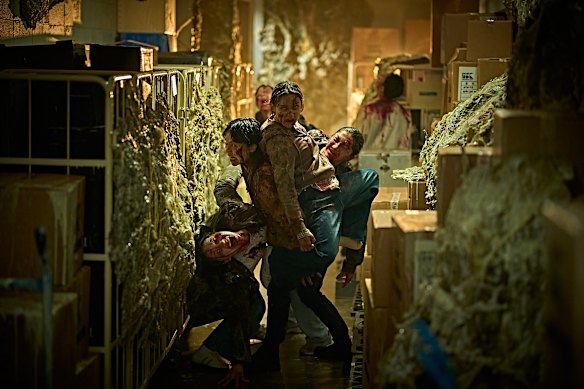
His new film, Colony, sees Yeon return to the zombie genre, though these creatures are unlike any of his previous creations. A rapidly mutating, mind-controlling virus, unleashed by a disgruntled former biotech employee in a high-rise shopping mall, transforms people into a violent collective, similar to the swarm intelligence of ants. Together, they evolve into a dangerous super-organism intent on recruiting all survivors.
“Zombies represent a fear – an innate concern for society at the time,” Yeon says via a translator.
This began with George A. Romero’s Night of the Living Dead (1968), he says, which was interpreted as a political statement on contemporary issues like the Cold War and civil rights. Once Yeon jumped on the zombie wagon in 2016, those societal anxieties had changed, shifting instead to neoliberal selfishness.
Train to Busan follows a father as he travels with his estranged daughter from Seoul to Busan on a fast-moving train. What should have been a simple journey turns into chaos when most of the passengers transform into ultra-violent zombies.
“Seok-Woo, the main character in Train to Busan, is a trust fund manager, which is the farthest-right capitalist alignment you can have for a job,” Yeon says. “I wanted to explore the fear around what happens when a capitalist society comes crashing down. How does this man protect his family and livelihood in these circumstances?”
This film changed the game for zombie cinema. Not only were the zombies deadly, but they were also incredibly fast, setting them apart from the slow, bumbling on-screen monsters that came before. It also paired apocalyptic mayhem with genuine heart, chronicling the breakdown and subsequent resurrection of a father-daughter relationship.
A decade has passed since this film blew global audiences out of the water, and societal concerns have again shifted. In Colony, fears around money and hierarchies are replaced with more existential anxieties like the loss of self.
“I wanted to explore the current trends we see in information being spread and exchanged at such a rapid pace, and how this is affecting our society. At this point, we don’t know what the world will look like five years from now because it’s all moving so quickly.”
Social media and artificial intelligence are at the core of this concerning evolution, Yeon says, encouraging everyone to gravitate towards the simplest and most mainstream ideas. “We’re losing our identity as individuals. The people who ‘agree’ don’t necessarily believe these ideologies 100 per cent, it’s more so out of fear of being left out and not conforming to society.”
This mob mentality manifests physically in Colony. The infected move in disturbing balletic unison, even their bones seem to crack and crunch simultaneously. Eventually, they literally merge, climbing on top of each other to create infected, contorting towers.
Such choreography is Yeon’s forte. Like in Train to Busan, he forwent CGI, instead working with skilled dancers to carefully choreograph sequences that elicit fear and discomfort, but also a strange sense of wonder. In the 2016 film, he used break-dancers and stunt performers to perfect the back-breaking movements of the individual zombies. In Colony, however, he needed something different.
“I brought in three teams to help craft the film’s movements,” he says. “I wanted the bodies to be a picturesque portrayal of the collective, so I brought in avant-garde dance troupes … I didn’t want everybody just moving in one direction, together at the same time. I wanted a group of collective beings that are moving together for the same purpose, not necessarily moving in sync. It was almost as if I wanted them to have 10 separate fingers playing the piano in the same tune.”
Despite how alien these creatures appear, Yeon says it’s through them that we discover what it truly means to be human. This has been the case in all his zombie productions, from Train to Busan and Seoul Station to Peninsula, but it arguably reaches a crescendo in Colony.
“The zombie collective only breaks apart when the [survivors] inject their own ego, individualism and identity into their framework,” Yeon says. “I wanted to show this duality of humanity: We wish to be part of the collective, but we also strive to be individuals.”
Colony is in cinemas from June 11.
Must-see movies, interviews and all the latest from the world of film delivered to your inbox. Sign up for our Screening Room newsletter.
 Nell Geraets is a Culture reporter at The Age and The Sydney Morning Herald.Connect via X or email.