

Source :- THE AGE NEWS
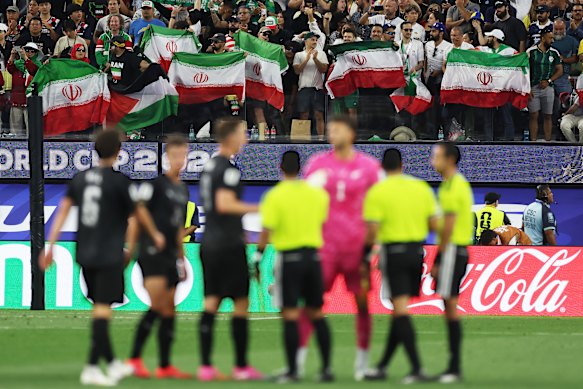
Los Angeles: They proudly wore T-shirts of defiance, smuggled banned flags in their pants and spent many hundreds of dollars to boo, jeer and whistle over the top of the national anthem.
If Iran playing in the United States when it’s been at war with the host nation wasn’t complex enough, then the feelings and atmosphere inside Los Angeles’s SoFi Stadium, where tens of thousands of Iranians gathered, added a new layer.
Los Angeles is home to the biggest Iranian community outside Iran, many of whom fled the country after the 1979 Islamic Revolution. For thousands of Iranian-Americans, the country’s opening World Cup game against New Zealand was a prime opportunity to get international attention on their protests against Tehran’s regime.
Yet the diaspora remains deeply divided. Many hold mixed feelings over how to show solidarity with the Iranian people without appearing to endorse its government. Some attended to back the team while actively protesting the regime. Others refused to cheer at all, arguing the squad has become too tied up in politics.
Some chose to stay home, fearing their presence might be misconstrued as supporting the regime. Hundreds more turned up outside without tickets just to make their voices heard.
Inside the stadium, FIFA had warned that any symbols of protest, including the pre-revolutionary Iranian flag, would be confiscated. Many defied the ban, smuggling the banners past security. Others wore the historic Lion and Sun symbols on T-shirts, knowing security guards would be reluctant to strip them of their clothes.
When the Iranian national anthem played before kick-off thousands cheered and booed in an attempt to drown it out. The reception for the players was largely positive. The stadium erupted each time Iran scored in what finished a 2-2 draw, although events on the pitch consistently felt second to the politics.
Leaving the ground, her face still painted in red and green, Bahar Pour said she was able to separate the team from the politicians.
“I love them, I love the team of Iran. I know they don’t represent the government,” she said. “Everything inside was positive … the boos during the anthem are understandable. They cheer the team, they don’t cheer the government.”
But Ashkan Gousheh said he attended specifically to ensure the world didn’t look away from the human rights protests back home.
“I came to be the voice of the Iranian people. I spent hundreds of dollars on tickets,” Gousheh said. “I actually came here wanting to see Iran lose.”
Iran’s World Cup participation has been hit by challenges. The team was forced to relocate its training base from Arizona to Tijuana, Mexico after being refused visas to set up in the US. The team has to fly in and out of the country for its three games.
Mark, an Iranian-born LA resident who declined to give his surname, wore a red T-shirt featuring the banned Lion and Sun crest but insisted he wanted to focus on the game.
“I’m really just for the football, and I really hope I just hear cheers for the boys,” he said. “I was really surprised how FIFA treated them, with all the baloney, and them having to travel in from Mexico to here. Have you ever heard of such treatment? It’s absurd. They say politics and football are separate, that’s complete baloney.”
Adrian Moayedi, who was attending his fourth World Cup with the banned flag tied around his waist, said he had to support the players. “There are some fans who think that this is the regime team, but as someone who is anti-regime and who grew up playing sports – this is the pinnacle of any footballer career.
“You’ve got to respect these boys; they have worked their whole lives to get to this point … if they haven’t spoken out against the regime, well, I don’t expect anyone in that position to speak out because they’ve got their family in Iran. They’ve got their whole careers in the line.”
Having qualified last March, Iran’s participation in the World Cup has been fraught given the country’s conflict with the US and Israel, which began on February 28.
A day before their first match, US President Donald Trump announced a peace deal had been reached with Iran and a plan to reopen the Strait of Hormuz.
Iran captain Mehdi Taremi said the support from Iranian fans in the stadium made it feel like a home game. “It was an incredible atmosphere in the game, all 90 minutes,” he said.
He said he preferred to discuss soccer, not politics, and wants to see the Iranian people united in Iran and outside the country.
Iran’s next World Cup match is at the same venue again next Monday (AEST) against Belgium.
Get across our World Cup coverage
News, results and expert analysis from the weekend of sport sent every Monday. Sign up for our Sport newsletter.
 Nick Ralston is the deputy editor and investigations editor for The Sydney Morning Herald. He has previously spent time as news editor, justice editor and world editor.Connect via X or email.