
SOURCE :- THE AGE NEWS
Washington: The United States will immediately waive restrictions on Iranian oil exports and ultimately lift all sanctions, as well as help create a $US300 billion ($425 billion) development fund for Iran, under President Donald Trump’s deal to end the war.
It also says Iran and Oman will “define the future administration and maritime services in the Strait of Hormuz” in discussion with other Gulf countries, potentially ceding power over the crucial waterway to two states which have countenanced imposing tolls.
The full text of the agreement, which was kept secret for days, was revealed by US officials on a call with reporters on Wednesday (US time), just as Trump trumpeted the success of the war at a press conference at the G7 in France.
Under the deal, Iran “reaffirms that it shall not procure or develop nuclear weapons”. The US and Iran will hold further discussions on how to dispose of Iran’s highly enriched uranium, which at a minimum will involve down-blending the material on-site under supervision by the International Atomic Energy Agency.
“We will push for more than that,” a senior US official said, speaking on condition of anonymity to explain the deal. “But the fact that they’re conceding to that is a major, major win for the United States of America.”
Military operations will cease “on all fronts, including in Lebanon”, and both parties will “refrain from the threat or use of force against each other”, while also ensuring Lebanon’s “territorial integrity and sovereignty”.
The US will immediately wind down its naval blockade of Iranian ports, and fully end the blockade within 30 days. Iran, meanwhile, would “make arrangements using its best efforts” to provide safe passage through the Strait of Hormuz with no charge “for 60 days only”.
The agreement says long-term management of the strait will be subject to dialogue between Iran and Oman, along with Gulf countries that border the waterway.
Defending that clause, the senior US official said while the Iranians would aggressively assert their rights during negotiations about the long-term future of the strait, Gulf countries would never agree to any arrangement that did not permit toll-free access.
Under the deal, the US agreed that with its regional partners, it will “develop a definitive, mutually agreed plan with at least $US300 billion for the reconstruction and economic development of the Islamic Republic of Iran”.
A senior US official said this clause did not require the US “to ever pay a cent of money to the Iranians”. Rather, the US would enact sanctions relief that would allow Gulf countries to invest in Iran, giving the example of the United Arab Emirates building a power plant. “That’s all it says.”
The agreement further stipulates that upon the signing of the Memorandum of Understanding (MOU), the US Treasury will immediately issue waivers for the export of Iranian crude oil, petroleum products and derivatives, and all associated services.
The senior US official said this was prudent because it would end the status quo whereby Iran still sold oil to China but with a “big fat discount”, which was “absurd”.
Beyond that, the US also agreed to “terminate all types of sanctions against the Islamic Republic of Iran” in accordance with a schedule that shall be agreed in the final deal.
And the US undertook to fully unfreeze Iranian funds and assets upon implementation of the agreement, in accordance with procedures to be determined as part of the final deal.
Senior US officials stressed that giving Iran access to its billions in frozen funds and assets was contingent on Tehran behaving and complying with the deal, such as destroying the highly enriched uranium.
Asked how the US would evaluate Iran’s compliance, one official said there was now much more interaction between the two nations. “We’re going to just work together and see if we can do some things to build trust.”
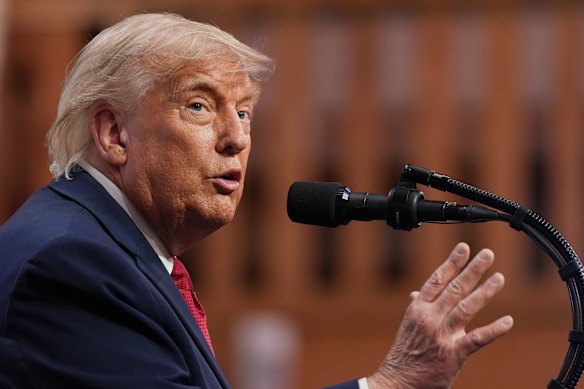
Trump, speaking from the G7 in France, said the deal had achieved “everything we set out to accomplish, and much more”. That included Iran’s reiteration of its long-standing claim that it doesn’t seek nuclear weapons.
The US president praised the “brilliant” stock market, noting indexes rose each time he announced progress towards a peace deal, and fell when there was bad news. He said avoiding a worldwide depression motivated him to sign the deal.
“The one thing I didn’t want to see is, I didn’t want to see economic catastrophe. If you kept this going, that could have happened,” Trump said. But he also entertained the idea of restarting the war.
“It’s a memorandum of understanding. If it doesn’t get done in 60 days, that’s alright, we go back to bombing. I don’t want to do that because it’s so good, but we might have to.”
Trump said the deal would be signed shortly. “Tomorrow (Thursday), maybe the next day.”
Get a note directly from our foreign correspondents on what’s making headlines around the world. Sign up for our weekly What in the World newsletter.
 Michael Koziol is the North America correspondent for The Age and Sydney Morning Herald. He is a former Sydney editor, Sun-Herald deputy editor and a federal political reporter in Canberra.Connect via X or email.