

Source : THE AGE NEWS
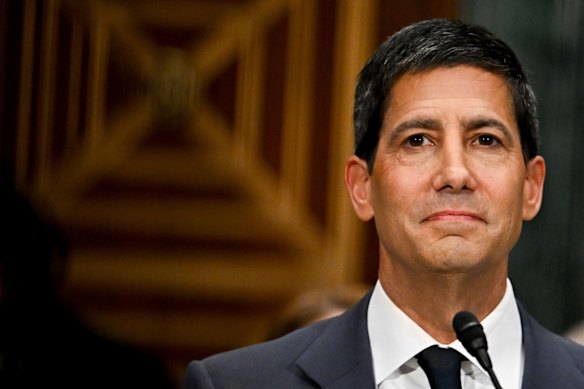
Kevin Warsh faced some novel, perhaps unprecedented challenges as he chaired his first meeting of the US Federal Reserve Board, not the least of which was to demonstrate that he wasn’t Donald Trump’s “sock puppet”.
And so far, so good.
The Fed’s first statement on monetary policy under its new chair was far more concise than those issued during the tenure of his predecessor Jerome Powell, and lacked the guidance that has been a feature of Fed statements dating back to the aftermath of the 2008 financial crisis.
There was, however, a decidedly “hawkish” tone to it, to Warsh’s own statements and to the signals sent via the famous “dot plot” projections of members of the Federal Open Market Committee (FOMC) that decides US monetary policies.
Appointed by a president who made it abundantly and very loudly clear that he wanted a Fed chair who would deliver lower interest rates, the clear emphasis Warsh placed on “price stability” and an inflation rate that has remained above the Fed’s target for the past five years was a statement of his and the Fed’s independence.
Warsh also needed to show that he could lead a board and FOMC that had been, most unusually for an organisation that has traditionally been driven by consensus, increasingly fractured.
‘The recent past need not be a prologue. I am pleased to report that members of the FOMC are unambiguous and unanimous. This committee will deliver price stability.’
New Federal Reserve chair Kevin Warsh
That was, perhaps, because its members wanted to signal their own independence in the face of the vicious verbal and legal attacks by Trump on Powell and another Fed governor, Lisa Cook. Powell’s term as chair ended last month but he remains on the board until it is apparent that the Trump administration’s legal assault on him and, effectively, on the central bank’s independence, is “well and truly over”.
At each of the Fed’s most recent meetings, the level of dissent has grown. At this meeting, however, the decision to hold rates steady was unanimous – even though a number of governors and FOMC members had been publicly advocating a rate rise in the lead-up. The threat of a resistance movement developing within the Fed to their new chair has receded.
Given that Warsh has advocated significant changes to the way the Fed communicates, gathers the data to inform its decisions, manages its balance sheet and considers the implications of changes to the structure of the US economy, he also needed to justify why they were necessary and defuse the suspicion that they could be camouflage for his intention to deliver what Trump has demanded.
Again, so far, so good.
Apart from producing a very condensed version of the Fed’s usual FOMC statement – sans any forward guidance, in line with his aversion to making forecasts – Warsh announced five task forces that will review the Fed’s communications policies, its balance sheet policy and its reliance on existing data sources, look at the nation’s productivity and jobs trends “in an era of transformation” and the Fed’s framework to manage inflation.
If the basis on which the Fed makes its decisions is to change, it won’t be on a personal whim or conviction but after considered review by internal and external experts.
While he’s outlining potentially radical shifts in the way the US central bank operates, communicates and interacts with financial markets, any changes will have to be evidence-based and the arguments for change persuasive enough not to trigger a backlash in financial markets.
The introduction of the task forces does point to significant change – the start of a “Warsh era” for the Fed – but the core challenges for any central bank are the same as the Fed’s dual mandate of maintaining price stability (i.e. keeping the inflation rate subdued) while maximising employment.
US inflation is not under control and, as Warsh himself noted, hasn’t been for the past five years. The Fed’s preferred measure – the core Personal Consumption Expenditures index (PCE) – most recently came in at 3.3 per cent and has been rising steadily this year.
The Fed’s “dot plot” chart – which might be the last one, as Warsh isn’t at all keen on the FOMC individual members’ projections for key economic data – reflects significantly more pessimism for US inflation and interest rates since the last set of projections was released in March.
The median projection for PCE inflation has been raised from 2.7 per cent in March to 3.3 per cent, and for core PCE from 2.7 per cent to 3.3 per cent. In March the median projection for the Fed’s policy rate, the federal funds rate, was 3.4 per cent at the end of this year. Now it’s 3.8 per cent.
With the Fed currently targeting a federal funds rate of between 3.5 per cent and 3.75 per cent, that implies an expectation of at least one 25 basis point rate hike this year. Nine of the 18 members who voted (Warsh, perhaps unsurprisingly, didn’t provide his dots) pencilled in at least one rate hike; six anticipate at least two.
That’s a big shift from March and, given that Warsh chose not to dwell on the jobs market, other than to say it was moving in a good direction, provided the backdrop to what was a clear focus from the new chair on the inflation rate.
“The recent past need not be a prologue. I am pleased to report that members of the FOMC are unambiguous and unanimous. This committee will deliver price stability,” he said, having described “persistently high prices” as “a burden for the American people”.
The Fed’s formal, truncated statement said the US economy was expanding at a solid pace despite “elevated uncertainty that owes, in part, to the conflict in the Middle East”.
The US inflation rate was, however, edging up even before Trump decided to wage war on Iran.
The end of the conflict, if that is what the 60-day ceasefire agreed this week is, might lead to oil and gasoline prices falling back from their recent elevated levels, but some fallout from those price hikes will still be seeping through the US economy, along with the continuing effects of Trump’s tariffs and the increasing impact of the extraordinary levels of investment in artificial intelligence and the hardware and data centres associated with it.
Warsh has linked prospective AI-driven productivity gains to an ability to lower interest rates (a hypothesis his taskforces will investigate) but the AI investment is massive, ongoing and inflationary, while the productivity gains, if they emerge, are somewhere out there on the horizon. It could take some time, and rate hikes, before Warsh can contemplate delivering what Trump wants from him.
Trump himself, who has responded aggressively and abusively in the past when the Powell Fed disappointed him, adopted an “it’s all right, whatever” approach to the outcome of his personally vetted and appointed new Fed chair – although he is still advocating rate cuts despite the rising inflation rate.
“It’s hard to believe. It just keeps the country down, and it’s so unusual,” he said (even though it is highly usual for central banks to maintain or increase their policy rates when the inflation rate is edging up).
“But we have a good guy over there right now, so I’m guided by what he wants,” Trump said.
Warsh is still in the honeymoon period with his Fed colleagues, financial markets and the president. Whether Trump’s disengagement from his long-running feud with the Fed and his backing for Warsh lasts, will be tested if the FOMC members’ projections of a rate rise, or two, before the end of the year come to pass.
One suspects not. But provided he’s prepared for a potential Trump tongue-lashing, Warsh is in the chair now to chart his own course.
The Market Recap newsletter is a wrap of the day’s trading. Get it each weekday afternoon.


