

source : the age
This morning, the Australian Education Union’s leadership was blindsided by the rejection of the in-principle agreement they struck with the Allan government. As a teacher in a public secondary school, with a daughter in a public primary school, the strength of the No vote was not a surprise at all.
The offer simply does not address the low pay and crushing workload that are driving teachers out of the profession and undermining the high-quality education Victorian students need and deserve.
We were told the pay rise would make us the best-paid teachers in Australia – despite leaving us well behind our colleagues in Western Australia. Even the more limited claim that we would catch up to NSW was fudged; all but two classifications would remain thousands of dollars behind, year after year. In real terms, the offer would barely bring us back to our 2021 salaries by 2030.
Education support staff, the unsung heroes of our education system, were presented with a false pay rise, with much of the claimed increase in a lump sum allowance rather than a real salary improvement. Even that allowance was overstated, with union leaders not mentioning it would be partially offset by removing an existing allowance.
The workload measures were also exaggerated. For instance, we were offered an increase to four professional practice days to focus on marking and planning. While welcome, this would just restore the four PPDs we used to have – but in the new version, rather than teachers being covered by a relief teacher, these would be additional pupil-free days, pushing the cost onto students and their families.
Teachers and school staff are at breaking point. We have huge issues with burnout. An offer that did not seriously address these issues was doomed to fail.
But where do we go from here? School staff want this dispute resolved swiftly and so do their students. So what needs to happen to get negotiations back on track?
First, the AEU leadership needs to recommit to internal democracy. They had simply no idea what members were thinking, and they need to change their approach quickly so they can represent us properly.
In previous industrial campaigns we have held mass meetings of members, or of delegates representing every school in the state, to debate priorities and campaign plans and to allow the union leadership to accurately gauge what members want and need.
This time, opportunities for discussion and debate were shut down. Our regular regional meetings were cancelled and replaced with briefings, with no opportunity for members to debate priorities or vote on next steps. The union’s social media accounts were vigorously policed to remove dissenting comments and dozens of members, including elected school delegates, were blocked.
Key decisions, such as suspending planned industrial action or accepting an in-principle agreement, are made by an elected branch council – but the union doesn’t publish a list of who these councillors are, or how they can be contacted by the members they represent. The electorate boundaries are secret, and councillors have complained that even they don’t know which schools are in the areas they represent.
Of course, members need to take responsibility for this, too. Participation in union elections is notoriously poor. Many councillors are elected unopposed and the turnout for the executive elections is abysmal. The Victorian branch secretary was elected in 2024 with less than 8000 votes – but the union has more than 50,000 Victorian members.
Is it any wonder that the union is out of touch with the views of the broader membership? This culture needs to be fixed as an urgent priority.
Second, we need to send a clear message to the state government that AEU members are serious about fixing the crisis in public education, and we won’t settle for a deal that does not make meaningful progress towards that goal.
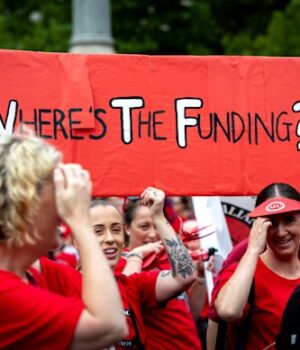
Shamefully, the so-called Education State remains the only state or territory without a timeline for full funding of public schools. As it stands, Victorian students are only funded to about 90 per cent of the Schooling Resource Standard, because the Allan government cut $2.4 billion from the education budget over the coming years.
But last week, at The Age’s Education Summit, Education Minister Ben Carroll confirmed that an agreement with the Commonwealth for full funding is currently being finalised, and he expects the deal to be done around the same time as the schools EBA. That’s excellent news! But we want to know the true state of the education budget before, not after, we sign an agreement.
Full funding for public schools will have the biggest impact if it is directed towards addressing the workload concerns of teachers and support staff, ending the burnout and attrition that leads to staff shortages, and giving us the time for planning and feedback that supports the individual needs of the students in our care.
Sadly, cancelling our industrial action was not seen by the government as a show of good faith (as our leadership naively believed) but as a sign of weakness. We need to immediately reinstate our bans on unnecessary meetings and on Labor MPs making propaganda visits to our schools, and we need to begin planning for another statewide strike early in Term 3.
If our own leaders and the government get the message this time, we will soon see a better deal for teachers and support staff – and crucially, for students and families, too.
Robert Corr is a public school teacher and a member of the Australian Education Union.
The Opinion newsletter is a weekly wrap of views that will challenge, champion and inform your own. Sign up here.
 Robert Corr is a public school teacher and a member of the Australian Education Union.