

Source : the age
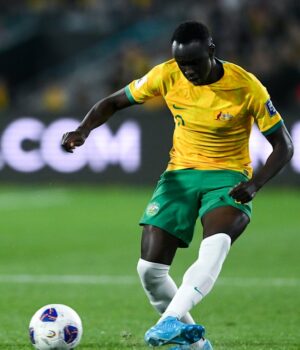
There’s nothing like the World Cup to bring people of different cultures together. Australians of all backgrounds roared with delight when Nestory Irankunda and then Connor Metcalfe scored against Turkey in the Socceroos’ first match of the tournament.
The Socceroos’ second World Cup game on Saturday comes after a week in which One Nation leader Pauline Hanson argued for a stop to multiculturalism, and at a time when members of the Australian team are proudly proclaiming their rich, diverse backgrounds in a social media campaign that speaks directly to those who criticise immigration.
Irankunda was born in a refugee camp in Tanzania; his parents were originally from neighbouring Burundi but had fled due to civil war, eventually settling in Perth when he was three months old. His teammates Awer Mabil, Mohamed Touré and Miloš Degenek also came to Australia as refugees.
“The Socceroos now are a representation of [multiculturalism]; you have many different backgrounds representing one jersey,” Mabil told ESPN of the video, called Football is for Everyone. To his mind, that is one of Australia’s strengths: “You have the whole world in one place.”
It’s this unifying theme – and the fever-pitch excitement of the Australian team’s win – which the Immigration Museum taps into with its show, Football is Home: Belonging in Australian Soccer.
Thomas Deng, a former Socceroo now based in Japan, is part of the show and was back in the country for the exhibition opening. Now playing for Yokohama F. Marinos, he watched Sunday’s game with his brothers and a few friends and is thrilled about the win. “We knew that Turkey is a dangerous team and they’ve got some really good players, but it’s great for Australian football to get that result,” he says. “It’s massive for the sport.”
Deng knows firsthand how powerful the game is in bringing people together. When he arrived in Australia, aged six – with his relatives from Kenya, many of whom had spent time in refugee camps – he spoke English, but many pupils at his school didn’t.
“When we played football at recess or lunch, it just felt like it was normal, there was no language needed; it was just off feelings or emotions. It was natural.”
The 29-year-old says the exhibition allows people involved in football to tell their stories. “You get to know the players a lot better, not just on the surface, you can really deep dive: what’s my identity, what do I believe in?” he says, adding that these questions are what resonates with the public.
While there will always be negative voices, Deng argues “it’s not entirely the full picture”, which is why he is such a fan of the museum show. “For us, it gives us a voice to tell our stories, the things we’ve been able to go through and get out on the other end and still be where we are in today’s society.”
He believes it’s something soccer players, and indeed the Socceroos, could focus on a lot more, “getting our fans to know us on a deeper level”.
Dr Moya McFadzean, senior curator of migration and cultural diversity at the Immigration Museum, says many of the anti-immigration conversations become very generic and reductionist. The exhibition provides a background to the real person, she says.
Soccer really hit its straps in Australia after World War II with the influx of immigrants from the UK and Europe. McFadzean’s favourite items include a pair of football boots worn by the Italian player Rino Mazzocato, who came here in 1951 and joined one of Australia’s oldest soccer clubs, Brunswick Juventus, and a ball once owned by Hungarian legend Attila Abonyi, who played with the Socceroos in the 1974 World Cup – all of whom signed the ball on display.
“My parents didn’t have a word of English [when they came to Melbourne having fled Hungary in 1957] … but the fact there was a Hungarian soccer club, they could go along … and mingle with Hungarians. It was a social event even more than a football club,” Abonyi told The Guardian’s Sportblog in 2014.
Also featured in Home is Football is Charlotte Dougherty, a player with the Bilbies, the Australian Women’s blind football team. She can see about four metres in front of her, but until she discovered blind football, she kept that to herself.
In blind football, the players, except the goalkeepers, wear special goggles, the football pitch is smaller, the ball jingles and the crowd is silent. Players call voy! – which means “I’m going” in Spanish – to signal they are on the move and to avoid collisions.
“I look back and I think that 16-year-old me would not have expected football to be everything I do – my work, my play, my life,” Dougherty says. “I want the next little girl who is blind to know that football is something she can do, there’s a community ready to welcome her.”
Psychology is a big part of the game, according to Deng, who is looking forward to the next time the Socceroos – widely considered an underdog – face off in the World Cup. “A lot of these big nations underestimate the smaller teams. What they don’t realise is that the smaller nations are making a lot of improvements, they’re getting better.”
Home is Football: Belonging in Australian Soccer is at the Immigration Museum until January 2027.