

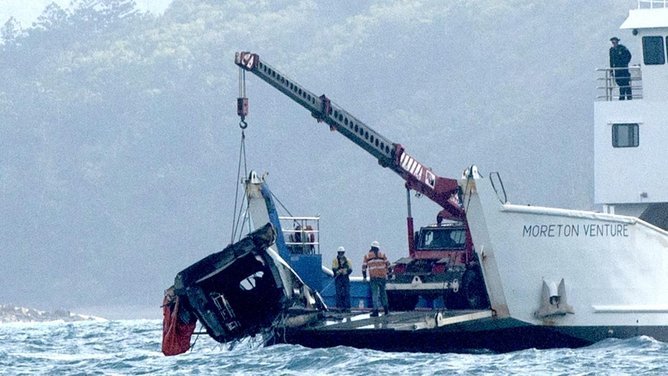
Source : Perth Now news
The father of a soldier killed in a catastrophic Army helicopter crash in the Whitsundays has told a Senate Inquiry investigating the tragic incident the MRH90 Taipan should never have been flying on the night of the fatal incident.
Captain Danniel Lyon died alongside co-pilot Lieutenant Maxwell Nugent, Warrant Officer Class 2 Phillip Laycock and Corporal Alexander Naggs during Exercise Talisman Sabre on July 28, 2023.
The crash occurred when their Taipan helicopter plunged into the ocean off Hamilton Island while flying in formation with three other helicopters.
A Defence Flight Safety Bureau (DFSB) investigation concluded the primary cause of the crash was spatial disorientation.
DFSB investigators believe Captain Lyon and Lieutenant Nugent became disoriented for 21 seconds before impact.
Then, in the final moments, Captain Lyon rolled the aircraft to the right, diverting it from a potential collision course with Bushman 82.
But the families of the four men that died strongly believe authorities ignored warnings about crew fatigue, high workloads and equipment.
The Legal and Constitutional Affairs References Committee is holding a Senate Inquiry into the incident to determine the airworthiness assessments of the MRH-90 and equipment, Army Aviation’s compliance with regulations, investigation findings and whether a decision not to prosecute any matters arising from the incident was appropriate.
Retired Major Ian Wilson told the inquiry that a crash protection helmet worn by pilots displayed an image of the world through a green light on the inside of a visor screen.
He said the image could be overlayed with critical information from the cockpit and replicated on the inside of the visor.
But when it was used in challenging conditions with low cloud and rain, similar to when the crash occurred, it looked like a green haze.
He said could be disorientating because its pitch and roll information could reverse and you did not know which direction to point the aircraft, like what happened in the crash.
“This accident was completely foreseeable,” he said.
“I had reported it in all our internal and external avenue available to us to try and prevent this and the conversation we had in the unit was well, our loyalty when we were n the organisation was to the organisation.
“Once this accident has materialised our loyalty now is only to the families.”

Fronting the inquiry, Lieutenant Nugent’s father Daniel Nugen said the Australian Defence Force leadership and Government knew the Taipan was a failed aircraft six years before the fatal crash.
Mr Nugent said reports identified the Taipan was unsuitable for special operations and a risk to safety, but the information was never acted upon.
He said government assessments described the helicopter as inefficient, expensive and unreliable, and that unreliability had fatal consequences.
“The aircraft should have been withdrawn from service, instead billions of taxpayers’ dollars were spent on a platform that should never have entered service,” he said.
“They identified the Taipan as a medium risk to aircrew safety, yet those risks were not addressed, even as the aircraft was pushed into even more complex and demanding flight profiles.”

Lieutenant Nugent’s partner Chadine White told the inquiry the reported sequence of fatigue and high workload was identified by their own unit, but were set aside before the fatal incident.
Ms White said the crew were among the Army’s very best and the fatal outcome was a result of systematic error, not human error.
She called on the Committee to establish the full truth of what happened to ensure accountability where the evidence supported it.
“Accountability has not been delivered, it has been diffused across process after process, none of which answers for the whole,” she said.
“My hope moving forward is that institutions learn from this, that they lead with the same integrity he demanded of himself.
“Anything less is an insult to his life and memory, and to those who remain in service, please do for them what was not done for him.”

Captain Lyon’s widow Caitland Lyon said her husband was exhausted doing four people’s jobs when he put his power helmet and climbed into the aircraft.
The mother of two said her husband was unaware the equipment he was wearing was deemed un-airworthy and potentially deadly by the Army’s own test pilots.
She said the Army ignored warning signs and nobody stopped the fatal exercise from going ahead.
“He trusted the army, his bosses, his instruments, just as he was trained to do, and he never came home,” she said.
“The least this community can do is truly find out why, independent of the controlling and self-interested actions of Defence, to determine proper accountability.”
Ms Lyon called for an independent military aviation authority to be established that could not be overruled or influenced by a senior chain of command.