
Source : the age
Pauline Hanson is right. The woke mind virus has taken over and you can’t say anything in Australia any more. You can’t call climate science a hoax, you can’t call Islam a disease, you can’t call workers lazy, you can’t call Indigenous welfare an industry, and you can’t call female heads of government witches.
Actually, you can, because she just did.
But political correctness is not all bad. It protects Hanson from being called stupid. Some insults are beyond the pale.
Back when Pauline Hanson was representing a few thousand Queensland first preferences, it was common to call her the Oxley moron. Ah, for the long-ago monoculture. Today, if you called her stupid, no matter what the evidence, you would also be insulting the one-third of Australians who are saying they would vote for her. You would probably increase their numbers.
In our public discourse, the unspeakable S-word is not the one Hanson refrained from using when describing multicultural overseas ghettos she thought she had seen in clips on social media. “S-holes,” she said, suffering a sudden attack of reticence. But “shit” is not censored. “Stupid” is.
Politically, the appearance of brains is poison. Paul Keating, Kevin Rudd and Malcolm Turnbull all made themselves unelectable by failing to control their apparent intellect. John Hewson, the human abacus, lost the unlosable election in 1993. He thought it was an advantage to seem smart. Australians, however, will tolerate being looked down on by the rich and the corrupt, but not by the intelligent. Our most successful recent prime ministers, John Howard and Anthony Albanese, have shrewdly managed to conceal any sign of braininess.
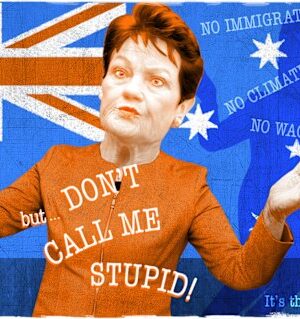
But Hanson, with her unique brand of pre-emptive rage, has advanced the cause of anti-intellectualism. She has become Otto West, the Kevin Kline weapons expert in A Fish Called Wanda. Paranoid about his intelligence, Otto’s catchcry was “Don’t call me stupid!” If you get caught, as John Cleese did, you will be hung out a window by the ankles until you apologise. So we don’t, and we won’t. In fact, we can’t. When every other word is permitted, one taboo will remain.
The roots of Australian anti-intellectualism are 238 years deep, and Hanson is simply exploiting a tradition. Back in the good ol’ days when we were all white and happy and united, Donald Horne wrote in The Lucky Country in 1965 that anti-intellectualism was “extreme” even among educated Australians. It was a fetish. The attack on proxies of intelligence – universities, the ABC, the arts, the scientific community – is hardly new.
Aggressive anti-intellectualism is a quality whose moment has arrived. Not only is it popular, it is marvellously disarming. (Overheard at a conversation of inner-city elites suddenly forced to take Hanson seriously: “Is she stupid, or rat cunning?” As if one excluded the other.)
It has sent the Liberals so dizzy that Angus Taylor, ever an ambition in search of a posture, has now turned to Hansonian shrillness. Goodbye Rhodes scholarship, McKinsey’s and The King’s School, hello rolled-up sleeves and shouty slogans. His problem is, Hanson is 30 years ahead of him and he can’t make himself sound so furious that his voice quivers. If you can’t fake sincerity, you’re cooked.
Interpreting the polls, Hanson is admired for saying things the way they are. But she is also the beneficiary of politically correct censorship. Responses to her National Press Club speech dance around the issue with fact-checking and, well, questions. Rational examination of her positions is just a sign of intellectual snobbery, the great Australian unforgivable. Hanson inverts accountability to portray the fact-checks and questions as a sneer. The relentless victimiser becomes the victim. It’s a form of political ju-jitsu that ties her opponents into knots of their own making. Is it smart? Irrelevant; its point is that it makes her more popular.
Hanson does not have what you might call a deep bench behind her, but it’s also taboo to call her parliamentary colleagues stupid. In a Senate estimates committee hearing last month, Malcolm Roberts pressed Creative Australia’s representative, Tim Blackwell, on the “disproportionate” funding given to Indigenous artists. Problem was, Roberts had his numbers wrong by several multiples. Desperate, he blamed his staff for coming up with the question and asked Blackwell to help him. Respectfully, Blackwell couldn’t do so. It wasn’t his role to help Roberts drum up a case against his organisation.
Roberts was left muttering that whatever the numbers were, funding Indigenous artists was still excessive. Just don’t call him stupid; that would make you a snob. His ignorance is itself a virtue; only a smarty-pants would come into the Senate hearing with the facts.
The unknown is how much further it can go. Across the Pacific, Hanson’s populist model, the original Otto West, has turned anti-intellectualism into a Möbius strip of self-regard. Donald Trump deploys the usual array of populist attacks on expertise that were used to similar effect by Ronald Reagan and both George Bushes. But one of Trump’s favourite insults is to call his adversaries “stupid” and “low-IQ”, and expresses his own aggressive stupidity by harping endlessly on how smart he is.
It is hard to see Hanson taking this further step. But who can say? When everything is unprecedented, the scientific method of thinking is redundant, held in contempt, and wrong before it starts. If you want to use your brains or the process of logical deduction in explaining, or understanding, the rise of One Nation, you have already missed the point.
What sneaks by, almost unnoticed, is how useful the shelter of political correctness, applied selectively, is for Hanson. Amid her assault on “safe spaces” – their existence, the terminology – there is one safe space specially reserved for her. When all other words have been spoken, when Australians can again say what they truly think, there will be one last exception, one last snowflake.
Malcolm Knox is an author and columnist for The Sydney Morning Herald.
 Malcolm Knox is a journalist, author and columnist for The Sydney Morning Herald.