

Source :- THE AGE NEWS
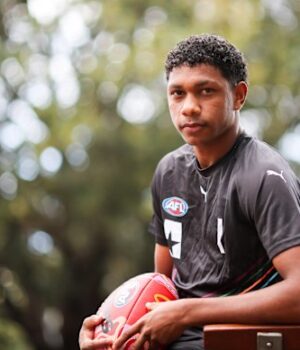
Should Sonny Smiler’s name be called out in either the national or rookie drafts this November, the teenager will be the first member of the Gurindji people, and the first footballer from the Northern Territory community of Kalkarindji, to make it to the AFL.
Smiler, though, cannot lay claim to being the most recognised, or venerated of the Gurindji, or of his own family.
In 1966, his great-grandfather, Vincent Lingiari, instigated what would become known as the Wave Hill walk off, when Lingiari took on the owner of the Wave Hill property, Lord Vestey, setting off a chain of events that culminated in the Whitlam government’s historic awarding of land to the Gurindji.
Gough Whitlam’s gesture of pouring soil through Lingiari’s hands in August 1975 would become possibly the most-celebrated moment for the lands rights movement – known to millions through Paul Kelly and Kev Carmody’s anthem (performed at Whitlam’s funeral and often sung by Kelly’s musical compatriots), From Little Things Big Things Grow.
Smiler is being watched by AFL clubs this Sunday, as a member of the Allies team playing against South Australia in the national under-18 championships in Adelaide.
AFLNT is optimistic that Smiler will be drafted, in what his parents Sonny Smiler (snr) and Sophia Donnelly-Patterson say would be a great moment for Kalkarindji, where he has grown up, not far from the Wave Hill property where Sonny’s father was born.
“He started when he was only two or three years old,” said Sonny’s mother, Donnelly-Patterson, whose background is Warlpiri, and is a relative of that people’s famed football personage, the prodigiously gifted ex-Melbourne forward Liam Jurrah. “He wouldn’t let go of footballs,” she said.
Smiler is less than 180 centimetres tall (listed as 176, but seems taller in the flesh), and, as with many Territory prospects, is slender in build. “I don’t think he’s done weights yet,” said his father, who is taller than 190cm, according to Patrick Bowden (the ex-Bulldog and Tiger), one of Sonny’s mentors. Sonny’s parents reckon he’s still growing upwards.
But his skill is excellent – as I saw when watching the NT under-18 team play the far-more drilled and stronger-bodied Western Jets last month; once, Smiler launched from the edge of the 50-metre arc on his preferred left boot for a goal; it was his quality, rather than quantity, that impressed.
From talking to his parents and Bowden, one of the distinguished Richmond clan who reside in the NT, Smiler would appear to have three factors in his favour as a prospective draftee.
One is his diligence. “He trains every day,” said his father, who calls the son “Junior” (Mum refers to him as Sonny). Every week, as his father explained, Sonny runs home from his training venue, eight kilometres away. “Sophie follows him in a car all the way back,” said dad. “He never stops.”
And while Smiler hasn’t had the benefits of weights training as yet, his capacity to run long distances is evident in his three victories in the NT’s All-Schools cross country championships. AFL club recruiters sometimes stamp a kid’s passport in the negative on the grounds that, “He can’t run.”
Increasingly, NT youngsters found it difficult to gain the nod from AFL clubs, irrespective of their talents, if they are not based in Darwin, where the under-18 representative team and much of the coaching and administrative resources are centred; some who’ve made it in the AFL have been sent to boarding schools in Victoria in their mid-teens.
Smiler is boarding at Haileybury College’s Darwin campus, several hours’ drive from Kalkarindji.
The AFL and NT officials are well aware of the challenges that face many talented Indigenous teenage football prospects, not least that of moving to major cities and to the relentless rigours of AFL clubs, who had major cutbacks in football spending during COVID that Richmond and other parties argued would be detrimental to the Indigenous young footballers and their cultural needs.
Smiler, however, has the advantage, as his parents noted, of having spent two years in Melbourne from the age of 12, when he went to the Melbourne Indigenous Transition School in Richmond (based then at Richmond’s Punt Road, to return in 2027 in the redeveloped William Cooper Centre), and then attended Brighton Grammar.
Should he land in Melbourne – or any capital city – he won’t find it difficult to adjust. “He’s used to how the city works” said his father. “He can live like a local.”
Bowden, who mentored Smiler as part of the Clontarf program for Indigenous youngsters (which uses sport to help in completing secondary school), is confident that Sonny has the traits – running, skill and dedication – that the clubs crave. “His endurance is well above anyone of his age [in NT pathways].”
Smiler did not gain a mountain of possessions for the Allies last week against Vic Country, when GWS academy product Ethan Matthews pushed his claim for the top 10 in the draft.
Smiler, who turns 18 in October and is finishing year 12 (he barracks for Collingwood), is well aware of his great-grandfather’s legacy. One of the NT’s federal seats is named Lingiari in honour of the Gurindji leader.
In 2020, Sonny snr and his sisters wrote to then prime minister Scott Morrison requesting that the electorate of Lingiari be preserved, when there was the possibility of an electoral redistribution wiping it off the electoral map (it has remained). His sister Rosie co-wrote an account of the Wave Hill walk off with Indigenous leader and union official Thomas Mayo.
“He’s aware his great-grandfather was a leader of the walk off,” said Sonny snr, who was born in 1975, the year of Whitlam’s visit.
The NT folk know there are no guarantees in the national draft. But they – and Sonny Smiler’s people – are cognisant of what his landing in the AFL would represent, to have a representative in the competition. It might inspire others.
 Jake Niall is a Walkley award-winning sports journalist and chief AFL writer for The Age.Connect via X or email.