

SOURCE :- SIASAT NEWS
Monday, June 22, marked the 115th day of the US-Israel war on Iran, as a senior representative of Iran’s Supreme Leader warned that Iranians would not rest until US President Donald Trump was “drowned” in a “sea of anger”, even as Washington and Tehran reported progress in talks aimed at ending months of conflict.
Abdollah Haji Sadeghi, the Supreme Leader’s representative to the Islamic Revolutionary Guards Corps (IRGC), said Iran would never accept foreign domination and urged negotiators to remain cautious in dealings with the United States. According to Iran International, he described Washington as an enemy that Iran could neither trust nor befriend.
The comments came as both sides signalled advances following high-level negotiations in Switzerland that focused on sanctions relief, oil exports and broader efforts to end the conflict that began in late February.

Talks lay foundation for broader agreement
US Vice President JD Vance said recent negotiations had laid a “good foundation for a successful final deal” and represented an important first step towards a permanent settlement.
Speaking after talks with Iranian Parliament Speaker Mohammad Bagher Qalibaf, Vance said Iran had agreed to allow inspectors from the International Atomic Energy Agency (IAEA) back into the country, calling it a major milestone in addressing concerns over Tehran’s nuclear activities.
He also said any future release of Iranian assets would be structured to ensure the funds benefit the Iranian people rather than militant groups.

Iranian Foreign Ministry spokesperson Esmaeil Baghaei said the 18-hour discussions produced progress on sanctions relief, oil exports and the release of frozen Iranian assets.
According to Baghaei, issues relating to oil sales and export licences could soon move towards implementation. However, he stressed that formal nuclear negotiations had not yet begun and insisted that any commitments undertaken by Tehran must be matched by corresponding action from Washington.
Baghaei also said Iranian officials raised concerns during the talks over recent remarks by Trump, arguing that such statements were inconsistent with commitments to avoid threats while negotiations were underway. Despite reports of a temporary Iranian withdrawal, discussions continued through mediators behind closed doors.

US grants temporary sanctions relief
The US Treasury Department issued a 60-day general licence authorising the production, delivery and sale of Iranian-origin crude oil, petroleum and petrochemical products through August 21, 2026.
US Treasury Secretary Scott Bessent said the move followed progress in Switzerland, including Iranian commitments to maintain free transit through the Strait of Hormuz and permit IAEA inspectors into the country.
The measure temporarily eases restrictions on Iran’s energy sector and allows countries to continue purchasing Iranian oil during the licence period.
Strait of Hormuz remains central issue
The Strait of Hormuz remained a key focus of negotiations and market attention.
Iran announced new requirements for vessels transiting the strategic waterway, stating that ships would need insurance approved by Tehran. While the insurance is currently free, authorities indicated fees could be introduced in the future.
Despite the announcement, tanker traffic showed signs of recovery. Reuters reported that crude carriers and supertankers passed through the strait on Monday, while shipping data pointed to a gradual increase in commercial activity.
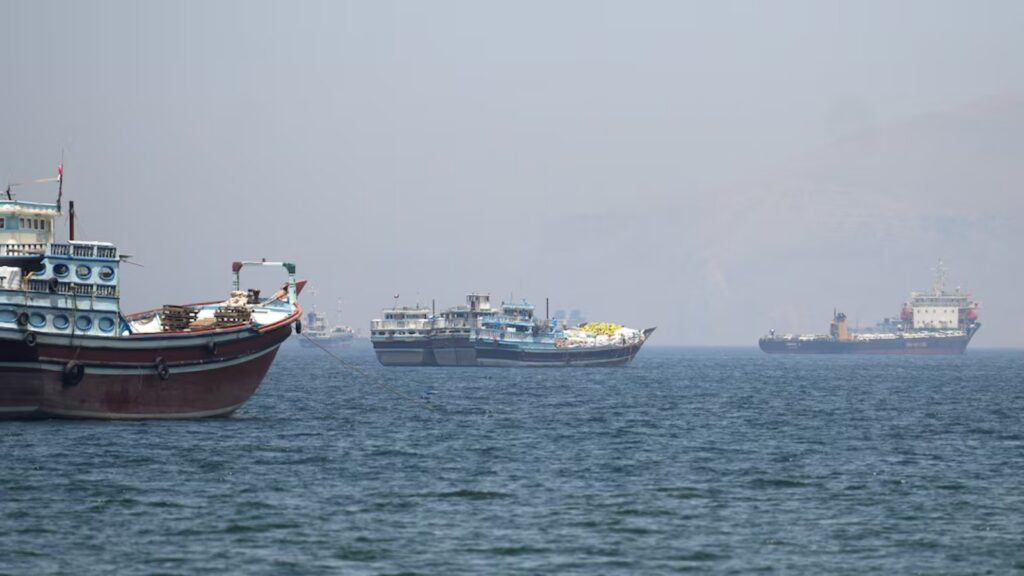
The Financial Times reported that more than 400 large vessels were waiting near ports on the eastern side of the strait in anticipation of broader reopening measures following progress in negotiations.
Oil prices fell after the Switzerland talks eased concerns over supply disruptions, while gold prices rebounded after three consecutive sessions of losses.
Regional diplomacy gathers pace
US Secretary of State Marco Rubio is expected to visit the United Arab Emirates, Kuwait and Bahrain this week to brief Gulf allies on the outcome of the negotiations. According to the US State Department, he will also meet representatives of the Gulf Cooperation Council.
In New Delhi, Indian National Security Adviser Ajit Doval met Ghadir Nezamipour, a senior member of Iran’s Supreme National Security Council, on the sidelines of a BRICS meeting. India’s Ministry of External Affairs said the discussions focused on developments in the Middle East and bilateral relations.
Pakistan Deputy Prime Minister Ishaq Dar welcomed what he described as substantial progress in the Switzerland talks.
Meanwhile, Iran’s chief negotiator arrived in Oman alongside Foreign Minister Abbas Araqchi, highlighting Muscat’s continuing role in facilitating dialogue between Tehran and Washington.
Iranian President Masoud Pezeshkian is expected to visit Pakistan following the latest round of negotiations, according to Al Arabiya.
Lebanon remains a flashpoint
Israeli Foreign Minister Gideon Saar said Israel would continue to uphold the ceasefire in Lebanon as long as Hezbollah complied with its commitments. However, he stressed that Israeli forces would remain in a security zone in southern Lebanon.
Prime Minister Benjamin Netanyahu later said Israeli troops retained full freedom of action against any direct or emerging threat and would remain in the area for as long as necessary.
Separately, The New York Times reported that Israeli field commanders had received revised instructions limiting military operations in Lebanon primarily to defensive actions unless authorised by senior commanders.
A joint assessment by the United Nations Development Programme and Lebanon’s National Council for Scientific Research estimated direct damage to buildings in southern Lebanon at approximately USD 1.38 billion.
The report said 11,095 buildings had been completely destroyed, affecting 17,891 housing units. Another 2,242 buildings suffered partial damage, while 9,311 sustained minor damage.
Lebanese Civil Defence teams recovered 13 bodies from rubble in southern Lebanon, while the Lebanese Health Ministry said the death toll from Israeli strikes since March had risen to at least 4,106.
Pope urges greater focus on hunger
Speaking at the headquarters of the World Food Programme in Rome, Pope Leo said governments were devoting more resources to conflicts than to combating hunger.
He called for stronger international support for food security programmes and urged countries not to allow geopolitical interests to hinder humanitarian assistance.

SOURCE : SIASAT