
Source : the age
Click here for live coverage of the 2026 state budget.
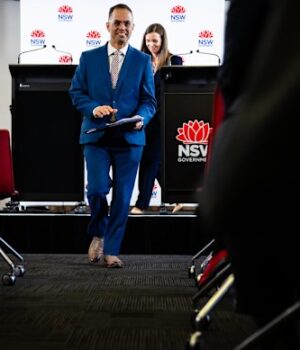
Daniel Mookhey’s fourth budget is a sign of confidence heading into the state election next year, and a subtle message to voters that NSW Labor is a different beast from its counterparts across the country.
Compared with other states, such as Victoria, which spent more than $1 billion on cost-of-living measures, the $561.4 million cost-of-living package is limited. A $10 weekly cut to the toll cap, $100 discount on car rego fees and a cap on Opal charges, while welcome, isn’t going to make heads spin.
That’s sort of the point. Labor knew it had to provide support for voters after the triple threat impact of an oil price shock, consecutive interest rate increases and inflation.
But they believe their strongest card to play leading into next year is a reputation for sound financial management.
So they will welcome comparisons with states such as Victoria. In fact, within the budget were charts comparing expenditure growth in NSW to all other jurisdictions. They show NSW’s average spending growth of 3.6 per cent between 2023 and 2026 is far, far lower than across the country (though it has also risen considerably from 1.8 per cent in 2024-25, to 5.4 per cent this financial year).
That conservatism inevitably leads to charges the government isn’t doing enough, however. Beyond a welcome record investment in domestic violence, there was not a huge amount of other major new policies or funding announcements on Tuesday.
Housing, long the key pillar of this government’s reform agenda, was strangely peripheral.
Committee for Sydney chief executive Eamon Waterford said the budget was “short on the hope” that Sydney needs.
But the fact the government did not feel the need to swing for the fences shows they believe they are in good shape heading into next March.
And spending restraint – coupled with a projected $5.6 billion increase in GST money, the performance of the government’s investment umbrella OneFund and some rosy budget forecasting – is what has allowed NSW to hang onto its forecast budget surplus in 2027-28 (though even Mookhey concedes “lots of things need to go right” to get there).
While some might accuse the government of not doing enough on cost of living, for example, most people won’t go to the polls in March consciously thinking about what the government did or didn’t do in a budget delivered nine months earlier.
Vibes matter, though, and positioning themselves as the sensible and sober counterweight to those communists in Canberra might well be a smart play.
Politicians in Macquarie Street are only too aware that the public sentiment around whatever is happening at a federal level inevitably spills over to state politics, so differentiating themselves from federal Labor is crucial if NSW Labor wants to avoid the brickbats which polls indicate could be coming for Anthony Albanese’s show.
There is a caveat to this, however.
While the government has pitched this budget around its economic credentials, the truth is a lot of it is defined by what we don’t actually yet know. Within the budget is a $1.1 billion appropriation fund the government can use for costs that have yet to emerge.
Mookhey namechecked a potential bailout for the Tomago aluminium smelter, a gun buyback and shark mitigation strategies as examples of where the funds could be spent, but it is also a fund the government can use for election sweeteners it has yet to announce.
In any case, whether pitching yourself as the sensible economic stewards at a time of rising populism is a smart play is an open question. Whether we’re still talking about Labor’s steady financial stewardship this time next year depends largely on how voters answer it.
Start the day with a summary of the day’s most important and interesting stories, analysis and insights. Sign up for our Morning Edition newsletter.