
Source : THE AGE NEWS
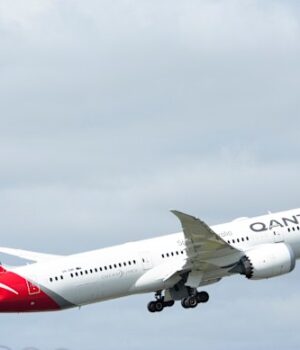
A Qantas flight from London to Perth has been forced to make an unexpected landing in a West Australian mining town after running into headwinds without enough fuel to complete its planned journey in one go.
The 17-hour flight, QF10, was scheduled to land at Perth Airport at midday today, but instead diverted to Karratha Airport, about 1500 kilometres north in the Pilbara region.
The 787 Dreamliner was forced to refuel after weather conditions changed en route, a somewhat rare situation that occurs occasionally on long-haul flights.
The surprise landing comes days after Qantas revealed the timing of its ambitious ultra-long-haul Project Sunrise flights, which will connect Sydney to London on flights that can last 22 hours non-stop. It shows how weather could confront the new service.
The Boeing 787-9 Dreamliner needed more fuel to complete the final two hours of its journey after weather conditions during the flight forced the crew to adjust the flight path, Qantas said.
The aircraft spent about one hour on the ground before continuing on to Perth.
Karratha Airport, mostly used to service the region’s fly-in, fly-out mining workforce, was approved to accept larger aircraft only last month.
The location, based in the town that is home to about 25,000 people, became a designated restricted use international airport and alternative international airport.
The Perth-bound plane departed London Heathrow at 12.28pm British Standard Time and landed in Karratha some 16 hours and 23 minutes later at 11.51am on Tuesday, local time.
It departed Karratha at 12.58pm, local time, and arrived at 2.36pm local time (4.36pm AEST).
Melbourne’s Swinburne University aviation lecturer Salim Hijazeen said that for routes over the ocean that are hours away from an airport, a plane’s flight plan explicitly details the nearest available diversion airfields for every specific point in time.
“Pilots constantly run fuel calculations in flight to ensure their actual fuel burn matches the pre-flight projections,” he said.
Planes typically optimise their fuel supply to ensure they have the capacity for the duration of the flight, as well as the scope for diversions or delays.
Hijazeen said pilots make decision about diversions quite early in a flight, looking at whether the aircraft can physically land at that airport and weather conditions. They’re helped by air traffic control as well, he said.
“Essentially, they know exactly where to go if anything happens. It’s not a last-minute change where they are frantically looking for an airport; they already know which airport they would divert to.”
The Perth-London has route has helped demonstrate the appetite for long-haul direct connections between Australia and the UK. The 17-hour duration is seen as a step on the way to Qantas’ Project Sunrise flights which will connect Sydney to London on a 22-hour route.
Qantas said it will begin flying Sydney-London direct flights from 2027 aboard a modified Airbus A350-1000ULR (for ultra-long range).
The 18,000-kilometre range of the A350-1000 ULR means that depending on winds and airspace limitations, the plane can fly east or west from Australia to arrive in London.
The London-Sydney Project Sunrise flight is expected to take between 18 and 20 hours, while Sydney to London would take about 19 hours 25 minutes at the fastest to about 21 hours at the longest.
The routes can vary widely from day to day, meaning the plane could approach London from the north after transiting the North Pole.
The Business Briefing newsletter delivers major stories, exclusive coverage and expert opinion. Sign up to get it every weekday morning.
 Chris Zappone is a senior reporter covering aviation and business. He is former digital foreign editor.Connect via X, Facebook or email.