

Source : the age
I am a Millennial, and currently my generation is being heavily wooed with pop-culture nostalgia. I especially feel the sentimental bullseye via my algorithm, where I’m constantly getting “throwback” content.
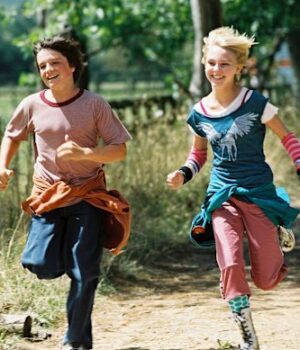
One that recently crossed my screen was a sad TikTok fan-edit tribute to the 2007 movie, Bridge to Terabithia, based on the 1977 novel by Katherine Paterson, and focused heavily on the foreshadowing and grief over the death of one of the main characters. Paterson wrote the book to help her son cope with the death of his childhood friend, who was struck and killed by lightning when she was just nine years old.
The comments about the film were mostly focused on one question: “How was this OK to watch as a kid?!”
You’ll see such remarks and accusations of “emotional trauma!” on many of these videos that dig into sad moments from Millennial pop culture – from Vada’s cries of “He can’t see without his glasses!” (spoken at the funeral of her best friend) in My Girl (1991), to Littlefoot pleading with his dying mother to “Please get up!” in The Land Before Time (1988). But after one person in the Terabithia discussion bellowed about “The TRAUMA we all collectively share from this ‘kids’ movie”, I finally snapped.
“Hey, hey you,” I replied. “This movie gave you empathy. In little and big ways. You were able to mourn for a fictional character, and that’s helped you care about people you’ll never meet experiencing tragedies you may never live through yourself, on the other side of the world or right there in your community – if this story hurt you and made you care, that’s a beautiful gift.
“I am an author who writes sad kid’s books, and I maintain that children are a lot stronger than we give them credit for, and their inner universes so much more complex than we acknowledge. I never try to make my readers upset, I just hope they care enough to feel empathy for the characters I’m giving them.”
I got more than 3000 likes on that comment, and if I could add more, it’d be this: every story is teaching you emotional literacy. This has been scientifically proven. In 2013, psychologists David Comer Kidd and Emanuele Castano, at the New School for Social Research in New York, conducted an experiment into the “mind-reading skills” provided by reading. They found that reading literary fiction, in particular, enhanced participants’ ability to detect and understand other people’s emotions. In other words, reading books improves empathy; caring for fictional characters in the abstract leads to more compassion in the real world.
As a child with big emotions, I yearned for tales that would validate and mirror my own sensitivities, from All Dogs Go to Heaven, to the writing of Margaret Wild and Melina Marchetta. Unsurprisingly, when I became a children’s author, I was still preoccupied with mapping big emotions in young people.
I once had an opportunity to ask one of my favourite Australian children’s authors – Morris Gleitzman – how he managed to write such poignant and important books. Specifically, how there was such sadness amid the humour and adventure in his books, and a devastating loss at the heart of his bestselling Once, the story of a 10-year-old boy surviving the Holocaust. “If it’s in the world, it’s for them,” he said. Simple as that.
This has become my mantra. It’s my first question when ruminating on an idea – like the one for my new book, Shakespeare in the Orchard, aimed at readers aged 10 to 13. The book is set during World War I, and is inspired by the true events of Australia’s home-front war that unfolded in my hometown of Langwarrin. In 1914, the Australian government suspended habeas corpus for the first (but not the last) time, and imprisoned “enemy aliens” of German and Austro-Hungarian descent.
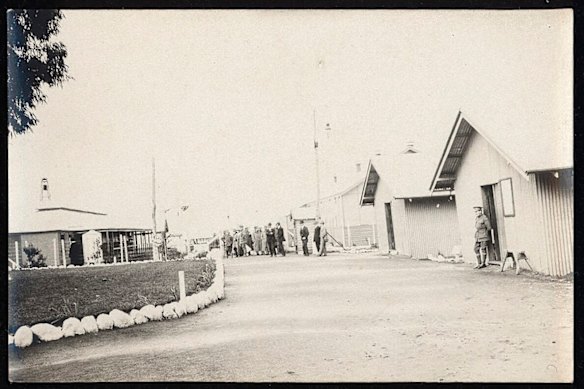
I chose to tell the story from the point of view of a 14-year-old boy named Jack, a military cadet whose brother has joined the war effort and who is being fed a jingoistic form of hyper-nationalism, right when the military reserve across the way from his family’s apple orchard opens its doors to German prisoners.
It’s a true but shameful tale of Australia’s war history; a moment when our government arguably did the wrong thing, for the right reasons. The book also tells the true story of how those German prisoners staved off boredom and retained their humanity in the face of such adversity: with theatre. When Jack overhears the prisoners practising Hamlet, he’s shocked and horrified by their humanity – and his curious response to it.
If it’s real and really happens – from prisoners of war to genocide, and children dying – then it’s a narrative that can exist in their books. Not for trauma and cruelty, but emotional literacy. To show them the real world, in all its complexity, in the hope that they might understand it better and be better prepared.
Shakespeare in the Orchard is published by Lothian Children’s Books on July 7, $17.99. Danielle Binks launches the book with Karen Comer at Readings Carlton on July 4.
Get a weekly wrap of views that will challenge, champion and inform your own. Sign up for our Opinion newsletter.