
Source : ABC NEWS
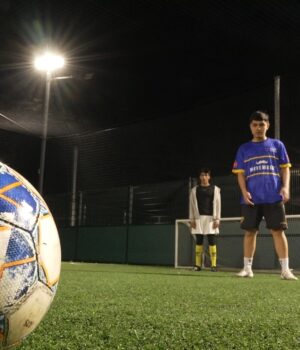
It is a crisp winter’s evening at Fairfield in Western Sydney, but a common passion is warming those braving the night air.
Ahmad Hakimi is in his element: a ball at his feet, surrounded by new friends.
“I love everything about football. It’s a part of my life. It helped me a lot, and that’s why I’ve got a lot of friends, because of football and futsal,” he says.

Ahmad Hakimi says he has made friends through football. (ABC News: Scott Preston)
The 22-year-old came to Australia almost two years ago.
“The Taliban were in Afghanistan, so we decided to go to Pakistan, and we came from Pakistan,” he says.
He made the journey with his mother, two brothers and his sister. His father had settled in Australia in 2011.
Ahmad hopes his fiancée, who is still in Afghanistan, will one day be able to join him.
“I miss her a lot, too much,” he says.
“I put [in an] application for her.”
The program is run by not-for-profit organisation Reclink Australia. (ABC News: Scott Preston)
Ahmad is working as an electrician. Asked what he loves most about Australia, he says: “The nature, the society, everything, the culture, the opportunities, everything about it.”
On a Tuesday night, he takes part in a FIFA Foundation program run by not-for-profit organisation Reclink Australia.
“In essence, it’s looking to support refugees, newly arrived migrants to Australia, [to] support them not just in terms of providing a sport that they love and they flourish in, but also supporting their settlement journey,” says Jarrod Galbraith-Marten, Reclink’s senior sports coordinator.
“Reclink Australia is the only organisation in Oceania, not just Australia, that’s directly funded by the FIFA Foundation,” he says.
The program is funded for two years and removes the cost barrier that often prevents many new arrivals from participating in sport.
Roman Abasy experienced that challenge firsthand.
“I tried to do some sport activity, and when I checked the venues, it was so expensive for me, and also the … the sport equipment [was] so expensive,” he says.
Roman Abasy says the cost of taking part in sport and buying equipment is high. (ABC News: Scott Preston)
The 33-year-old refugee advocate was a professional athlete in Afghanistan.
He came to Australia as a refugee almost four years ago and recently joined the Reclink program as a facilitator.
He says the benefits for new arrivals participating in the program span far beyond physical activity.
“When the refugees, they came to Australia, they were dealing with social isolation, with mental problems, with lots of issues, and the only way that we can support them is through sport and recreation,” he says.
The majority of participants in the FIFA Foundation program are referred by Settlement Services International (SSI).
Anastasiia Kachurovska is SSI’s youth engagement coordinator.
“Most of our clients and most of our children are coming from Afghanistan, from Iraq, from Iran, from Congo, from Eritrea, Myanmar,” she says, explaining that citizens in these countries face complex political and humanitarian challenges.
“Their background is indeed challenging, and when they’re coming here, very often they say it is a time of new hope.”
About 80 people are enrolled in the program. (ABC News: Scott Preston)
She says for the children involved in the football program, “it is a time for them to reclaim their childhood and reclaim their youth and reclaim their joy”.
About 80 participants are enrolled in the program, and many are learning English for the first time. But on the pitch, there is a universal language.
“Football, I like football,” one participant says.
“In football, it’s like everyone unites; you don’t need to know the language,” Sarah Skandari says.
“You just say ‘ball, ball, pass’. It’s very simple. And I guess we just connect in that way.”
Sarah’s family came to Australia in 2004. She was born a year later.
Sarah Skandari (right) says she is making a difference in people’s lives through the FIFA Foundation program. (ABC News: Scott Preston)
The 20-year-old connected with Reclink’s FIFA Foundation program and has become a leader among the group.
“It makes me feel like I can make a difference in those people’s lives,” she says.
When they’re not on the pitch themselves, the participants have their eyes on football’s most coveted prize: the World Cup.
- Check out the full World Cup schedule here in Australian times
- ABC Sport podcast: Check out the latest episode here
Ahmad says his favourite team is Australia.
“I’m here, and I’m going to support them,” Ahmad says.
He also follows Afghanistan’s national team, but it didn’t qualify for the tournament.
“The other team would be Argentina,” he says, acknowledging Lionel Messi, who this week made history as the World Cup’s all-time leading goalscorer.
Ahmad sees Australia as a land of opportunity and says watching former refugees, such as Nestory Irankunda, Awer Mabil and Mohamed Touré, line up for the Socceroos is proof that new arrivals can dream big.
“It depends on your goal … you can do whatever you want, you can be whatever you want.”