

source : the age
Thousands of beanie-clad citizen scientists will take to cliffs, capes and bluffs on Sunday to join in the annual whale census, a pursuit that has helped reveal humpbacks as one of the world’s best conservation comeback stories.
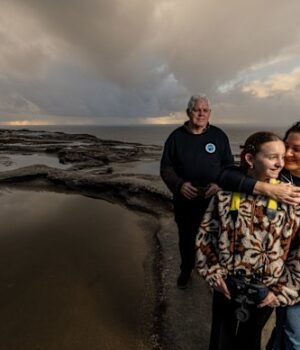
Jessica Fox and her family make up three generations of whale-watching pros who will line up on Cape Solander near Kurnell to count the passing giants.
“My dad, Greg Fox, his heritage is Maori. His family, and my ancestors, used to actually be part of whaling in the 1800s. For Dad, it’s a way of making that right,” she said of the census.
Fox is now a committee member of the Organisation for the Rescue and Research of Cetaceans in Australia (ORRCA), which runs the census. She and her father are trained to spot and report whale entanglements in nets and fishing gear, a growing problem.
“Whales and the environment have always been something that’s really close to us culturally, and we’ve always had this magnetism to the ocean,” Jessica said.
She has seen the pull of the whales come through in her children Lockie, 14, and Eloise, 12, too: “My children’s ability to be able to see wildlife in the ocean is incredible.”
The Fox family’s story exemplifies the exceptional turnaround of humpbacks on the Australian east coast.
Estimates hold that their numbers were reduced to as few as 100 to 200 by whaling, until the International Whaling Commission called off the humpback hunt in the southern hemisphere in 1963.
More than half of Southern Ocean whale populations had been taken in just two seasons via illegal industrial whaling by the Soviet Union: more than 25,000 were butchered for oil in the seasons of 1959-60 and 1960-61.
But, given the chance, humpbacks in particular have roared back from the brink. Scientific papers have used data from the whale census and other citizen science counts to estimate the population has recovered by about 10 per cent year-on-year. They also make new discoveries about where they strand and give birth.
Now, each winter, at least 50,000 humpbacks migrate up the coast from Antarctic krill feeding grounds to the warm water nurseries surrounding the Great Barrier Reef to breed and give birth.
“Years ago when we first started, we would be so excited if we saw 30 whales in a day. And now we see that in an hour,” Jessica said.
On Sunday, Fox will arrive at Cape Solander before dawn, swathed in a blanket, jumper and a beanie and armed with a hot thermos, berries and coconut chocolate to combat “whale fatigue”. There are so many now that counting them becomes taxing.
Luckily, hundreds of people show up each year to help, and count each whale that passes a distinctive wave-detecting buoy out from Botany Bay.
“Last year we saw over 300 whales in the day,” Fox said.
Not all whales have recovered as spectacularly as the humpbacks. Fox and her family will keep keen eyes out for southern right whales, which are bigger than humpbacks and sport unique white markings on their heads called “callosities” that can identify individuals.
The species’ recovery from whaling has stalled and they are considered endangered in Australian waters, possibly because climate change has warped their Antarctic habitats and because of a crash in krill populations due to retreating sea ice.
Fox has seen endangered blue whales just once, off Bondi. “We are due a blue whale sighting,” she said for this year.
Data gathered by volunteers is critical because there was little funding for whale research, said Griffith University whale scientist Dr Olaf Meynecke.
“It’s all run basically by NGOs and citizens who are willing to go out and spend their time and money to observe whales and compile all this data that otherwise simply wouldn’t exist,” Dr Meynecke said
As for the human impact, Fox said being surrounded by like-minded people during the count nourished her mental health. “It feels great to be able to contribute to something that’s bigger than us.”
The Examine newsletter explains and analyses science with a rigorous focus on the evidence. Sign up to get it each week.
 Angus Dalton is the science reporter for The Sydney Morning Herald.Connect via X or email.