

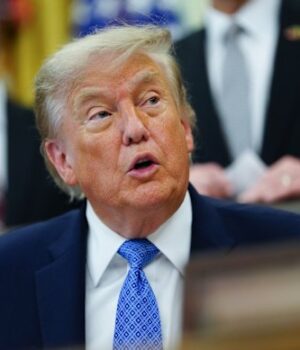
Source : THE AGE NEWS
No sooner had the ink dried on the European Union’s reluctant signing of the trade deal it agreed with the US last year than Donald Trump threatened to tear up that deal and impose 100 per cent tariffs on the EU’s exports to the US.
The belated signing of the deal struck at Trump’s Turnberry golf course in Scotland last July occurred on Thursday last week, after the EU’s assent to it was repeatedly delayed by Trump’s threats to take over Greenland.
On Friday, in a post on his Truth Social platform, Trump made his threat of a new trade assault on Europe.
“Numerous European Countries have been discussing the imminent implementation of a Digital Services Tax on American Companies,” he wrote.
“Some of these Countries are close to actually doing this. Please let this statement serve to represent that any Country that imposes such a Tax will immediately be met with a 100 TARIFF on any and all Goods sent to the United States of America. This TARIFF will supersede Trade Deals made with the Country, whether implemented, signed, or not. Additionally, the 100 per cent TARIFF will be immediately imposed, if they proceed. Thank you for your attention to this matter. President Donald J. Trump.”
Earlier this month Trump threatened to put a 100 per cent tariff on French wines as retaliation for France’s 3 per cent digital services tax, although he hasn’t yet done so.
Now he’s saying he will impose a 100 per cent tax on all the exports to the US of any EU state that has, or plans, a digital services tax, which would effectively close the US market to their goods.
The EU responded to Trump’s threat by describing digital services taxes as “non-discriminatory” and that “unilateral measures targeting such legitimate policies are unjustified.”
“If pursued, the EU will respond swiftly and decisively to defend its rights and regulatory autonomy,” it said.
When Trump first imposed tariffs on EU exports, the EU considered responding with tariffs of its own on imports from the US.
It also toyed with the idea of deploying its trade “bazooka” or its “anti-coercive instrument” that would broaden the conflict from a trade dispute to the entire economic relationship with the US.
In the end, seeking certainty for its companies and economies, the EU agreed to a deal tilted in America’s favour, with a 15 per cent tariff on most of its exports to the US, but a zero rate on US exports to the EU.
Now Trump is threatening a new trade war, one that could draw Australia into another round of his tariffs.
For nearly a decade and a half, the OECD countries have been wrestling with the implications for government taxes bases from the growth of the digital economy and the fact that the leading technology companies, predominantly American, shift their profits from the countries in which they are selling their services to tax havens or lower tax jurisdictions like Ireland.
No self-respecting sovereign nation is going to allow Trump to dictate, not just tax policy, but policies that shape and protect their society.
There has been a global effort, led by the OECD, to establish a global minimum tax rate for the big tech companies. In 2021, 140 countries, including the US, agreed a 15 per cent minimum rate that was expected to raise at least $US150 billion ($218 billion) a year of new tax revenues.
Trump, however, threatened a tax surcharge (dubbed the “revenge” tax) on the income of foreign companies and individuals, starting at 5 per cent but climbing to 20 per cent over time, if US companies were caught up in the new tax net. US companies were subsequently excluded from the proposed regime.
Impatient with the lack of real progress in implementing the global digital services tax, some countries – France, the UK, Portugal, Italy, Spain, Austria and Hungary among them – introduced their own tax, while others in Europe, including Germany, have been considering emulating them.
The taxes apply to the digital revenues generated by the biggest tech companies in the countries that impose them. The UK raised about £944 million ($1.8 billion) in the 12 months to April 6 (the UK financial year) from its tax.
The US argues that the taxes are discriminatory – even though they apply to all large companies selling digital services, regardless of their domicile – because big tech is dominated by US companies.
Trump it appears, will use Section 301 of the US Trade Act to implement his threat. Section 301 is the legal heading he used recently to announce tariffs ranging from 10 per cent to 12.5 per cent on every US trading partner, citing the inadequacy of their efforts to prevent imports made with forced labour or having “excess” manufacturing capacity and production.
He was forced to use the section, which involves time-consuming investigations and public hearings, after his previous attempt to create a universal tariff regime – his “Liberation Day” tariffs – was declared illegal by the US Supreme Court, which ordered the tariff revenue raised to be refunded to the US importers that had paid the duties.
Trump’s temporary replacement for the Liberation Day tariffs, a 10 per cent levy on imports based on a supposed balance of payments crisis that the US hasn’t been experiencing (and technically, with a floating exchange rate can’t experience) have also been ruled illegal within the lower courts.
The Section 301 tariffs will also probably be litigated, but are more robust. The section gives a president the authority to retaliate against foreign trade practices that are “unjustifiable,” “unreasonable” or “discriminatory” and that burden or restrict US commerce.
The EU, of course, would say that digital services taxes aren’t discriminatory – they don’t single out US companies – and don’t burden or restrict US commerce.
In the context of the scale of European economies, the revenue raised by those countries with a tax is quite modest. Moreover, like the tariffs, when faced with a tax on their revenue, the tendency for the companies being taxed is to raise the prices of their services – it’s European consumers, not the companies, that pay the bulk of the taxes.
A more efficient, and less provocative, way to capture the economy activity of the big tech companies is a value-added tax, which the Europeans have, as does Australia with the GST.
While the Trump administration has made noises about targeting valued-added taxes, the argument against taxes that are economy-wide is more complex and more difficult to make than one against a tax that is aimed at a relative handful of easily identified and mostly US companies.
The EU won’t succumb easily to the latest threat of tariffs because it threatens the economic sovereignty of its 27 member countries if Trump is allowed to dictate their tax policies.
It would also encourage the administration to target other policies, in the EU and elsewhere, like the EU’s Digital Markets and Digital Services Act, which regulate the behaviours of big tech companies, or Australia’s News Media Bargaining Code and social media age restrictions.
No self-respecting sovereign nation is going to allow Trump to dictate, not just tax policy, but policies that shape and protect their society.
If Trump presses ahead and restarts the trade war with the EU, it could – as China did when Trump threatened it with 145 per cent duty rates on its exports to the US – and counter with 100 per cent tariffs of its own, along with the non-tariff measures it could employ if it activates its anti-coercion instrument.
Yes, it would be mutually destructive, but US companies and consumers – and the US Federal Reserve Board – would be horrified at the prospect of such large-scale price hikes and supply chain disruptions. The EU’s key exports to the US are autos, pharmaceuticals and machinery.
Trump’s threat is, if the EU holds its nerve and defends its sovereignty, an empty one – a bluff, given the blowback it would cause for the US if Trump actually followed through with it, that the Europeans should call.
The Business Briefing newsletter delivers major stories, exclusive coverage and expert opinion. Sign up to get it every weekday morning.


