

Source :- THE AGE NEWS
Berkeley: Anyone looking at the scarce football history between Australia and Egypt before their knockout World Cup clash will want to treat their last meeting with extreme caution.
Ahead of their round of 32 match at Dallas Stadium on July 4 (AEST), the Socceroos and the Pharaohs have played only twice before, once in South Korea in 1987 and most recently at Cairo International Stadium in November 2010. There are questions about whether that latest game should count at all.
The friendly was arranged as Football Federation Australia’s billionaire backer Frank Lowy was crisscrossing the globe, using international friendlies to shore up support from voting nations, including Egypt and the African bloc, for Australia’s ill-fated 2022 World Cup bid. Coincidentally, the Socceroos had faced Paraguay, their previous 2026 World Cup opponents, two months prior for the same reason.
On the pitch, the Holger Osieck-coached Australians turned in an unremarkable performance as they were thrashed 3-0 by the Pharaohs. But four years later, allegations emerged that the game had been bought and paid for before it had kicked off.
In his 2014 memoir Kelong Kings, convicted match-fixer Wilson Raj Perumal detailed exactly how his network of crooks had allegedly successfully rigged the Cairo clash to guarantee three goals would be scored.
“The game went according to plan,” Perumal, a Singaporean national, wrote. “The Bulgarian ref awarded a single penalty in the final minutes of Egypt vs Australia, which ended 3-0 in favour of the Pharaohs.”
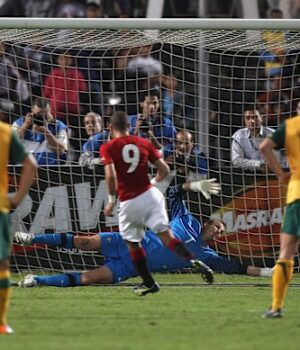
Former Socceroo Luke Wilkshire played that game and recalls Egypt’s third goal – a 90th-minute penalty awarded against Australia’s captain Lucas Neill – was particularly contentious. Neill appears to hardly come into contact with the Egyptian attacker as the spot kick is awarded. Fox Sports commentator Simon Hill said he’d “seen more push and shove in the playground” during the broadcast as it was awarded.
“I remember obviously the penalty. It was soft. Back then, you just had to brush it off and get on with things,” Wilkshire said. “It’s more so when you look back at it that you question some decisions. But obviously in modern-day football, those sorts of things wouldn’t happen now.
“I had no idea. Maybe we were blind … you just don’t want to think that anything like that could happen, or should happen in the sport. I definitely wasn’t aware of it. But the game itself, I just remember that it was a tough contest. It was a tough place to go, but definitely wasn’t one of our best games.
When it comes to soccer match-fixing, Perumal was one of the biggest fish caught. He estimates he fixed between 80 and 100 matches worldwide, says he occasionally gave instructions from the coach’s bench, and he pocketed $US5 million in the process, only to lose it all gambling.
His attempts at fixing a soccer game had an 80 per cent success rate, he claimed.
Perumal claimed that at the height of his match fixing powers, he sent an associate to Cairo in 2010 to negotiate a deal with the Egyptian Football Association to install compromised referees in games.
While most of their suggestions were rejected, one got through: Bulgarian referee Anton Genov was appointed to officiate November’s international friendly against Australia.
Genov’s selection was brazen. Less than a year earlier, he had been investigated by UEFA over his handling of a December 2009 friendly in Skopje involving Macedonia and Canada. Betting syndicates had flagged concerns when there was a plunge on bets predicting at least three goals and a high number of penalties. Officials’ suspicions grew when Genov awarded four second-half penalties in Macedonia’s 3-0 win.
Perumal denied involvement in that fix, but claimed the architects of it were furious with Genov’s lack of subtlety.
“Why the f–k did you give away so many penalties?” Perumal writes that they allegedly asked the referee. “If the player misses, just say that the goalkeeper moved before the kick and retake the penalty.”
Initially suspended by UEFA but ultimately cleared of wrongdoing, Genov was again allowed to officiate. However, Perumal’s syndicate gave him strict instructions to be more inconspicuous during the Egypt and Australia clash.
“Anton,” he was warned, “You just came back from your suspension, so don’t do anything funny. Just wait for the right time.”
All seemed in place until there was almost a last-minute hiccup when an Egyptian football official complained about Genov’s appearance: “This guy looks a little too fat.”
“We insisted, and finally Anton was designated to officiate the match,” Perumal wrote.
“The game went according to plan. The Bulgarian ref awarded a single penalty in the final minutes of Egypt vs Australia, which ended 3-0 in favour of the Pharaohs.”
Perumal said the syndicate wagered upwards of $US1 million on the match, netting him a $US200,000 cut. But he also pocketed hundreds of thousands more by placing his own side bets.
“I had shared the information on Egypt’s match with a friend, telling him to throw 500 thousand dollars on it for me.
“‘Are you very sure?’ my friend asked. ’500,000’”
“‘Yes, don’t worry,’ I reassured him. ‘The final whistle will not come before three goals are scored.’”
When Permual’s allegations became public, Australia’s goalkeeper in that game, Mark Schwarzer, told the ABC that the game’s governing body had to examine what had gone on.
“I think there should be an investigation from the top. FIFA should investigate it,” he told ABC’s 730.
Twelve years on, Permual has turned informant and is helping authorities uncover those attempting to fix matches. And until Dallas, the match still remains in the history books as the last meeting between Egypt and the Socceroos.
Get across our World Cup coverage
 Nick Ralston is the deputy editor and investigations editor for The Sydney Morning Herald. He has previously spent time as news editor, justice editor and world editor.Connect via X or email.