

source : the age
Examine, a free weekly newsletter covering science with a sceptical, evidence-based eye, is sent every Tuesday. You’re reading an excerpt – sign up to get the whole newsletter in your inbox.
Something is very wrong with our understanding of the universe.
In 2011, Australian astrophysicist Professor Brian Schmidt co-won the Nobel Prize in physics for discovering that the universe is expanding at an accelerating rate.
It was a finding that held weight for every other observation we make about the vast expanse of the cosmos – a wilderness of galaxies, supernovae and colossal gas clouds that has always captured the imagination of Earthlings.
But two camps of scientists are brawling (or at least politely publishing opposing papers) over something crucial: the rate of that expansion, known as the Hubble constant.
There are two evidence-backed estimates, but they don’t agree. This disarray is called the Hubble tension. Some have started calling it the Hubble crisis.
“It’s incredibly important. It tells us the true age of the universe,” says CSIRO astronomer Dr Kelly Gourdji of the Hubble constant. “It tells us the true distance to objects – galaxies and what have you – in the universe. And it also tells us their true size.
“So having an incorrect or imprecise value of the Hubble constant is kind of like having all of our metre sticks on Earth off by a centimetre.”
Now Gourdji and her colleagues have used a super-rare cataclysmic collision and a colossal jet of light to help settle the debate. And they may have found a way to unpick the biggest crisis in astronomy.
Two opposing sides
There are two different ways scientists have tried to clock the rate of the universe’s expansion.
One method analyses cosmic background radiation, the leftover “echo” from the Big Bang which still murmurs across the entire universe.
This is called the “distant universe” method because it uses the earliest, most ancient light we can detect.
The other is the “nearby universe” method. It looks at phenomena including Cepheid variable stars (which “pulse” with brightness at a known rate) and supernovae explosions.
As these bright objects move away from Earth, the wavelength of the light they emit is stretched out – like an ambulance’s siren becoming longer and deeper as it moves away from you – and becomes more red.
This is called redshift, and measuring it helps astronomers determine how fast objects are moving away from each other as the universe expands.
The expansion rate is measured in kilometres per second per megaparsec (km/s/Mpc). A megaparsec is a cosmological unit of distance equal to about 3.26 million light years.
The distant universe method using the Big Bang’s echo has yielded an estimate of about 67-68km/s/Mpc.
The nearby universe method using stars and supernovae puts the rate at 72-74 km/s/Mpc.
“When we try and stitch the history of the universe together based on these two sets of observations, they don’t match up. It doesn’t make sense,” said Professor Adam Deller of the Swinburne University of Technology.
Perhaps one team has a mistake lurking in their calculations. Or, more intriguingly, there may be some undiscovered maxim of physics or dark energy at work that we need to find and factor in.
But a paper just published by Deller and Gourdji – both part of the ARC Centre of Excellence for Gravitational Wave Discovery, or OzGrav – in The Astrophysical Journal offers new hope the tension can be rectified.
The neutron star collision and a giant jet
It all came down to the smashing together of two neutron stars – the densest objects that exist, apart from black holes – in a galaxy 140 million light years away.
“It was so massive, this collision, that the ripples in spacetime fabric travelled all the way to us on Earth,” Gourdji says of the event called GW170817.
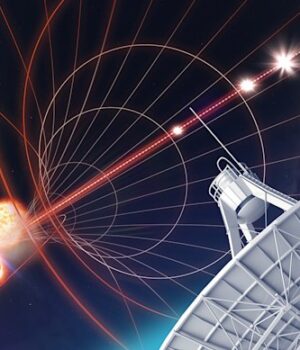
But that’s not all. From the explosion launched a violent jet of radiation rocketing at close to the speed of light. The jet itself only lasted two seconds, but its resulting glow was detectable by Earth’s telescopes for about a year.
For the first time, astrophysicists could analyse both gravitational waves and light from this rarely observed event.
That allowed them to estimate the Hubble constant in a new way.
“This particular merger we were very lucky with,” Gourdji says. “It’s not only the first binary neutron star collision that was detected via gravitational waves, but it stands to this day as the first and only one where its afterglow – the light that was emitted after this collision – was detected.
“That allows us to pinpoint precisely which galaxy the merger occurred in. And that’s one of the crucial ingredients required to directly make a measurement of the Hubble constant.”
Deller, meanwhile, pinpointed in unprecedented resolution the direction of the jet of light.
By combining data from three telescopes – including the famous Hubble telescope itself – they used the fiery event to calculate a new Hubble constant estimate: between 61-70km/s/Mpc.
That finding is exciting because it used a measurement similar in method to the “nearby universe” Hubble constant estimate, but achieved results closer to the “distant universe” method.
After decades of debate, we may have found ourselves a tie-breaker.
“The precision they’ve managed to get out of a single option is quite impressive,” says Schmidt, our Nobel Prize winner, who wasn’t involved in the study.
The new estimate is, however, four times less precise than other Hubble constant measures. Another neutron star collision is needed to sharpen up the estimate, but they are rarely detected.
Deller says they’ve been scanning the skies for another collision since GW170817 was observed in 2017, but “the universe has not played ball”.
Schmidt predicts we may spot between two and 10 collisions in coming years. The suspense!
Says Deller: “If we want to understand the origin and evolution of the universe – which is the biggest-picture question you can really ask, I think – then we need to resolve this.”
The Examine newsletter explains and analyses science with a rigorous focus on the evidence. Sign up to get it each week.
 Angus Dalton is the science reporter for The Sydney Morning Herald.Connect via X or email.