

source : the age
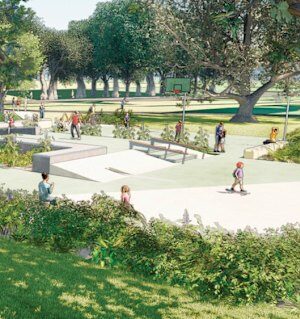
The 10-year-olds who first stood before Woollahra Council with petitions for a place to skate are now adults. The girls who might have learnt to shoot hoops will, by the time the facility opens this spring, have nothing but a childhood spent waiting. Thirteen years of planning, deferral and review have passed since the need for the Rushcutters Bay youth recreation area was first identified – long enough for an entire cohort to age out of the very space designed for them.
It is worth being precise about what the objection has been: the Darling Point Society’s president, Robert Pompei, argued in a submission opposing the youth area that it “destroys the historic open green space landscaping principle” of the park, and went further to “highly question the necessity of this facility”.
When the proposal surfaced, the then-member for Wentworth, Malcolm Turnbull, objected that “adding hard surfaces and concrete structures is not sympathetic to how the park is currently used”, raising noise concerns and noting that Bondi (an hour’s walk away) already had a skate park.
The opposition, in other words, rests on heritage, aesthetics and the comfort of established residents. That a strip of land amounting to just over 2 per cent of a 5.3-hectare park could absorb 13 years of objection on those grounds tells us something about whose preferences our planning processes are built to protect.
The dispute is being framed as a contest between heritage and concrete, between green space and youth amenity. This framing obscures the more consequential question: as we prepare for 10,000 new homes around the future Woollahra railway station, with towers of up to 21 storeys under consideration, the eastern suburbs are about to absorb a substantial increase in residential density. The real issue is what happens to communities when growing populations are denied multi-use, intergenerational infrastructure.
When density rises without a corresponding investment in shared, intergenerational public space, the people who feel the loss most acutely are those with the least private space and the fewest alternatives.
Apartment living concentrates households into smaller footprints, removing the backyards, garages and verandas that once absorbed everyday recreation. This is particularly damaging for young people aged between 10 and 20. This cohort is increasingly underserved by and actively excluded from Australian urban design.
They are too old for the fenced playgrounds calibrated for younger children, and too young, or too unwelcome, in the commercial and licensed venues built for adults.
The frameworks that produce child-friendly cities – and there are good ones – have no coherent extension into adolescence. When a community refuses to build for this age group, it displaces these young people into spaces where they are tolerated rather than invited, and where their presence is read as loitering rather than belonging.
There is a gendered dimension to this that the heritage debate entirely ignores. National data shows that girls’ physical activity declines sharply through adolescence, when they are far less likely than boys of the same age to meet recommended activity guidelines by their mid-teens.
Open, well-designed, multi-use recreation areas are one of the few public interventions shown to begin closing that gap. To frame such infrastructure as a 2 per cent intrusion on amenity, as one resident did, is to measure the wrong thing: how much lawn is lost instead of how much access is gained, and by whom.
The longer-term cost is a quiet erosion of community cohesion. Intergenerational infrastructure, the kind that places a junior skate park beside a basketball half-court and a netball ring, brings different ages into proximity and normalises the presence of teenagers in public life.
It also gives residents of a densifying suburb a reason to share space rather than retreat from it. Refusing it produces the opposite – a population that grows in number while shrinking in connection, where young people learn early that the public realm is not built with them in mind.
Mayor Sarah Dixson is correct that the need for recreation space for youth is acute, “now, more than ever”. The deeper lesson of Rushcutters Bay is that the decision to build, or not to build, for an expanding population is never neutral. Saying no is also a choice, and its costs are borne disproportionately by the young, by women and girls, and by the social fabric of communities asked to grow without growing together.
Dr Sanne Mestrom is an Australian Research Council fellow and research director at the Sydney College of the Arts, University of Sydney.
 Dr Sanne Mestrom is an academic at the Sydney College of the Arts

