

source : the age
The dress code was strictly black tie and elastic-sided boots for the barbecue beneath the stars on the red dirt outside Longreach, Queensland.
It was quite an occasion.
John Howard and his entire cabinet were meeting in the little old central-west Queensland town. It was May 1999, and such a thing had never happened before.
Howard, it happened, was celebrating his 25th anniversary as a politician, and he wasn’t about to let it be the last.
Unmatched in sniffing the political wind, he knew large sections of country Australia, angry at his government, were beginning to turn towards a woman named Pauline Hanson and her then two-year-old outfit, One Nation.
And so the prime minister flew to the outback to deliver the message that he was not only listening to rural Australia, but his cabinet was working on policies to help the bush.
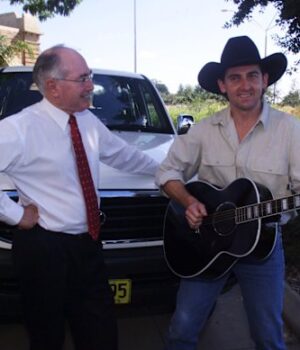
In celebration, Longreach threw an outdoor concert featuring country singer Lee Kernaghan. Howard and his wife, Janette, in evening wear appeared slightly perplexed at the crowd dancing in rum-fuelled abandon to the massively amplified strains of “We’re the boys from the bush, and we’re back in town / And we get high when the sun goes down”.
The outback outing also coincided with the 20th anniversary of the National Farmers’ Federation’s founding.
The NFF’s leadership headed to Longreach, too. Their offering was the black-tie dinner beneath the stars.
National Party bigwigs joined NFF worthies for Longreach-sized steaks before settling down for an address by a big-time barrister from Melbourne named Sir Murray Rivers, QC (retired).
It quickly became apparent no one in the audience knew anything of the dishevelled Sir Murray.
Everyone paid courteous attention as he launched into a long-winded introduction about how he and his drinking pal Bumsy from his club in Melbourne felt congratulations were in order for the work of the “rural wing of the Howard government, the National Farmers’ Federation”, in destroying the wharfies’ union the previous year.
In Sir Murray’s opinion, there ought to be more balaclavas and vicious German shepherds in politics.
Slowly, it began to dawn on guests that this barrister from Melbourne was taking the mickey. Nervous laughter and anxious whispering rippled until the truth dawned.
The wives of the politicians were soon bellowing their appreciation of Sir Murray’s deft knifing of their husbands’ side of politics, while the chaps in black ties and shiny R.M. Williams boots shifted self-consciously in their seats.
Sir Murray was the creation of satirist Bryan Dawe.
His Sir Murray was a pompous, whisky-infused defender of the rich, the entitled and the powerful, whose grandiloquence pricked the balloons of the self-important before they knew he was doing it.
Dawe and his long-time partner in parody, the late John Clarke (TV’s Clarke and Dawe), were unmatched for decades in the art of straight-faced Australian parody. They, like all satirists of worth, were subversives. Their job was not simply to get a laugh, but to disrobe the pretensions of their chosen subjects. Their short, deathless sketches are still popular on YouTube.
Norman Gunston, like Sir Murray Rivers, was another wonderfully fictitious character who sabotaged the mighty.
Created and performed by the actor Garry McDonald, Gunston satirised the cringe-making reporters of his time who were given to asking inane questions of celebrities.
Gunston took it to magnificently absurd lengths, presenting himself as a hopelessly inept reporter from Wollongong with a bad comb-over and toilet paper sticking to razor cuts on his face. He ambushed and questioned with toe-curling naivety the unsuspecting rich and famous.
Interviewing Mick Jagger in the US, Gunston told him he was a huge fan “since your time with The Beatles”.
In the UK, he managed to speak with Paul and Linda McCartney. Feigning mixing up Linda with John Lennon’s wife Yoko Ono, he blurted “you don’t look all that Japanese”.
He reduced American actor Sally Struthers to disbelieving, hysterical laughter, which she tried to control out of pity for the poor Australian fool with the microphone. Desperate to help Gunston out, she noted the toilet paper on his razor nicks and suggested he should use an electric shaver. “I do,” said Gunston, leaving Struthers so overcome she hid her face in her hands and could not speak.
Gunston was a consummately subversive character, masterfully dismantling Australia’s self-satisfied reputation wherever he went on the national and international stage. He became the first fictional character to win a gold Logie.
Paul Hogan’s early years as a performer, long before his famous cinematic send-up of a crocodile hunter and his move to the US, were those of a satirist happily undermining the culture of Australian boofheadedness.
His line-up included an ocker beer-swiller, Arthur Dunger, a hapless stuntman named Leo Wanker, beer-gutted policeman Sgt Donger, and George Fungus, a parody of the macho 60 Minutes journalist the late George Negus.
Hogan’s very entry to comedy was anarchic. Unimpressed with arrogant judges on television’s New Faces, the unknown Hogan turned the tables by presenting himself as a “tap-dancing knife thrower” quite unable to dance and who fumbled and dropped his throwing knives.
He refused to submit to the judges’ verdict, declared, “Oh, I don’t need that, I know I’m good”, and walked off to become an Australian legend specialising in drongos and galahs.
All these years later, Pauline Hanson, who has long become a caricature of herself, professes that Norman Gunston and Paul Hogan are “essentials” of a monocultural Australia.
Seriously.
It caused Hogan to lose his sense of humour. “She’s a pelican. Outrageous, so racist. It sounds very much like this stupid boofhead over here, Trump,” he told the Australian Financial Review.
Sadly, we’ll never see Norman Gunston interview Hanson. He’s gone back to where he came from, which is to say to Garry McDonald’s absurdist imagination.
Bryan Dawe declared long ago that it had become useless to try to satirise Australian politics because “politicians are doing it far better than John and I ever could”.
Turns out he was right.
 Tony Wright is an associate editor and special writer for The Age and The Sydney Morning Herald.Connect via email.

