

source : the age
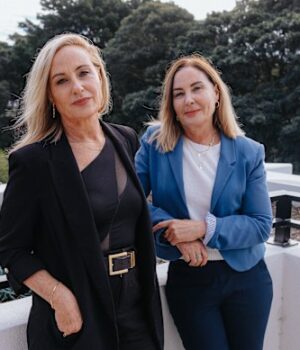
Identical twins Samantha Lee and Rebecca Wood, 54, survived a terrifying, violent childhood. Despite barely going to school until they were 14, they’ve both become lawyers. The trauma, though, has left its mark.
Rebecca: Sam and I grew up in a family on the run, living in cars and motels, in and out of children’s homes. Our father experienced severe psychotic episodes, drug-induced, and was a petty criminal; Mum had manic depression. Our brother, Carl, was a year older; our little sister was fostered out early on.
Our earliest memories are of extreme violence by our father, like being thrown against walls and knocked unconscious, or watching your sister’s head being slammed repeatedly into the kitchen sink. It sets up a particular sibling dynamic, with everyone trying to defend themselves. Our father would hurl one of us into a wall, then pick us up off the floor and say, “Tell your siblings you’re OK.” And, through terror and tears, you would.
When Sam and I were about six, the three of us were made state wards and put in a children’s home [Allambie Reception Centre in Victoria’s Burwood]. One day, my father kidnapped us, triggering a massive manhunt. We still remember the police finding us and smashing down the door. Later, incredibly, we were sent back to Dad.
He’d often go out first thing and not come back until 9 or 10pm, leaving us in some tiny motel room. You ended up hating each other: there was no escape, just the tension of who’d cop it when he came back. Then you’d have normal days where you’d all cook dinner together.
You’d think such a childhood would bring you closer, but with so much terror, the bond can fracture. Still, once, when we were living in Sydney with our mother and she was having a bad episode, she sent Sam and Carl off to Melbourne where our father was in prison. She kept me with her. Standing at the train station, I thought, “I’m never going to see Sam again.” I knew then there was a twins’ bond. Once it’s taken away, you realise you want to keep it. It’s all the love you know.
We’ve had to acknowledge how our childhood has stained our relationship: siblings are a reminder of the history. Our father always treated Sam as much older; I was always treated as the baby, as hopeless. I still feel as if Sam thinks she has one over me.
We’ve followed similar paths. We both care about social justice. Sam did social work and is now a lawyer at Redfern Legal Centre. I did a social-work degree and law, too – just to prove I could, I think. A bit of competitiveness there. Sam has a son and I have twin daughters. We recently both separated.
We do love each other – Sam is caring and very generous with her time – but we also push each other’s buttons. My filter tends to the negative, so I’m more likely to point out what she’s doing wrong than right, but she’s not really doing anything wrong! We were set up to fail in our relationship and we’re trying to repair the bond; our children have been like a seawall to all that violence. There was a beautiful moment when Sam gave birth to her son in 2009. The past faded away. We were just so present with each other, relying on and needing each other during that very intense time. I felt, “She is my blood; I am her sister.”
Samantha: As children, we were very much aware of Dad’s moods, and they could be brutal. There was a lot of violence, like Dad knocking out Mum’s front teeth, strapping her to a chair, naked, and beating her, hitting her in the face with an iron. He’d drag us across the room by our hair or knock us to the floor. He could go from very loving to very violent quickly.
Dad was always in and out of jail. We travelled from state to state, not attending school regularly until we went to live in a Salvation Army children’s home [in Sydney’s Stanmore] when we were about 14.
Bec, Carl and I became our own survival unit. We still managed to have fun, even though, looking back, you wonder how. There were moments of trying to be courageous, but they were few and far between. More often, we were terrified and would lie low in our room, trying to comfort each other. We’d do imaginary play and we’d go on lots of walks. Monkey-bar races were a big release.
As identical twins, Rebecca and I were close, but our father always positioned me as the “older one” and targeted me more. It created a sense of separation between us. Bec witnessed me being hurt and that, as well as being positioned as the “little one”, has had its own impact on her. There were times we could have been fostered out or adopted separately, which would’ve made it easier to find places, but we never agreed to that. The bond helped us to keep going.
Bec and I lived in the same room in the Salvation Army home, went to high school together, had the same friends, fought over the same boys and, when we had to leave at 18, went to uni and rented a little flat together. I loved getting our own place.
We’ve both had children and there has been a big drive to create a new story, be a very different kind of parent. Our parents were role models of what not to be like. You don’t want to put your trauma on your children, but I still have nightmares and so does Bec. And yet she’s managed to get through a really horrific situation with her humour intact, still able to love and have compassion and a drive to participate in life. She’s much more of a risk-taker than I am, and more financially savvy.
There’s a strong connection, but we’ve also had massive fall-outs. She can be very blunt. Bec has always felt a bit in my shadow, thinks I think I’m better than her, that I take up too much space. This was set up, from the very beginning, by Dad.
I know she loves me dearly, but I wish she could see herself, her potential, beyond me. Unfortunately, you can’t just tell someone to feel better about themselves, especially as one of her annoying habits is to cut off a conversation if she doesn’t like where it’s going! We might not speak to each other for a few weeks after a painful encounter, but we always reconnect. I can’t let her go, no matter what. This twin thing is like a magnet.
If you or anyone you know needs support, call the National Sexual Assault, Domestic and Family Violence Counselling Service on 1800RESPECT (1800 737 732).
Read more from Good Weekend’s Two of Us column:
Get the best of Good Weekend delivered to your inbox every Saturday morning. Sign up for our newsletter.


