

source : the age
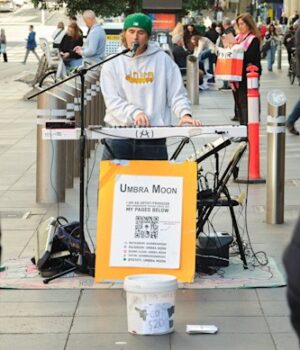
Somebody tells me Umbra Moon will be here soon. The words ring of destiny and I’m afraid to disobey. The guidance proves sound. Her act is hard to ignore, and this corner of Melbourne’s Bourke Street Mall feels like a serendipitous hot spot. Against a towering billboard backdrop reading “Get double done”, Moon switches from keyboard to violin mid-song while tennis star Nick Kyrgios ambles by, cap turned backwards, holding hands with his girlfriend. Moon, 26, strokes a sharp note and winces, while Kyrgios and friend share a gentle kiss.
A lunchtime crowd of 50 or 60 watch from the GPO steps. Several hold up their phones and record. On the walkway a little girl flounces, clutching a leaf. A weary tram driver weaves past after his shift. A man in a Dennis Rodman T-shirt and dark sunglasses stops and stares implacably, Boost Juice in one hand and Versace shopping bag in the other.
Afterwards, Moon feels as if she undershot. “Busking can make you feel like God on Earth, and it can make you feel like disappearing,” she says. “But I’d be really sad if I couldn’t do it. I hope I can busk all through my life.”
If the money from busking was ever easy, it’s not anymore. Human traffic now comes wired for any number of amusements, often without cash in hand. Add a boa constrictor-strength cost-of-living squeeze, and it takes guts – and skill – to stand defiant and hopeful in a city street.
Bourke Street Mall, however, is a roomy and attractive stage, demanding a specific premium permit from the City of Melbourne council to play here. A performer in another street told me she’s auditioned for The Mall three times without success. The council’s buskers handbook notes that performers are preferred who “possess a unique quality, subtle or dramatic, that gives them an interesting edge”.
Fun fact: the council allocates about 900 busking permits annually. They cost a bit more than $100 for a “premium” mall permit, $41 for general areas. No caps or quotas on performance types. Auditions for premium permits are held every three months – a chance for a few City of Melbourne event managers to assess the aspirants. Plenty fall short. “It was pretty intense,” says one who passed, “but it should be. It’s important to filter out people who don’t take it seriously.”
At 70, John Curran seems more like a teenager going haywire in his room than a senior citizen. The rangy, Irish-born guitarist – a mainstay in The Mall – is decked out cowboy-dandy style, singing Shania Twain’s Man! I Feel Like a Woman and thrusting his axe at the sky. Shania, Kylie, The Stones, Violent Femmes: he skews, splices and celebrates them all to the hilt. At first, it looks like he’s flailing – it looks gimmicky – but stick around and you’ll get a free lesson in undiscriminating warmth.
A burly dad pushing a pram stops for a Dire Straits number and grooves. A gawking toddler hammers the pram. “Oh yeah,” Curran sings, “the boy can play!” Five years ago, he lost the top of his left middle finger in a kayaking accident – “Gone. Just like that” – but played his guitar five hours a day for 18 months to recover dexterity.
Around the corner stands another musician who mutilated a finger, more than 60 years ago in Hungary. Aged seven, Joseph “Gypsy” Sukaro, now 70, was using a knife to cut kindling so the house would be warm for his mum’s return from work. After the accident he remembers being instantly upset that he wouldn’t be able to practise his violin that night. A doctor told him he’d never regain full use of the finger. He did. And here he stands on Elizabeth Street, playing something crisply evocative; fluent as water under a bridge.
“Fuel is now problem you must take into consideration,” he says, when I mention his threadbare tips. Asked if there’s a piece he plays especially well: “If you sound good only in one, you lose. If I repeat, repeat, the traders, they kick my arse.” He has no interest in playing Bourke Street Mall. “You get lost, nobody listens.” And he disdains the technology some buskers use. “Machine composing. Altering just one or two notes.” He’s not mentioning names. “I play the real music, mate.”
A stone’s throw away, a much younger violinist regales The Mall. Konstantin wears jet black jeans and green high-tops. I sit down beside a couple, Wendy and John from Brighton, who are eating lunch. Wendy says, “He’s clearly a better player than the one over there [Sukaro], but he should play something recognisable – Greensleeves or something.” In a lingering flock of high-school girls in navy tracksuits, a dancing, exceptionally tall girl of east African heritage lets her hair down. On the crowded steps, a woman meditates.
Konstantin has been playing publicly since boyhood. Auditioning for his place on the pavement here didn’t daunt him. Speaking calmly, with workaday forbearance, he says he felt confident he’d meet all requirements, especially uniqueness of repertoire. Does he aim for a certain amount of earnings? He hesitates, looks away, says he prefers not to discuss money and that he’s grateful for whatever he receives.
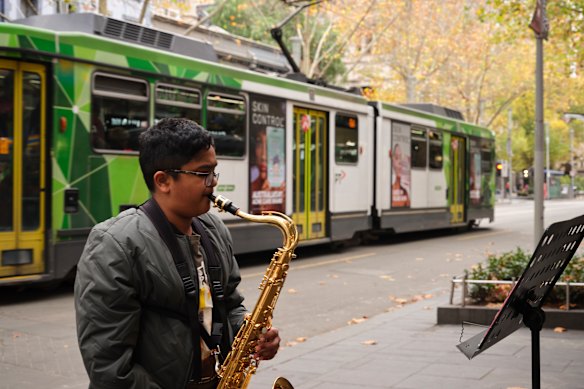
Twelve-year-old saxophonist Ashand isn’t shy about the dough. When I spot him on Swanston, he’s playing Céline Dion’s My Heart Will Go On, reading the music on an iPad. His father tells me that, last year, the boy earned enough for a new iPhone. His biggest haul is $380 in three hours. I ask Ashand what he likes about My Heart Will Go On, and for a moment he seems confused. He’s sure it was I Will Survive. At 12, he’s already playing functions. Is there a song he’d never play, busking? “Happy Birthday,” he says. No wavering.
As we’re chatting, a protest approaches in defence of disgraced Australian soldier Ben Roberts-Smith. Flags everywhere. “Lest We Forget” T-shirts. AC/DC blaring. A jaded Staffie lolls a thirsty tongue. Ashand and his younger sister watch. Old Australia is passing, all white noise. Then Ashand gives us a cool take of Gary Moore’s Still Got The Blues (for You).
It’s safe to say busking was first pursued by outsiders. And safe to say the first exponent was self-directed and incorrigibly curious. The English word “busker” is relatively recent, from the mid-1800s. The act of playing for impromptu donations is much older. At agricultural festivals outside Ancient Rome, for example, songs of raillery attracted a keen audience and, eventually, coins. Later, in the city of Rome, came musicians, dancers, mimes and those perennials at admiration’s door: poets.
A brief history of musical busking in the ensuing centuries would embrace everything from returned sailors and soldiers singing songs of stone-cold woe, itinerants dragging mysterious notes from the hurdy-gurdy (part hand-cranked organ, part harpsichord, part typewriter), and psalterists finessing the psaltery (a gorgeously strange-sounding string instrument). Count the hopeful sounds across the lands: hand and leg bells for French jongleurs′ jigs, tambourines for Spanish trovadores, cutting-edge spoons and more fiddling than a Steve Smith double-century.
In a wickedly detailed 1981 opus, The Buskers: A History of Street Entertainment, the authors describe how, in 14th-century England, troubadour numbers were likely boosted by the Black Death. After scores of workers perished, labour was at a premium. Suddenly it was possible for a serf to move around and live a little. Later, progress in wool production sent even more out wandering, as the fields they’d been farming went to pasture. Traders loved an entertainer pulling a crowd.
But as an extract in The Buskers illustrates, not everyone was in love. Pamphleteer Philip Stubbes wrote in the late 1500s: “If you would have your sonne softe, wommanish, unclean, smoth mouthed, affected to bawdrie, scurrilitie, filthie rimes, and unsemely talking; brifly, if you wold have him, as it weare, transnatured into a woman, or worse … Cursed be those [performing] licences which lycense any man to get his livying with the destruction of many thousands.”
Four centuries later, their descendants now display Soundcloud and Instagram addresses. Busking is now a way to be seen on platforms broader than any boulevard. And if passers-by like what they hear on the street and wish to donate later, there’s always a QR code. Some make up to half their donations this way.
Saxophonist Chris Wright, 49, stands on Bourke Street facing westbound faces, serenading with sultry solemnity, transferring bodyweight foot-to-foot, swaying with the afternoon breeze. Seriously good player. Plenty nod or signal thank you. Not many drop coins. With 10 minutes left in his set, his amp runs out of charge and briefly he’s livid with himself. He shakes my hand with warmth, as he did yesterday, and reminds me not to miss Sharaz Cavernet, a blind pianist.
An hour later, instead, I’m watching a young Japanese bloke sing too many Ed Sheeran songs. Two girls sitting beside me, Omi and Ari, supply me with the titles. “This one is Justin Bieber,” says Omi, pausing with deliberate effect. “Ed wrote it.” Later, the performer asks us to do all we can to post and follow and make him more famous.
On Swanston Street, Argentinian saxophonist Pablo Torres, 37, is giving the street a loose, understated soundtrack. In his tips case, for luck, sits a US dollar bill. His sound is soulful and the city street is teeming, but it’s not adding up to much. Eventually a Chinese woman with a hot pink cane drops him a dollar. Torres gives a subtle nod. Between songs he wipes sweat from his fingers. His English is a work in progress, but four mellow words say it all: “I need to play.”
Our cities profit, in every sense, from that creative need. A retail worker puts it succinctly: “If they weren’t here, it’d gut the whole city’s vibe.” Rush hour, she might have added, demands what they bring.
Mysterious Gene spent time watching the buskers in St Mark’s Square, Venice. Today he’s barefoot, all in black, including a dainty umbrella under clear skies, watching the buskers in Melbourne. He tells me to keep my eyes peeled for a sax player from (he thinks) somewhere in Africa, or maybe South America. “Plays with his eyes shut,” Gene says, “and his head somewhere way off in the clouds.”
Later in the balmy dusk, that must be him: coffee-complexioned Tiago Prince, from Brazil, and damned if he isn’t stealing the show. He’s not especially loud. He’s just playing something perfect for this hour. A guy in a wheelchair pulls up, stares, double-punches the air three times, turns and wheels away. Two women fresh from drinks stumble close. One films the other dancing, inhibitions sunk, waving a Sapporo can like a blazing torch. The pair roll away laughing. After a few days observing buskers, my notes show plenty of similarly spontaneous shenanigans.
Tiago had a monetary goal – $150 a day – but he’s revised that down, markedly. He’s untroubled. Most of the performers say there’s no point focusing on money. Predicting when and where you’ll do well is fraught. And though impressing and connecting aren’t the same, they’re related. Connection takes proficiency, which takes practice, and busking is great for practice.
When Tiago resumes, I sit on a nearby step and put away my notes. Half of Melbourne seems to be passing here. After a while, utterly unexpectedly, unaccountably, I notice my inner babble dialling down. At some point, thought stops. For 10 wonderfully strange minutes, my brain just drops dead.
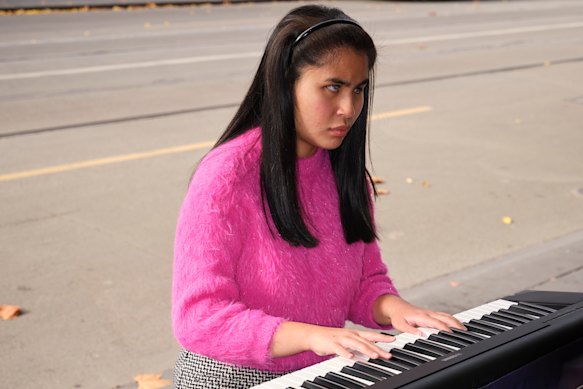
Soon, Sharaz Cavernet – the blind pianist I’ve heard about – appears on the non-premium side of Bourke. Her singing is on the gentle side. At one point, the noise around her includes two rumbling trams, a man circling on a bike amplifying a slogan, a sweeper buggy and a guy wheeling a cage trolley stacked with slabs. Not for a second does Cavernet (Shana Dang, 21) allow any of it to spook her concentration. A woman gets up from a nearby seat, approaches her and introduces herself as Amithi. She sounds nervous. “I’m sorry, but I don’t have words to express how you make me feel.”
Sharaz tells me she’s on a mission to prove what people living with a disability are capable of. “Winters can be tough. You get phases where you just have to keep showing up, keep proving yourself.” She aims to make a hundred bucks a day. Like most buskers, she once had her earnings swiped.
I ask to hear her current favourite song to play. She gives me something I’ve never heard: Birds of a Feather by Billy Eilish. An unbroken human river pours by as her delicate fingers manage subtle changes in tempo. It’s not an easy melody for her to play. It’s not easy for her to be here.
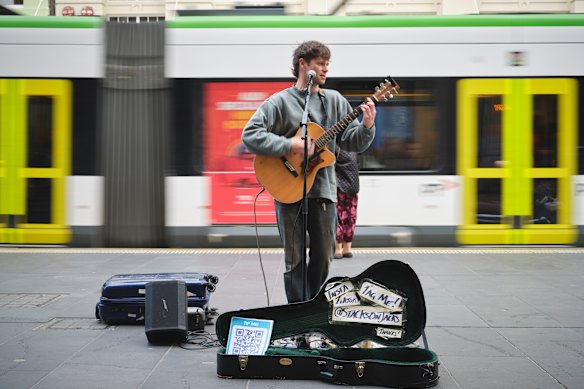
The next day, watching a young busker in Doc Martens and theatrically wide-legged jeans stopping abruptly between knee and ankle, I find myself talking to a dapper man from Kew in his 50s. I noticed him watching the performer, Jackson Preece, 30, like a nervous father might watch a son. He tells me the guitar sounds a bit low in the mix.
Minutes later, I feel I’ve known this man half my life. He tells me that when he was 18, he tried to end his life. At 20, he tried it again in a much more violent way. He thinks we are all paradoxes, all capable of angelic acts and their opposite. It occurs to us that without music, our conversation wouldn’t be happening.
‘Winters can be tough. You get phases where you just have to keep showing up, keep proving yourself.’
Afterwards, I sit with Preece. “Sometimes busking can feel like riding a wave. Other times I get up here and just shit the bed.” Duality, truly. He has a small, silver spike piercing his left eyebrow and a small, wavy scar surfs his upper lip. The second part of his statement surprises me. He seems so at ease when playing, yet to prepare for a shift he sometimes does breathing exercises using an everyday straw. For each hour he’s here, he aims to make minimum hourly wage.
In the evening I see him going for it outside Myer, singing Tracy Chapman’s Fast Car. He grapples the riff’s trickiest part, and a 50ish woman in fawn corduroy dances, really getting down. I scribble a note to talk to her, but when I look up she’s gone. In her place stands another shopper, 60ish, with plaster on his nose and a cap that says HOWZAT. He stares at Preece with an impassive look that could mean anything from admiration to mystification. Beyond, the billboard says: the grit shift.
Passing the new Town Hall Station on Swanston Street, I stop for one more busker in the dimming dusk. Somebody calling himself Andy Remind is taking Hit the Road Jack for a deeply strange, whispery waltz. Something about his lived-in loose threads, charms and independent demeanour seems quintessentially of the troubadour. Poker-faced, he finishes Under the Bridge with a line from Stairway to Heaven. Nice. When he plays one of his own tunes, it’s all shadowy pathos and restless rhythms.
At his back on Collins Street’s northwest corner towers the Gotham-style stronghold of the Manchester Unity Building, lit mauve at the apex. “If I focus on money,” says Remind, a 34-year-old Italian, “I don’t play well. Focusing on money will only make stress. And anyway, it’s not an easy time, because of the fuel.” The jarring cost of petrol, diesel and everything tethered to it chips away at our spur of the moment generosity.
The beat goes on. Next night I meet a French kid lounged on a Swanston footpath, aggressively ad-libbing guitar licks, shredding in sustained runs, and when I finally, sheepishly, interrupt, he claims he can go two hours without stopping. Ten, maybe 11 dollars in the cap. I meet a very old guy, dead ringer for Moses, thrumming three chords (A, G, then A, E) on a cheap magenta acoustic, an enormous book by his side: Strong’s Expanded Exhaustive Concordance of The Bible. Spent his working life in sheet metal. And I meet a young bagpiper in fullest regalia, sporran and all; partial to rain because anyone with an amplifier leaves, leaving him to prosper. “Your presentation,” he adds, enunciating each syllable, “is as important as your performance.”
Away from the city, on another night, I meet Mardi Poulier, 57, giving blue-ribbon Brighton’s main drag her warmth. No amp. Just a grainy chest voice and an acoustic guitar. Earlier, down the street, an estate-agent stormed from his office, demanding she move, claiming he couldn’t concentrate. I ask her what she was singing at the time, and she plays a tender, stripped-bare version of Dragon’s Are You Old Enough?
Poulier has busked for 38 years. When she was younger she used to belt out the songs, but 10 years ago a polyp was removed from her larynx. “My voice changed. Can’t hit all the notes.” She still gets nervous in a new spot. “I used to make as much as a hundred bucks. Now it’s hard just to get a few dollars. Sometimes I feel like throwing my guitar up in the air.” Nervous knockabout laugh. “Or smashing it into the wall.”
I request her most trusted go-to song. She gives Abba’s Fernando the kitchen sink, acapella; knuckles knocking out a gentle beat. A Woolworths-bound shopper says something nice and puts $2 down.
Poulier sparkles. “Thank you, mate,” she says.
Get the best of Good Weekend delivered to your inbox every Saturday morning. Sign up for our newsletter.
Read more from Good Weekend:


