

Source : the age
As I flew over San Bernadino and saw the swimming pools and the houses … I was more thrilled than I have ever been in arriving in any city,” the late British artist David Hockney said of moving to Los Angeles in 1964.
Hockney was born in Bradford, northern England, where homes had neither backyard pools nor Californian sun. Both would become trademarks of the hugely popular and prolific artist, who died in London last month, triggering an outpouring of reflection and remembrance that extended far beyond the art world.
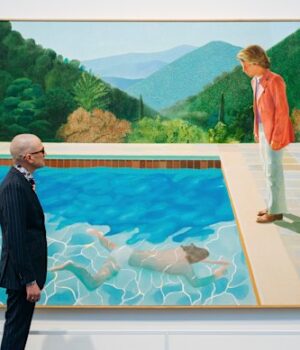
Hockney completed his first pool paintings the year he arrived in America. He met artist Peter Schlesinger, his lover and favourite model, two years later. Both feature in Portrait of an Artist (Pool with two Figures), from 1972, a painting completed after their break-up. In Schlesinger, Hockney found “the real-life embodiment of the West Coast dream boy”, curator Sarah Howgate once wrote.
In the painting, Schlesinger stands at the pool’s edge, while another man swims towards him beneath the water’s veiled surface. In 2018, it sold for $US90 million, setting what was then a record for a work sold at auction by a living artist.
Pool paintings, including Peter getting out of Nick’s Pool (1966), A Bigger Splash (1967) and even the artist’s own backyard pool in the Hollywood Hills – the bottom of which he painted with gestural blue brush marks mimicking the sunlit surface of the water above – captured Hockney’s embrace of California’s sunny and liberating ’60s lifestyle, one far removed from stifling and damp post-war Britain.
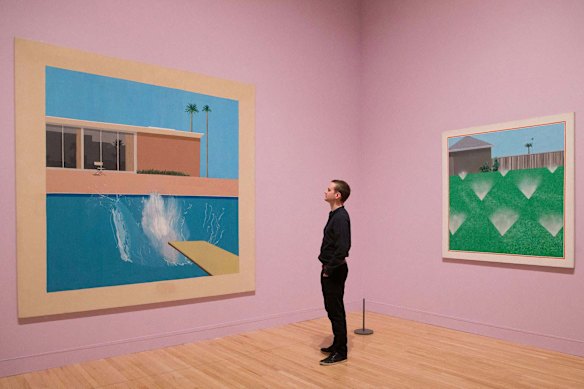
“David not only immortalised Los Angeles but forever changed the way we look at swimming pools,” Barry Humphries wrote in 2016, when his portrait hung in a Hockney exhibition at London’s Royal Academy.
The pair were also friends, but Hockney had been particularly close to Humphries’ father-in-law, the English poet Stephen Spender, whose daughter, actress and playwright Lizzie Spender, was Humphries’ fourth wife. Hockney had designed the invitations to her 21st birthday party.
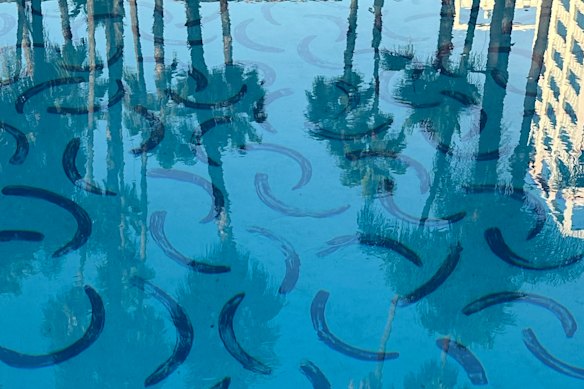
“The swimming pool, unlike the pond, reflects light,” Hockney once wrote. “Those dancing lines I used to paint on the pools are really the surface of the water. I liked to think of it as a kind of rippling, moving mirror.”
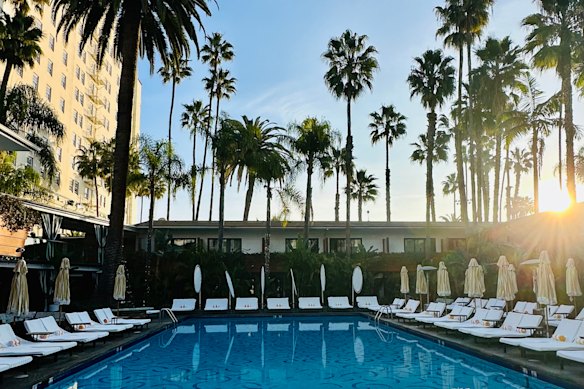
In 1988, Hockney reportedly arrived at LA’s storied Hollywood Roosevelt Hotel – home in 1929 to the first Academy Awards ceremony – holding a can of blue paint and a six-inch paint brush tied to a broom handle. He painted the same “dancing lines” he’d applied to his pool at home to the bottom of the hotel’s Tropicana pool. They’re still there. Or restored and repainted versions at least. Pool chemicals are no friend of forever.
Swimming in the pool today is like diving into one of Hockney’s paintings. The ephemeral effect of Californian sunlight dancing on the water is fixed in dark blue brushstrokes on the pool floor. The surrounding palm trees, long a symbol of LA, are reflected in its surface, as is the low-rise modern architecture of the hotel’s adjoining Tropicana Bar and Cabana suites. The artist once described painting water as a great challenge. But also “a nice problem”. Spending time in the pool as a hotel guest and Hockney groupie presented a similar dilemma: the water was freezing.
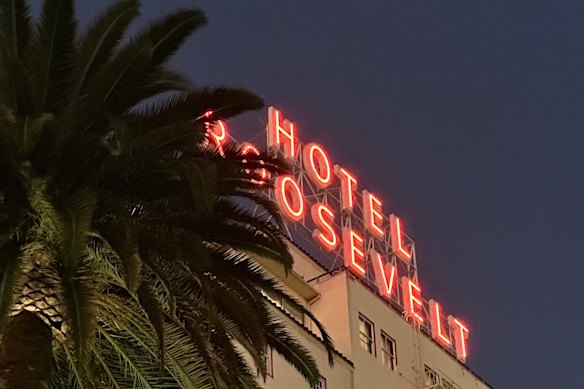
Unlike the down-at-heel neighbourhood that surrounds its Hollywood Boulevard address, the Roosevelt Hotel has retained much of its old-world Hollywood glamour. Having one of the most recognisable hotel pools in the world, painted by one the world’s most influential and admired artists, no doubt helps.
But the hotel has long been a magnet for generations of Hollywood celebrities, from Clark Gable and Carole Lombard – after whom the penthouse is named – to Marilyn Monroe, who did her first professional magazine shoot on the diving board while a resident in the 1950s. One of the Cabana suites (rumoured to be haunted by her ghost), is named in her honour. In May, Glamour magazine shot Sydney Sweeney on the roof.
John Saxby
Our room was not quite so high up, but elevated enough to take in the view over Hollywood High School across the street (“Go sheiks!”). Its roll call of ex-students resembles the credits of an unlikely film starring Sharon Tate, Judy Garland, Cher, Barbara Hershey, Mickey Rooney, Sarah Jessica Parker, Tuesday Weld and Swoosie Kurtz. Such names are also found on the Hollywood Walk of Fame opposite, while a few blocks away is the Musso & Frank Grill, a Hollywood haunt that opened in 1919. Rather than a suite, it has a booth named after Monroe.
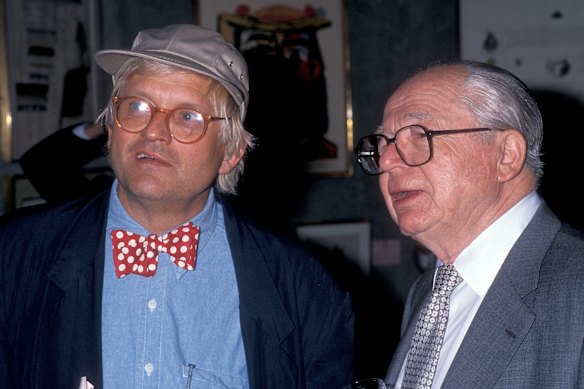
Billy Wilder, who directed the actress in Some Like it Hot and The Seven Year Itch, was a collector of Hockney’s work, a friend and the subject of numerous portraits. “We got along exceedingly well,” Wilder once said. “He and I talk about everything from movies to politics. The conversation jumps from Mrs Thatcher to Sylvester Stallone in one split second. If you have only one friend and it is Hockney, you are not lost in this world, so try and make it Hockney!”
Judging by the flood of Instagram posts following the artist’s death, it seemed many people had either made Hockney a friend – King Charles III, Paul McCartney, Ai Weiwei, Harry Styles (whose portrait Hockney painted in 2022 wearing a red and yellow striped cardigan, jeans and a string of pearls around his neck) – or wished they had.
For others, like myself, Hockney’s bright blue pools and portraits were an entry point into the murky waters of contemporary art. The non-painter’s painter. Except German-British artist Frank Auerbach once described Hockney as the “head of the profession”.
“He communicates with the public, which none of the rest of us even want to do. He’s endlessly prolific and endlessly communicative about painting,” Auberbach said.
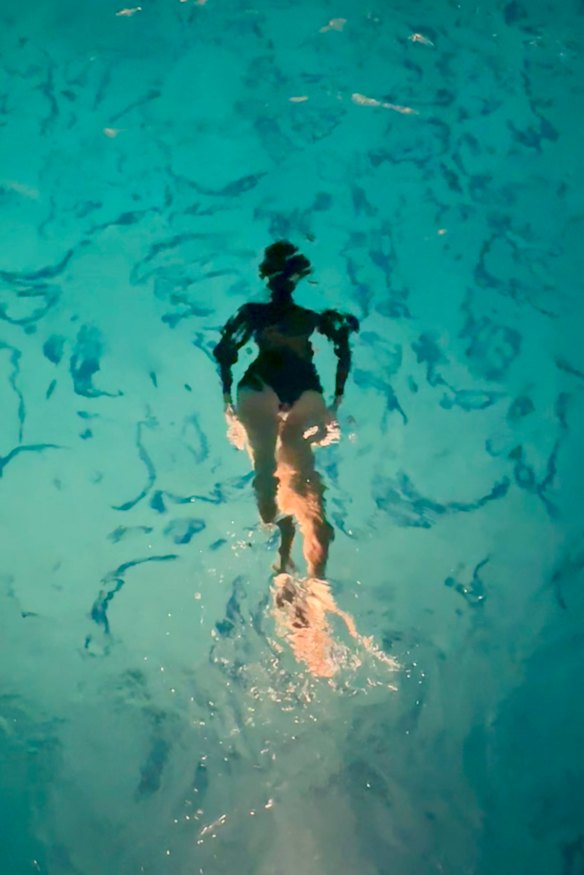
Hockney was also endlessly experimental across media and technology, from photography to the photocopier, acrylic paint to Polaroids. He completed his first artworks using a fax machine the same year he painted the Roosevelt’s pool and his final works on an iPad.
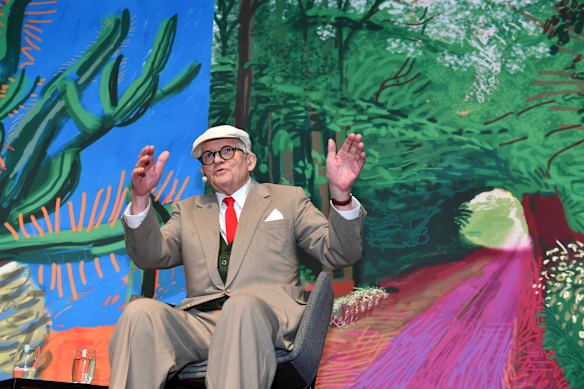
English art critic Martin Gayford, a frequent collaborator, has said Hockney’s “lucidity is mistaken for simplicity, just as the fact that his work is deeply pleasurable – and therefore popular – has obscured the fact that it is also filled with original and challenging ideas about how we see the world”.
Alex Farquharson, director of London’s Tate Britain, whose 2017 survey of Hockney’s work remains the gallery’s most popular show ever, remembered the artist as someone who was “always completely and courageously himself, both in his work and in life”.
In 2027, the Tate will open an exhibition spanning seven decades of the artist’s work, as well as a multimedia installation in Tate Modern’s Turbine Hall. In line with Hockney’s wishes, he was buried privately in June alongside his parents, who were also regular portrait subjects. Public memorials will take place in the UK next year.
For many people, contemporary art evokes an anxiety on par with a high school swimming carnival. Hockney’s vibrant paintings – whether a portrait of his parents, of his many friends, former lovers, carers, his dachshunds Stanley and Boodgie, an avenue of trees, a Normandy landscape, or a swimming pool bathed in bright California sunlight – invite people who barely know anything about art to dive right in.
His art is the kind of pool where running, diving, food and drink, and smoking, especially smoking, are not only allowed, but encouraged. “You wouldn’t be an artist unless you wanted to share an experience,” he once said. “I am constantly preoccupied with how to remove distance so that we can all come closer together, so that we can all begin to sense we are the same, we are one.”
The world is very beautiful if you look at it, Hockney was fond of saying. The artist repeatedly urged us to look up from our phones, to “really look”, to “love life”, and, in so doing, swim towards the deep end.
John Saxby is a writer, photographer and former editor of Spectrum, who has worked as an editor at the Museum of Contemporary Art and Art Gallery of NSW.