

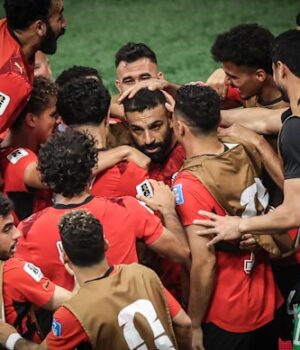
Source :- THE AGE NEWS
Mohamed Salah may no longer be a Liverpool player, but he is still the King of Egypt. Today he could be the King of Texas, based on the royal reception he received after touching down in Dallas.
You know someone is popular when police set up crowd-control barriers along the street outside the team hotel just to manage the sheer volume of fans angling for a glimpse of the 10-second walk from a bus to a building.
The majority of football enthusiasts operating on Australian Eastern Standard Time will hope 10 seconds is the most they see of this 34-year-old winger over the next couple of days. Hoping the hamstring is still strained so the Socceroos will not have to deal with the rest of him. But also feeling mildly regretful about that hope, because to see Salah play against your team means you still get to see him play.
There aren’t many footballers who reach this tier of torn fan loyalty. But then, there aren’t many footballers voted by their country as runner-up in a presidential election for which they were not even a candidate. Incumbent Abdel Fattah al-Sisi was re-elected in April 2018, in a landslide 97 per cent polling victory (of low turnout – 41 per cent of Egypt’s population) condemned by numerous human rights groups as “farcical”.
But where Al-Sisi’s sole opponent, regime backer Moussa Mostafa Moussa, received only 656,534 votes (2.9 per cent), a reported more than one million voters crossed out both names and replaced them with “Mohamed Salah”. As far as protest ballots go, the masses had spoken. Six months earlier, Salah had scored a decisive 95th-minute penalty against DR Congo to send his nation to their first World Cup in 28 years.
At the tournament in Russia he scored twice across the group stage, but Egypt still left their third finals campaign without a win. Now, eight years a later, they have qualified for a fourth. Salah scored nine goals in qualifying to get them to North America, and another in their second group game against New Zealand. The result? A 3-1 win. Ticked off the list.
That, of course, means both they and Australia will be hunting a first World Cup knockout-stage win when they meet in the round of 32 on Saturday morning (4am, AEST). Salah, for his part, needs one more international goal to reach 69 and equal the country’s all-time record held by head coach Hossam Hassan.
This is, for all intents and purposes, his moment. His World Cup swansong. His last hurrah. The people of Egypt have voted (for real this time, they hope), and they say this match-up carries the same air of destiny as a travelling ball off Salah’s left boot. He resumed limited training this week, which may or may not mean he’s a genuine chance to have a crack at Tony Popovic’s well-drilled Socceroos.
But there are two pertinent facts to know about Salah in this context: he does not like being left on the bench; and when on the pitch he scores goals that win the games.
Both were key elements of his historic nine-year spell at Anfield, where he scored 255 goals and provided 122 assists from 435 appearances across all competitions. His hand in Liverpool’s eight trophies during that time – two English Premier League titles, one UEFA Champions League, a FIFA Club World Cup, an FA Cup and two League Cups – is more straightforward science than subjective observation.
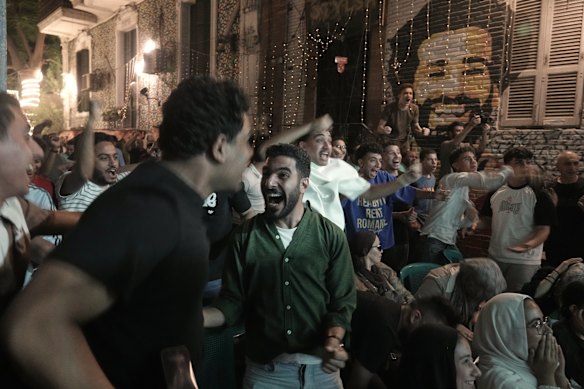
Salah was Liverpool in the same way Kenny Dalglish, Ian Rush and Steven Gerrard were Liverpool. And, despite his acrimonious exit following a breakdown in relationship with since-sacked manager Arne Slot – in December, after his third consecutive benching, he claimed the club had thrown him “under the bus”; in May he ripped into their style of play on social media – he leaves a loyal servant to the Kop and of such high esteem a statue will surely be erected.
It’s difficult to encapsulate Salah’s Premier League story with statistics, when statistics do not adequately convey the many significant moments and highlight reels too long for the attention span of the modern brain. His role in the Salah-Roberto Firmino-Sadio Mane triumvirate that drove Jurgen Klopp’s Reds in their pomp. His longevity and consistency, intricacy and clinical precision. The unrelenting discipline and work ethic.
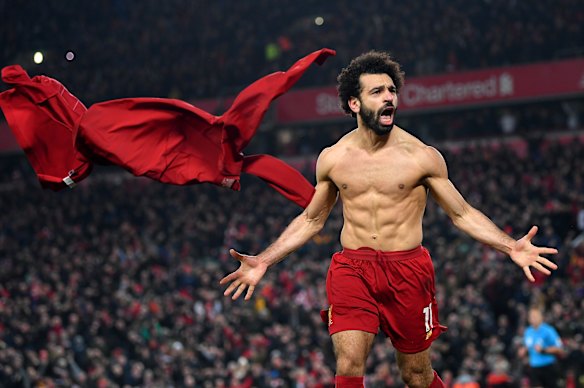
There was the famous stoppage-time goal against Manchester United in January 2020 that ended with a view of Salah’s six pack and chants of “we’re gonna win the league” (they won it that June – their first English league title in 30 years – with seven games to spare).
Then there was the one in October 2021 when he lost four Manchester City defenders with a turn and a few flicks and finished at an angle so acute it defied comprehension. The shoulder injury and the tears of the 2018 Champions League final against Real Madrid. His penalty 23 seconds into the triumphant 2019 final against Tottenham.
But if statistics are the cold-hard measure of greatness, then just know that the Premier League era exists in binary form: Before Salah and After Salah. The list – like the highlights – is too long to recite.
“This specific kind of player is irreplaceable,” Klopp said in March. “I’m not sure there is even another one existing out there. There are other people playing on that wing with different strengths and qualities but it is the numbers Mo produces – they are unmatched from that position. The numbers for a winger are ridiculous. For a striker they are pretty much unmatched.”
And now, despite the usual signs of ageing – the niggles, slight muffle on his high-speed ball control – the right teammates can still bring out the best. For Egypt that is Omar Marmoush, the Manchester City forward shouldering part of the attacking onus.
Then there is Salah as icon. That magnetic star power around which everything else orbits. His rapport with his fans. The way he danced with them on the streets of Vancouver after last month’s maiden World Cup win.
The individual with a reach so wide and well-regarded that one comment or social media post can spawn global headlines. Who can call out UEFA for commemorating the death of ‘Palestinian Pele’ Suleiman al-Obeid but failing to mention the nature of his death – killed in an Israeli attack while awaiting humanitarian aid.
The man whose presence in Merseyside, according to research from Stanford University, reduced hate crimes by almost 20 per cent and anti-Muslim tweets among Liverpool fans by 53 per cent in the approximately three years since he’d been signed from Roma.
The one for whom the fans chanted: “If he’s good enough for you, he’s good enough for me, if he scores another few, then I’ll be Muslim too.”