


SOURCE :- THE AGE NEWS
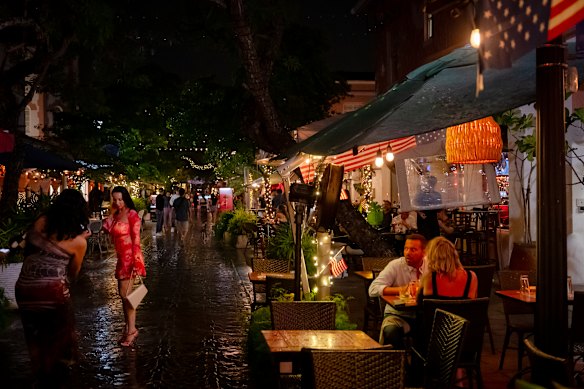
It’s 10pm on a Monday – Memorial Day in the US – on one of the main streets in Miami Beach. After a big holiday weekend, and with intermittent rain, much of this party town seems quiet. But then, at what looks like a vacant shopfront, the door opens and two scantily clad young women totter out on heels.
It turns out we have stumbled across M2, a legendary nightclub which for a few years in the 1990s was owned by music icon Prince and called Glam Slam. Tonight, it is hosting a fashion show for Miami Swim Week; the bouncer quickly invites me and my photographer to enter – a pattern that is repeated over the coming days. Here in Miami, a camera is a veritable key to the city.
Inside, it is organised chaos, with skinny models darting around the narrow lobby, dodging photographers and cameramen, or posing against a small media wall. A handful of drink cans and leftover burgers litters a makeshift snack stand. I find myself constantly getting in people’s way as I negotiate the crowd to reach a backroom bar and the cavernous main stage, where the lights are being dismantled.
Helin Cetin, 25, is ordering a drink after her performance. Born and raised in Germany, the bilingual English and Turkish singer moved here five years ago to chase her music dreams. “Miami is so warm, full of opportunity, love and excitement,” she says. “I just felt really, really drawn to the city.”
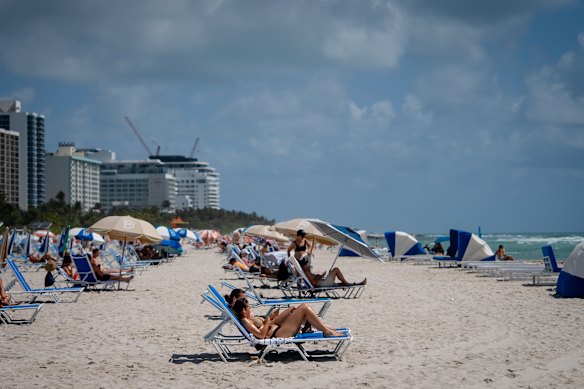
In decades past, Cetin might have tried her luck in Los Angeles or New York. But now, people are increasingly drawn to south Florida – a rapidly growing epicentre of financial, cultural, corporate and political power in the United States – lured by low taxes, warm (and humid) weather and career opportunities that are starting to rival the country’s north-east or West Coast.
Throughout its relatively short history, Miami has always been a city of booms and busts. But the post-COVID boom has a unique flavour, led by billionaire businessmen and celebrities, libertarians looking to escape high taxation and “woke” politics, and pandemic nomads who realise they can work from anywhere (especially the beach and the pool).
When one of the world’s richest people, billionaire hedge-fund manager Ken Griffin, moved the headquarters of his investment firm Citadel from Chicago to Miami in 2022, it signalled the game was on. Griffin, now the richest person in Florida, bought a waterfront mansion for $US107 million, breaking the record for Miami-Dade County. His neighbours recently listed their property for $US110 million.
Palantir, the AI firm founded by Peter Thiel and Alex Karp, announced in February that it was moving to Miami from Denver. Amazon, Apple, Microsoft and Uber have all established a significant presence in the city, and FC Barcelona relocated its North American HQ there from New York last year. Miami already hosts major financial summits such as the America Business Forum and the Saudi Arabia-funded FII Priority – while in December, world leaders will flock there for the G20, to be held at US President Donald Trump’s National Doral Miami golf resort.
A small island, Indian Creek, has become home to ultrarich and famous residents including Amazon founder Jeff Bezos, Meta chief executive Mark Zuckerberg, American football legend Tom Brady and Donald Trump’s daughter Ivanka and her husband Jared Kushner. Google co-founders Larry Page and Sergey Brin also recently snapped up waterfront property in Miami. The Miami Herald reported in March that four of the world’s five wealthiest individuals now own estates in the area.
“It’s almost like there’s FOMO now among the ultrarich – you’ve got to get your place in South Florida,” luxury real estate agent Ivan Chorney tells Good Weekend. “Miami or Palm Beach, depending on what turns their crank a little bit more, or maybe where their network is.”
The whole coastline is booming. About 40 minutes north of Miami is Fort Lauderdale, whose metropolitan area boasts another 2 million residents, and another 50 minutes past that is Palm Beach, where Trump’s Mar-a-Lago resort has become a secondary White House – a place where he meets business leaders, conducts affairs of state and even launches military operations (when US forces captured Venezuelan leader Nicolás Maduro in Caracas in early January, Trump oversaw the mission from Mar-a-Lago).
But the boom has consequences. While Miami is still more affordable than New York or California’s Bay Area, prices are rising rapidly, and working people are being priced out: not just of the housing market, but from restaurants and everyday life. Cost of living – one of the drawcards for ordinary people to relocate from the north-east or West Coast – is catching up to the places they are fleeing.
I have a number of meetings booked in during a whirlwind visit to Miami. But like all good cities, it’s the spontaneous discovery, the impromptu encounter, that can be the most revealing. On a hot, sunny Tuesday morning, while looking for parking (not one of Miami’s strengths), I see a throng of minimally attired young women queued outside the doors of the Plymouth Hotel in Miami Beach. The line stretches halfway around the entire block and appears to consist entirely of models – waiting to audition for the aforementioned Miami Swim Week.
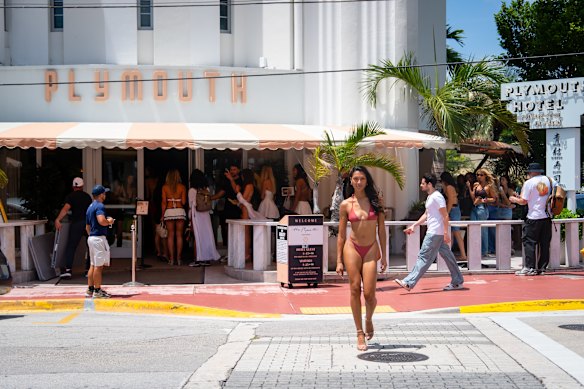
“It’s a tradition – every model wants to be here,” says Samantha Castillo, 28, who is wearing a ruby-red bikini as she struts across the sun-drenched street. “It’s a day and a week where you can fulfil a big dream.”
Miami might lack the stratospheric heights of New York or LA, says Castillo, who moved here from Chicago five years ago to pursue her modelling ambitions, but it’s a great place to make a start. “If you’re fresh and like me, if you wanted to just go out of college or just chase a dream, come to Miami.”
Nearby, Gracie Skye and Clover Rayne have come from Atlanta for the try-outs. “I feel like for so long, so many people were obsessed with LA and New York, whereas I really feel like Miami is becoming a new hot spot for so many different industries, especially in entertainment,” says Skye, who calls herself a professional model and content creator. “It’s a great way to incorporate the South into the fashion world.”
If New York and LA are America’s traditional cultural cradles, Miami might be the epicentre of modern-day creator culture: the influencers, fashionistas and sometimes grifters who populate social media and are this century’s answer to celebrity worship.
Here you’ll find the likes of Clavicular, a 20-year-old who became semi-famous for “looksmaxxing”, a trend where young men strive to improve their appearance through techniques such as microdosing LSD or hammering their facial bones with a hammer. Real name Braden Peters, he was dumped by his PR agent after overdosing during a livestream from a Miami nightclub in April.
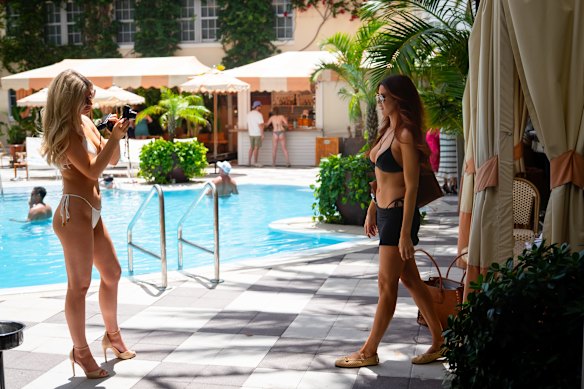
There’s also Alix Earle, a beauty and lifestyle influencer who does “get ready with me” videos for 8.5 million TikTok followers; culinary content creator Sam Schnur, whose Naughty Fork platform attracts 2.3 million Instagram followers; and Gonzalo Goette, a Spanish-language vlogger with 2.26 million YouTube subscribers. A recent CBS News report said social media influencers are gravitating towards the hot spot neighbourhood of Brickell, just south of downtown Miami on the water. But everywhere you go – from Miami Beach to the gentrifying Wynwood – it’s common to see someone filming themselves on the street or performing in front of a tripod.
We cannot linger at the Plymouth Hotel auditions because we have an appointment half an hour away on the Bay Harbour Islands, a small waterfront community separated from the mainland by the Biscayne lagoon. We are here to meet Demi Antelo, a real estate agent in the aforementioned Ivan Chorney’s team, and inspect a key feature of Miami’s post-pandemic boom: the unbridled growth in luxury condominiums.
The Well, a project that is still under construction when we visit, is all about health and wellness – a major Miami obsession. Antelo tells us that when it’s complete, residents here will have access to intravenous vitamin treatments and infrared therapy in the building, which, according to marketing material, also boasts a “halotherapy steam room” and Miami’s first caldarium. He takes us to a 150-square-metre apartment with three bedrooms that is priced to sell at $US3.75 million.
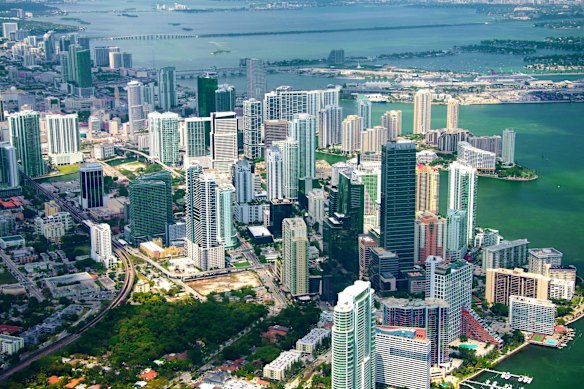
Born and raised in Miami, 32-year-old Antelo has worked in real estate for 12 years, giving her a front-row seat to the city’s transformation. “The skyline in and of itself has changed drastically,” she says. “It’s going to continue to change. The skyline that you see in Miami in the next three to five years is going to look completely different to what it looks like now.”
The buyer pool has transformed too, Antelo says, along with the reasons people are moving here, including lower taxes, cost-of-living difference, and climate. “Yes, it gets hot here,” she admits. “But for the most part, you have pretty great weather throughout the year. You don’t have six to seven months of the year when you can’t be outside because it’s too cold.”
When democratic socialist Zohran Mamdani was elected the first Muslim mayor of New York on a platform of raising taxes on the rich and building more social housing, his opponents said it would accelerate an exodus of wealthy business types from the Big Apple and prove ruinous. Mamdani only took office at the start of this year, and I ask Antelo if there are any signs this mass exodus is happening.
“A lot of what Mamdani’s doing in New York has to settle,” she says. “It takes a bit of time for those changes to actually affect the people, but we are starting to see a lot of that.” And it’s not just New York, she adds; they are coming from everywhere. The previous week she inspected properties with clients from Seattle in search of lower taxes. “They’re very clear: we don’t want to be in these states that are robbing us of the money that we’re making. That’s what we’re seeing.”
Florida is one of nine US states that do not charge personal income taxes, a policy lauded in a January paper by the White House’s Council of Economic Advisers. Several of those states ranked in the top 10 for GDP growth over the past decade, the paper said, and in the top 10 for net migration from other states. Washington state, where Antelo’s clients are moving from, has traditionally had no personal income tax except on large capital gains – but in March, it introduced a 9.9 per cent tax on income above $US1 million a year.
Residents of these states still have to pay federal income taxes, and corporations still have to pay federal taxes. In Florida, the state corporate tax rate is 5.5 per cent, below the median 6.5 per cent.
The state outlawed income tax in 1924, along with inheritance taxes – or a “death tax”, as some like to brand it. “That was a huge lure for people,” says Dr Paul George, resident historian at the Museum of Miami. And it still is. “Now more than ever there’s that mindset because there’s so much wealth here.”
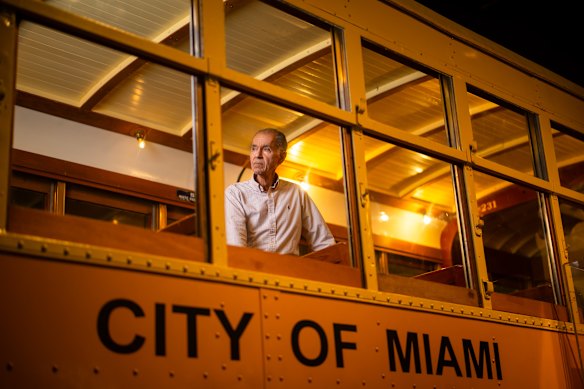
We meet George on a quiet Tuesday afternoon for a chat inside the museum’s historic Miami streetcar. The restored carriage is from 1906, when the city’s tram network opened – just 10 years after Miami was first incorporated as a city. In the 1895 Florida census, just nine people were recorded as living near the mouth of the Miami river.
The city was effectively founded by American industrialist Henry Flagler, who built Standard Oil with John D. Rockefeller, and later became attracted to the warmth and opportunity of Florida. Starting in St Augustine, he purchased and modernised railroads along the East Coast, extending the track to Palm Beach and what is now Miami (and eventually to Key West at the end of the Florida Keys). He is known today as the father of Miami.
Flagler built a grand hotel, the Royal Palm, which no longer exists, and poured a lot of money into the new city. It grew quickly, attracting people mainly from the South – other parts of Florida, southern Georgia and Alabama – as well as the Bahamas, both white and black. They built a brand-new city in the middle of America’s gilded age. “Its industry pretty quickly becomes real estate and tourism,” says George. “In the winter it becomes inflated. Flagler is connected to Rockefeller and the Carnegies and Vanderbilts and all those people who come down to his hotel. So it already has that glitter about it.”
A tremendous postwar property boom in the 1920s came to a crashing end with the Great Miami Hurricane of 1926, killing hundreds of people and devastating the metropolitan area. The economic damage was compounded by the Great Depression a few years later. But Miami rebuilt between the wars; it became a hub for two major airlines, Eastern and Pan American, and South Florida became a major strategic asset in World War II, with downtown Miami converted into a training and command centre for the navy and Miami Beach a training ground for the air force. Florida also housed thousands of prisoners of war.
By the early postwar period, says George, Miami was “clearly the ascendant city” in the US. It compounded in 1959 when the Cuban Revolution triggered a massive flow of refugees from communism to Miami, shaping the Hispanic and heavily Cuban city of today, and establishing a bedrock of conservative, anti-Marxist politics in Miami and South Florida.
George likens Miami’s current boom to its post-World War II growth spurt, and calls it another inflection point in the city’s history. As tech bros and libertarians and pandemic refugees flock to Florida, its politics are changing: a state that voted for Barack Obama twice has not backed a Democrat since. And Miami-Dade County, which hadn’t supported a Republican president since George H.W. Bush in 1988, voted for Donald Trump in 2024 by 55.2 per cent to Kamala Harris’s 43.8 per cent.
Still, the conservative slide is not linear, and Republicans would be worried about the backlash to Trumpism under way in his home state. In December, Democrat Eileen Higgins defeated the Trump-backed Republican, Emilio Gonzalez, to become Miami’s first female mayor. And in March, a Democrat won the highly affluent state-level electorate that takes in Palm Beach and Trump’s Mar-a-Lago home. Trump, who has railed against mail-in ballots as part of unfounded claims that American elections are systemically rigged, voted by mail.
Miami’s growth has become divisive, even in a part of the world where success is loudly celebrated and modesty is a dirty word. For some, the sky is the limit. Presiding over most of Miami’s recent boom was Republican mayor Francis Suarez, who was elected to the role in 2017 and finished his term late last year. Suarez contested the Republican nomination for president in 2023, campaigning largely on the economic growth of Miami under his leadership, but dropped out early and later endorsed Trump.
At the 2025 America Business Forum in Miami – attended by the likes of Trump, Jeff Bezos, soccer star Lionel Messi and Argentinian President Javier Milei, among others – Suarez sold Miami as a refuge for wealthy New Yorkers maligned by left-wing politics. Just the night before, Mamdani had stormed to victory, frightening the city’s business elite with his promised tax hikes and unabashed worker-friendly policies. For Suarez, it was gold. “New York is going in one direction and Miami is going in a diametrically different direction,” he said on Fox Business ahead of the summit. “That’s going to have significant implications for the future of our country.”
Suarez predicted a major market shift, and said people were already pre-buying property in Miami ahead of Mamdani’s expected win. “I believe there’s going to be a 30 to 40 per cent increase in real estate prices over the next six months to a year, particularly if Mamdani is successful in executing his agenda of ‘government for all’,” he said. “[It’s] this notion that government is the arbiter of success and failure, which we know is antithetical to American values of liberty and freedom and capitalism. That’s what Miami is all about.”
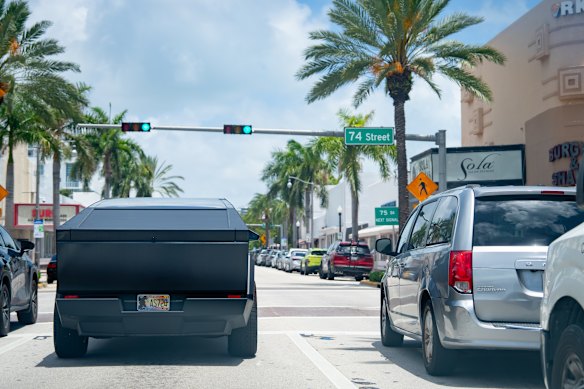
The city has modernised. One gritty industrial neighbourhood, Wynwood, was rezoned in 2015 to allow 12-storey apartment buildings, and now boasts a hulking set of residential units and hotels, thriving bars and restaurants, and cultural spaces that would look at home in Marrickville or Fitzroy. Its population soared from under 1000 to nearly 8000 and growing. Miami is the southern terminal for the Brightline, a privately owned rail service that runs up the Florida coast to Orlando at top speeds of 200km/h (although it is possibly going bankrupt). Overall, the streets are clean and crime is down.
But unbridled growth comes at a cost. The gentrification of Wynwood forced out many Puerto Rican families, gay bars, artists and bohemians. Land values have increased tenfold to $US2000 a square foot ($31,135 per square metre). An iconic live music venue, Gramps, shut its doors permanently in January. The major business tenant in Wynwood is now Jeff Bezos’s Amazon. According to Miami Realtors, house prices across all of Miami-Dade County have risen 145 per cent over the past decade, while apartment prices have doubled.
And in fact, despite the boom in the luxury market, Miami-Dade County actually lost 10,000 residents between July 2024 and June 2025. Much of this is attributed to Trump’s crackdown on foreign immigration, but George, the Miami historian, says class issues are at play too.
“There’s this divide between, say, the middle class and the extremely wealthy – and obviously the more impoverished class is in an even worse condition,” he says. “We look at class now in a much more defined way than we did before; it’s them and us.”
As the rich move in, the price of everything goes up – not just housing. Dining in Miami is among some of the most expensive in the US. “It comes up almost every day in conversation: ‘I just can’t afford this any more,’ ” says George. “We went out the other night, my wife, daughter and myself. We had two pizzas, two zero [alcohol] beers and a caesar salad. It was about $US110 ($160). This is ridiculous.”
Good Weekend gets stung by the restaurant rip-off too. After a long day of interviews and photo shoots, we opt for dinner at a Cuban restaurant in a touristy part of Miami Beach. A bottle of water (Acqua Panna, to be sure) is $US12 – more expensive than a $US10 beer. A paella to share is $US54. With two sides, an automatic 20 per cent service charge, Florida state tax and resort tax, our total is more than $US150. Not realising the tip has already been included, I stupidly add another 15 per cent.
Later, Uber driver Georgios Zervos explains the pitfalls of the system. The service fee is collected by the restaurant and legally treated as revenue, not tips. Management can distribute it as they wish, including to cover operational costs and salaries. The waiter doesn’t necessarily get a cent. “The restaurants are allowed to get away with it because they call it a service fee, they don’t call it gratuity,” Zervos tells me as we drive from Little Havana to South Beach.
“Because they do that and play that game, no one tips … The servers are making less money today than they were before COVID.”
Zervos turns out to be an interesting character; a former deacon at a Russian Orthodox church in Miami who, with others, is now embroiled in a legal battle against the Orthodox Church in the US that is being covered extensively in the Miami Herald. During our ride, he unloads on an assortment of city personnel, including a new city manager, whom he claims lacks experience, and former mayor and commissioner Joe Carollo, a Cuban-American who recently ended a 50-year career in Miami politics.
In 2023, Carollo settled a $US63.5 million lawsuit with the owners of a Miami restaurant and live music venue who accused him of wielding the city’s resources against them because they supported his political opponent. Then there’s Angel Gonzalez, a former commissioner who pleaded guilty to misusing public office in 2009 and resigned in disgrace. In May, the commission voted unanimously to name a street after him. “That’s Miami,” Zervos says.
He’s not the only one who questions how much the area has changed since the days of Miami Vice and the drug wars of the 1980s. In Fort Lauderdale, we meet Mitchell Jackson, the aforementioned PR guru who represents a slew of social media influencers such as conservative podcaster Candace Owens and, until recently, Clavicular. “When I grew up here, it was all sex phone operators or drug cartels – or you serviced the sex phone operators and drug cartels,” he says over lunch. “It’s changed a bit, but that’s still mostly how Miami is.”
Jackson is thriving in an area that has become the home of anti-establishment media: America’s rich vein of podcasters, vloggers, influencers, porn actors and “personalities” who circumvent traditional TV stations and media outlets by building their own following online. But, like the billionaires and tech titans, their arrival in Miami is not adored by all.
“The Colombians and the Venezuelans who come here, they all want everything handed to them because they’re beautiful,” says Zervos, the Uber driver. “And it’s like, ‘No, you actually got to work for it like everyone else did, like the old Cubans did, like the old generations did.’ ” Instead, he says, they become escort and strippers and OnlyFans stars. “They want the fancy cars and fancy clothes, and by the time they’re 35 they’re broke because they go blow it,” he says. “If you’re making $10,000 a month and blowing $10,000 a month, what are you going to do when you’re not young and pretty any more?”
On a Tuesday evening, we head to the lush greens of Miami Beach Golf Club for the campaign launch of Vicki Lopez, a Republican running for re-election to the Miami-Dade County Commission. There we meet the Mayor of Miami Beach, Steven Meiner, who brands himself the “law and order mayor”.
“Capital flows where people feel comfortable, and I think we’ve accomplished that – and that’s one of the main reasons you’re seeing capital flow so much down here,” says Meiner, who is politically independent.
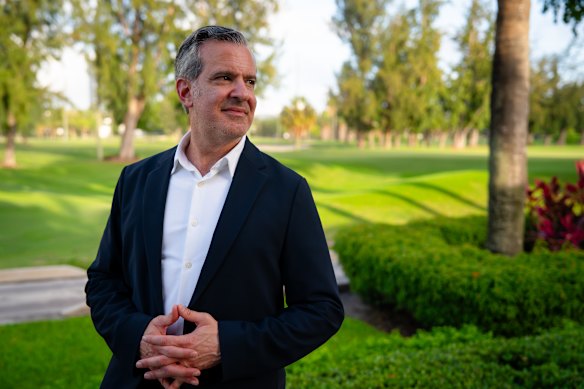
Public safety is his first thought when I ask him to explain the boom in his part of the world. He boasts that major crime is down 20 per cent this year, which already fell 20 per cent last year. This year’s homeless count was the lowest on record and down 60 per cent from three years ago. Miami Beach does not permit outdoor sleeping and camping – though police are required to offer shelter before arresting someone. They even fly drones over the city’s dunes to catch people sleeping rough on the sand.
Meiner is also proud of the city’s expensive hotels; he tells me that in the first four months of 2026, the peak season, the average room rate in Miami Beach was $US400 a night. “There’s not a city in America that is over $US300 besides us,” he says. “Revenue per available room, we are also number one. Occupancy rate, number one.” These are highly seasonal, however: in June, Good Weekend nabbed a lovely room for $US100.
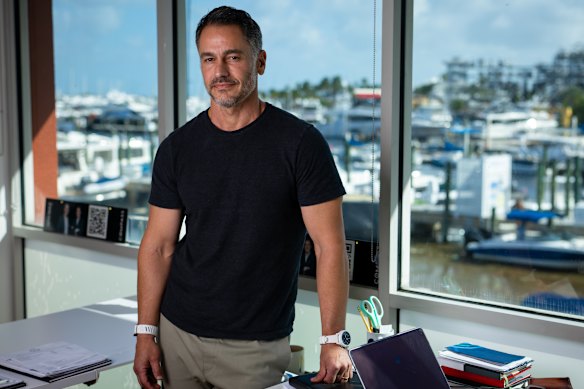
For most people here, growth is unashamedly good. That’s certainly true for Ivan Chorney, the luxury real estate broker in the Compass team Ivan & Mike, who welcomes us to his office in ritzy Coconut Grove. He and his team recently landed the biggest sale of his career: a $US50 million penthouse atop the forthcoming, ultra-luxury Mandarin Oriental at Miami’s Brickell Key, to a couple from California seeking different tax rates and different politics. And one of their colleagues just sold former Starbucks CEO Howard Schultz a $US44 million penthouse in Surfside.
Chorney says business has slowed in terms of volume since the pandemic but accelerated in value: fewer deals, but more with ultra-high net worth buyers. From next year, Chorney and his business partner Michael Martirena have decided they’re only interested in sales above $10 million. The buying “season” generally starts after Thanksgiving, when the great and the good travel to Miami for the Art Basel art fair, before a brief break over Christmas. “Then it’s, ‘Wheels off, you’re gone,’ ” he says, all the way through to the Formula 1 grand prix in May.
Many economists worry the current excitement about artificial intelligence in the US – which has driven share markets to record highs – is a bubble that will burst like the dotcom crash of 2000. Could that speculative investment trend extend to Miami property? Chorney doesn’t think so. “People hear of Miami real estate and they’re like, ‘It’s the boom and bust city.’ That was historically correct,” he says. “Now these are end users. They’re moving their primary residences here, they’re moving their businesses here, you have these big mega-hedge funds coming here, financial firms, insurance companies. They’re all coming. It’s much more sustainable and long term now.”
Paul George, the historian who has studied and lived through Miami’s ups and downs, doesn’t know what to believe. “It’s almost like a fantasy,” he says of the billionaires and celebrities settling in his town. “But it’s happened so quickly and happened in such an inauspicious way. We’re in a period where I’m sort of confused: will this continue, is this the trend? I fear it is – because we’ve got weather and water, we’ve got good tax laws for people. This could be the thing.“
George has benefited from the boom himself: his home, purchased in 1984 for $US50,000, was recently valued at $US860,000. But he is frightened of what he sees as the “us and them” dynamic developing between the wealthy transplants and those who have been here all their lives and are struggling to keep pace with the change. “I just hope I can kind of hold on,” he says.
Get the best of Good Weekend delivered to your inbox every Saturday morning. Sign up for our newsletter.
Read more from Good Weekend: