

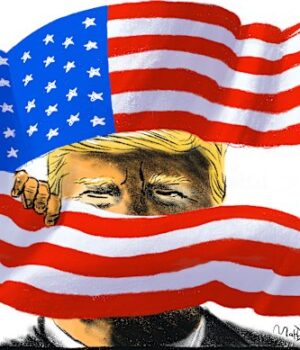
SOURCE :- THE AGE NEWS
America, when it comes to celebrating landmark national birthdays, has made a habit of being locked in internal conflict.
Its bicentennial took place in 1976, a year after the fall of Saigon affirmed defeat in a war fought in the jungles and paddy fields of Vietnam that had torn apart the nation. Washington DC was also shell-shocked from the Watergate crisis, which forced Richard Nixon, through his own criminality, to become the only president ever to resign from office.
On the eve of the country’s 200th anniversary, Gerald Ford, who was something of a makeshift president, confessed in his annual address to Congress “the state of the nation is not good,” an unusually pessimistic, albeit accurate, assessment.
The mood music for America’s centenary in 1876 was more dissonant still. The Civil War, a conflict in which at least 750,000 Americans were slain, had ended little more than a decade hitherto. In the states of the defeated Confederacy, the Ku Klux Klan was in the midst of its wave of terror against newly freed slaves.
That year witnessed a disputed presidential election, which was only resolved when the eventual winner, the Republican candidate Rutherford B. Hayes, agreed to withdraw federal troops from the south, a retreat which paved the way for the racial apartheid of the Jim Crow era, which lasted until the middle of the 1960s.
The 50th anniversary, marked in 1826, was more unifying, partly because of a cosmic fluke which saw the deaths on July 4 both of John Adams, the country’s second president, and his nemesis and successor, Thomas Jefferson. Widely was this strange coincidence interpreted as providential: a sign from the Almighty that a country which still felt like a state-nation rather than a nation-state had His blessing.
Up to then, the fear was that the United States of America could break up, which is exactly what happened less than four decades later when the slave states seceded. What now on this semiquincentennial, when the country is in a state of cold civil war?
Ahead of its big birthday, there is not even agreement over who should organise the party. Ten years ago, Congress set up America 250, a bipartisan commission with Barack Obama and George W. Bush serving as honorary co-chairs, to plan the commemorations.
After returning to the White House, however, Donald Trump set up a rival committee, Freedom 250, partly to make sure the celebration glorified himself. Trump has not only hijacked July 4 itself, but sought to merge the country’s 250th with his own 80th birthday.
On that high holy day in the MAGA calendar, he staged cage fights on the South Lawn of the White House, a primal exhibition which seemed designed to show that all men are not created equal. It’s a far cry from the bicentennial commemorations, when White House aides suggested Gerald Ford might want to plant a tree in the back garden or spend some private time with his family.
It is not just the trappings of the celebrations, but their meaning which is being contended. Both the anti-Trump left and pro-Trump right have claimed ownership on the spirit of the American revolution. The “No Kings” mass protests during Trump’s second term deliberately evoke the 27 grievances against King George III enumerated in the Declaration of Independence, the country’s first flowering of grievance politics. But “1776″ also became the MAGA battle cry chanted by many of the insurrectionists as they stormed the US Capitol on January 6, 2021. They styled themselves as patriots, not seditionists.
Nor is there even agreement over whether 1776 should mark the start of the American story. The 1619 Project, published by The New York Times on the 400th anniversary of the first ship carrying enslaved Africans arriving in the colony of Virginia, was an attempt to promote an alternative origin story. As its authors noted at the time: “It aims to reframe the country’s history by placing the consequences of slavery and the contributions of black Americans at the very centre of our national narrative.”
Trump’s 1776 Report, published in the final hours of his first term, was his rebuttal. It absolved the Founding Fathers of any blame for owning slaves and concluded America was “the most just and glorious country in all of human history”. Trump has always understood the political power of romanticised history and nostalgic nationalism. As the Harvard historian Professor Jill Lepore recently noted: “‘Make America Great Again’ is a four-word argument about American history.”
That history is endlessly contested. There is still no consensus, in a country that only achieved universal suffrage midway through the 1960s, about the rules of democracy. Arguments rage over who makes up “We the People,” and whether those born on American soil, regardless of their lineage, should automatically gain citizenship, as decreed by the 14th Amendment.
The Supreme Court affirmed that right only this week, although, alarmingly, three of its hardline conservative justices decided that the president should be able to fundamentally alter the meaning of the Constitution with the flourish of his Sharpie pen. The gun debate turns on the tortured wording of a Second Amendment ratified in the late-18th century which concerned militia groups rather than the arms they would bear. Only in 2008 did the Supreme Court rule there was a constitutional guarantee for individual gun ownership, a spurious interpretation of the Second Amendment overturning almost two centuries of jurisprudence.
The opening riff of the Declaration of Independence, that “all men are created equal”, was never meant as a “promissory note”, as the Reverend Dr Martin Luther King jnr claimed at the March on Washington in 1963. Thomas Jefferson, a slave owner himself, was not arguing for racial equality, which was anathema to the founding fathers. This foundational text was also published in redacted form. Sections condemning slavery penned by Jefferson were deleted following objections from southern colonies. Never would the declaration have been adopted without this compromise, just as the US Constitution would not have been agreed upon in Philadelphia without a Faustian bargain over slavery. As the historian Heather Cox Richardson has noted, “the principle of equality depended on inequality”.
From the outset, then, the American republic was beset by divisions: deep fissures more so than hairline cracks. That the country is so polarised on its birthday is therefore entirely fitting. Throughout its epic history, from July 4,1776 to July 4, 2026, the United States have always been the Disunited States.
Nick Bryant is the author of The Forever War: America’s Unending Conflict with Itself and the Substack, History Never Ended.
Get a weekly wrap of views that will challenge, champion and inform your own. Sign up for our Opinion newsletter.
 Nick Bryant is a former BBC correspondent and the author of The Forever War, America’s Unending Conflict With Itself.

