

Source : the age
Last Wednesday as temperatures in England soared to 35 degrees, more than 12 degrees above average, the London School of Economics cancelled an event to discuss the impact of extreme heat due to the extreme heat.
A heatwave, supercharged to its record-breaking extreme by global warming caused by the burning of fossil fuels, had settled over Europe under a dome of high pressure and unleashed carnage across the continent. So-called “red” warnings had been issued in London alerting people to the threat of extreme heat.
The event on June 24 was to have marked the start of London Climate Week. Its panel was to have included Professor Lord Nicholas Stern, a former World Bank chief economist, famous also as the author of the Stern Review on the Economics of Climate Change.
Apologising for the cancellation, the LSE explained that the venue it planned to hold the event in, known simply as the Old Building, did not have cooling mechanisms in place “like most buildings in London” and it would be unsafe to host a public gathering within its solid stone walls.
Given the death toll that was already mounting across Europe, it was not an unreasonable concern. That day the London Ambulance Service responded to 7900 calls, including 642 that fell into its most serious category. This was a record, but the record fell again the following day.
In France, hospitals buckled under the strain and staff in some resorted to begging fast food outlets for ice in which to pack patients suffering heat exhaustion. In early reports, health authorities recorded more than 1000 excess deaths due to heat, but there were other causes of death too.
France’s Sport and Youth Minister Marina Ferrari warned that more than 90 people drowned between June 19 the start of July as people sought to cool off in rivers and streams.
A three-year-old boy died after he climbed into a car in Paris while his parents were distracted, and was trapped by a child lock. A brother and sister aged two and four died in circumstances in southern France.
“We are living through a completely unprecedented period – a fact we must have the humility to acknowledge,” France’s President Emmanuel Macron told a press conference. “We have adapted to global warming, but there is no adapting to a peak unmatched in Europe today and unprecedented in our history, meaning a heatwave peak in which temperatures soar 15 degrees above seasonal averages for such a prolonged period.”
The World Health Organisation warned that extreme heat would become increasingly common. “Europe is warming at more than twice the global average. Heatwaves are no longer one-off freak events,” it said. “Every summer we fail to prepare for them is a summer we pay for in lives.”
Spain’s Carlos III Health Institute said in a report that there were at least 1028 heat-related deaths in the final days of June, and it is now bracing for temperatures of up to 44 degrees this weekend.
As health authorities are not equipped to quickly report heat deaths, and because elderly victims who die alone at home can go unreported for days or even weeks, the death toll is likely to be over 20,000, according to one analysis.
A rapid modelling study by Dr Christopher Callahan, a climate scientist at Indiana University, estimates that heat probably killed more than 20,000 people, with more than 5000 excess deaths in France, 4500 in Germany, more than 3000 in Spain, 2700 in Italy, 1070 in Poland and 862 in the UK between June 22 and June 28.
The disaster is, he says, is a “window into the future”.
Callahan’s study, which is not yet peer-reviewed, uses statistical analysis of excess deaths rather than reports of deaths from health authorities.
But the impact so far has gone far beyond deaths and injuries.
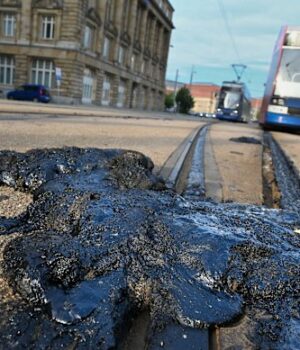
In Germany, which broke its all-time temperature record on three consecutive days, joint seals in tram tracks melted in the city of Leipzig, halting public transport. In France, rivers became too hot for nuclear power plants to safely discharge heated water into, so power production was cut as demand shot up. Schools across Germany, France, Spain and the UK were closed.
With hundreds of thousands of chickens dying in the heat, carcass collection services were overwhelmed in France, Reuters reported. The cost to agriculture is not yet clear.
Back in London, half an hour’s drive from the LSE’s cancelled forum, another event went ahead in a far larger and thoroughly air-conditioned venue. This was the Alliance for Responsible Citizenship’s conference, a growing annual gathering of conservative and right politicians and commentators.
Among ARC’s primary concerns is the defence of what it calls Western civilisation and the fight against climate action, which it considers to be a waste of money.
Addressing the crowd, Nigel Farage, leader of the far-right party Reform, now leading UK polls, thought the heatwave – by then hitting more than 150 million people – was a tremendous wheeze.
“I’m amazed to see so many people here. Don’t you know there’s a red warning? We’re in the red zone! Schools have all closed! No one’s going to work! There’s a danger to life!” he said at the start of an on-stage conversation.
He went on to attack both UK Labour and the Conservatives for their support for their climate action policies. “The Tories even wrote net zero into law, and they shouldn’t be forgiven for it, in my opinion,” he said.
Farage’s party rejects the scientific consensus on climate change, as does the emboldened new right across Europe and in Donald Trump’s America. During the ARC conference, which was attended by conservative figures from around the world, including Tony Abbott and Peta Credlin, Scott Morrison and Barnaby Joyce, when climate change was mentioned it was generally as a punchline.
There’s little sign that the terrible death toll will shift the hardening views of conservatives against climate action, even as a new heat wave builds in Europe and another builds in the United States.
Rather than address the link between fossil fuels and the rapidly mounting death toll this week, conservatives blamed progressives for opposing the deployment of air-conditioners.
“It is high time that France rolled out a major air-conditioning equipment plan,” the French far-right leader Marine Le Pen said in post on X. She blamed the French “so-called elites” for leaving ordinary people to suffer in the heat while they enjoyed air-conditioning.
“Hospitals, schools, nursing homes, public transport, etc., are not equipped, even though these places host French people who are particularly vulnerable to the heat.”
The failure of serious debate led one German commentator to lament that like floods, heatwaves are now natural disasters, “with the difference that when there’s flooding, every politician pulls out their rubber boots and speaks affectedly into cameras and microphones. But when it’s hot, [conservative politician] Markus Söder posts a picture of himself at an outdoor pool and says: ‘Swimming helps when it’s hot.’ Seriously?”
Richard Black, the Berlin-based climate analyst and author of the book Denied: The Rise and Fall of Climate Contrarianism, says it’s clear why some leaders would rather engage in a culture war over cooling infrastructure in the face of such an enormous long-predicted catastrophe. “It’s definitely better for the fossil fuel industry, and it’s also better for politicians and think tanks, aka lobby groups, who oppose the clean energy transition. Because we’re not then talking about the energy transition, we’re talking about air-conditioners.”
He doesn’t expect much to change in the near future either. Though conservatives championed climate and environmental protection – with Nixon and Reagan pushing for clean air and marine policy, and Thatcher leading the push for climate action – the emerging hard right sneers at such policy.
With no pressure from their opponents to act, progressive leaders have been allowed to backslide in their ambition.
On the last day of the Alliance for Responsible Citizenship conference, Abbott ended his speech, a criticism of black armband history, with the words, “We call this ARC. There was another ark, a biblical one that saved humanity, and maybe that’s our challenge too.”
Outside, a small group of Christian protesters waited in the heat, one holding a banner with a quote from Pope Francis emblazoned upon it: “Listen to the Cry of the Earth and the Cry of the Poor – Protect Our Common Home.”
Get to the heart of what’s happening with climate change and the environment. Sign up for our fortnightly Environment newsletter.
 Nick O’Malley is National Environment and Climate Editor for The Sydney Morning Herald and The Age. He is also a senior writer and a former US correspondent.Connect via email.