

Source : Perth Now news
Before a jury had even been chosen in the Cairns “amputation murder” trial, prospective jurors were told they would likely be shown graphic CCTV footage of a man’s leg being severed with a circular saw if they were selected.
The warning offered a rare glimpse into one of Australia’s oldest civic duties. Jury service is far more than turning up to court and delivering a verdict.
It can mean spending days, weeks or even months hearing deeply confronting evidence before 12 strangers retire behind closed doors to decide another person’s future.
The letter nobody wants
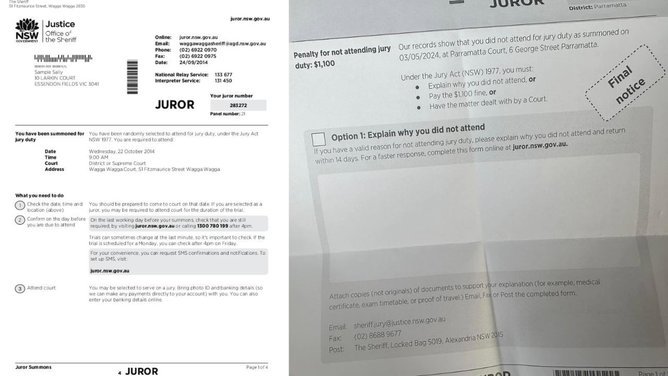
For many Australians, the jury summons is one letter they hope never arrives.
One NSW woman, who asked not to be identified, admits she initially felt the same.
She only discovered her summons after checking her rarely used letterbox just days before she was due to attend court.
“I was actually curious about the jury duty process,” she said. “But the actual period of time I needed to be available was listed as, like, 24 weeks.”
Living interstate from her family, she worried accepting the summons could prevent her from travelling for “birthdays and funerals and hard times back home”.
She was ultimately granted an exemption because she had booked flights before the summons arrived, but expects she will eventually be called again.
For many, the financial impact is another concern. While most trials are much shorter, the uncertainty can be difficult to manage. Juror payments also differ across Australia.
In NSW, jurors receive $106.30 a day for the first 10 days of a trial, increasing to $247.40 a day from day 11 for employed and self-employed jurors.
In Queensland, empanelled jurors receive $148.30 a day, increasing to $197.90 after the 20th weekday of a trial, with many employees entitled to have the gap between the allowance and their usual wage covered by their employer.
Every year, about 130,000 Queenslanders receive jury summonses after being randomly selected from the electoral roll.
Only a fraction will ever sit on a jury as many are excused because of work, caring responsibilities, health issues or pre-booked travel, while others attend court but are not selected once the jury is empanelled.
Judges, practising lawyers, police and corrective services officers, and prisoners are among those excluded under Queensland law.
Jurors who do serve are protected from dismissal by law and, if their employer does not continue paying them, receive an allowance that increases for longer trials.
Queensland Chief Justice Helen Bowskill says the jury remains central to our justice system because it brings ordinary Australians into the courtroom.
“The institution of the jury is the foundation of our criminal justice system,” she told 7NEWS.com.au.
“It ensures that a broad cross-section of members of the community are involved in decisions which affect the community.”

Bowskill says diversity is fundamental because jurors bring different backgrounds, perspectives and lived experiences into the deliberation room, ensuring verdicts reflect community standards rather than the views of legal professionals alone.
“The strength is in 12 ordinary people from the community with their wisdom, with their life experience, with their common sense, coming together to make a decision,” she said.
“The role of the jury also aids, to some extent, the acceptance of the outcome, because it’s something made by members of the community.”
How 12 strangers are chosen
After receiving a jury summons, prospective jurors attend court as part of a much larger panel of people than will ultimately serve on a jury.
Names are drawn at random until 12 jurors, and sometimes up to three reserve jurors, are selected.
Along the way, people may be excused for legitimate reasons, while the prosecution and defence can each challenge a limited number of prospective jurors without giving a reason, or object to someone they believe cannot be impartial.
Prospective jurors are told the names of the accused, witnesses and lawyers before being asked whether they know anyone involved or have personal experiences that could affect their impartiality.
Sometimes those conversations are deeply personal: a victim of domestic violence, someone who has lost a loved one in similar circumstances or another person with a close connection to the issues in the trial may conclude they cannot decide the case fairly.
“We do try to ensure that the person who feels, because of the type of case, that they can’t be impartial tells us before we get going so that we can select somebody else,” Bowskill said.
Sometimes, judges also warn them about the nature of the evidence they are likely to see.
Not long ago, juries largely relied on eyewitness accounts, photographs and forensic evidence to piece together what happened.
Today, they increasingly watch crimes unfold. Security cameras capture assaults in shopping centres. Dashcams record fatal crashes. Doorbell cameras document armed break-ins. Mobile phones preserve violent incidents from beginning to end.
Jurors no longer simply hear about traumatic events, they often watch them repeatedly as prosecutors, defence lawyers and expert witnesses analyse individual frames or challenge what the footage does, or does not, show.
Bowskill said judges rethink how they prepare jurors before evidence begins and must strike a careful balance.
Warn prospective jurors too little and they may be shocked by the evidence. Tell them too much and they risk forming views before hearing the case. Instead, judges generally advise them they may be exposed to serious violence, significant injuries or other distressing material.

The wording is carefully discussed with both prosecution and defence lawyers.
For Griffith University’s Innocence Project director Dr Robyn Blewer, the rise of graphic digital evidence has fundamentally changed the experience of jury service.
“It’s really hard,” she said.
Jurors may be required to watch confronting footage over and over before later discussing it with 11 strangers.
“I think that really raises the stakes … and makes it really important that we respect the work they are doing for us as a community.”
The emotional toll is increasingly being shared online. Blewer points to viral TikTok videos in which former jurors describe leaving court traumatised after particularly confronting trials.
“There’s a TikTok … with over five million views of a woman saying how traumatised she’d been by the jury experience,” she said.
“That’s also going to put off potential jurors.”
Yet she believes that should not diminish the importance of the role, saying: “I think it’s probably one of the most important civic responsibilities that we ask people to perform.”
The one thing jurors must not do
Once the jury is sworn in, the work has only just begun.
Most criminal jury trials are completed within a week, but complex fraud or murder trials can continue for months.
Throughout that time, jurors are expected to attend every day, concentrate on every witness and remember evidence that may later become crucial during deliberations.
Jurors are repeatedly told not to research the case, search legal terms online, discuss the trial with family or friends, read media coverage or post about their experience on social media.

The Chief Justice acknowledged the directions run counter to modern life, where answers are only a few taps away.
“We’re asking people to do something that’s different from what they would ordinarily do,” Bowskill said.
“I Google things too.”
But the rule exists for one reason: every verdict must be based solely on evidence tested in court.
Anything a juror finds online, whether it’s a news report, Reddit discussion, TikTok video or AI-generated summary, cannot be challenged by either side and risks undermining a fair trial.
If that happens, the consequences can be significant.
“It is very stressful for everybody involved,” Bowskill said.
“There is a lot of public money involved in a trial.”
In serious cases, juror misconduct can force proceedings to collapse and begin again months later.
Blewer points to the 2022 Bruce Lehrmann trial, which collapsed after a juror conducted outside research, as a reminder of how a single breach of the rules can derail an entire trial.
Prosecutors later abandoned plans for a retrial, citing concerns about the toll another criminal proceeding would have on the complainant’s mental health.
“The justice system is definitely working to deal with that,” Blewer said. “The evidence you have to decide this case on is the evidence you hear in this courtroom and nothing else.”
A mistrial can mean victims and witnesses are called back to relive traumatic evidence, the accused faces months more uncertainty, while taxpayers foot the bill for a subsequent trial.
“There is a lot of public money involved in a trial,” Bowskill said.
Behind closed doors
When the final witness has given evidence and the judge has finished summing up the case, the courtroom empties and the jury retires.
From that moment, what happens inside the deliberation room is one of the justice system’s closest guarded secrets.
Jurors debate the evidence, test one another’s views and work towards a unanimous verdict.
Depending on the complexity of the trial, deliberations can take a matter of hours or continue for several days before a decision is reached.
Jurors are given exhibits, transcripts (where available), written directions and increasingly “question trails” stepping them through the legal questions they must answer before reaching a verdict, Bowskill explained.
While juries strive for unanimity, Queensland law allows judges to accept an 11-1 majority verdict in many criminal trials after at least eight hours of deliberations if the jury remains deadlocked.
Unlike judges, jurors never explain how they reached their verdict.
“They need to be able to have those discussions between themselves, knowing that then it goes no further than that,” Bowskill said.
The secrecy is designed to protect jurors from outside pressure and allow frank discussion without fear their conversations will later become public.
Jurors are generally prohibited from revealing what was said during deliberations.
Until the late 20th century, jurors in some lengthy or high-profile trials could be sequestered in hotels, cut off from television, newspapers and outside contact until they reached a verdict.
The practice has largely disappeared because of its cost and disruption to jurors’ lives, although judges still have the power to isolate a jury in exceptional circumstances where outside influence poses a real risk.

It also means researchers know remarkably little about what actually happens once the jury room door closes.
“We don’t ever find out any information about who was on a jury or how they deliberated,” Blewer said.
“A lot of the research on juries is done with mock jurors.”
Blewer regularly runs mock jury trials with high school students and each group hears exactly the same case in exactly the same words, but the verdicts are often different.
“I’ve been doing this for a few years now and every time they will come up with different verdicts,” she said.
Some jurors place greater weight on eyewitnesses. Others focus on forensic evidence. Some change their minds after hearing other perspectives, while others remain unconvinced until the very end.
“Their verdicts are quite fascinating because they’ve all heard exactly the same words.”
So, juries can get it wrong?
Before leading Griffith University’s Innocence Project, Blewer’s interest in wrongful convictions was sparked by the Amanda Knox case — one of the world’s most high-profile alleged wrongful convictions.
Knox, an American exchange student, spent four years behind bars after being convicted of murdering her roommate in Italy before the conviction was overturned, ruling the evidence was insufficient and the investigation deeply flawed.
Knox was ultimately acquitted after years of legal battles.
Blewer says juries are rarely the reason justice fails.
“I think something has gone wrong really before it gets to the jury,” she said.
Evidence may have been missed or not disclosed. A witness may be mistaken. Forensic evidence can later be found to be tainted.
Jurors can only decide the case placed before them.
“They have to assess the evidence and assess the facts.”

Still, the justice system trusts ordinary Australians to decide the most serious criminal cases, while jurors trust judges to guide them through complex legal directions and ensure they hear all of the relevant evidence.
Neither side gets it right every time but, after decades studying wrongful convictions, Blewer says the solution isn’t to remove juries.
“I think it’s the best sort of system that we have at the moment,” she said.
“It provides us with an opportunity for lay people, for the community, to participate and perform a civic duty.”
Even after a verdict, the justice system includes safeguards. Convictions can be appealed if the judge made an error of law, the verdict was unreasonable or fresh evidence later emerges.
Back in Cairns, the prospective jurors who had been warned about the confronting CCTV footage still had a choice. Some may have decided the case was not one they could fairly hear. Others stayed.
Over the following week, 12 ordinary Queenslanders listened to witnesses, watched graphic evidence and grappled with one difficult legal question: had prosecutors proved beyond reasonable doubt that John Yalu intended to cause grievous bodily harm when he amputated Kalman Tal’s leg with a circular saw?
During deliberations, the jury sent Justice James Henry a written note questioning whether a murder conviction would be “incorrect and very unjust”.
The note was later read out in open court before the judge reminded jurors they were entitled to apply their “innate sense of fairness and justice on behalf of the community” while deciding the case on the evidence.
The jury returned a unanimous verdict of not guilty of murder but guilty of manslaughter.
Their verdict demonstrated exactly what the Queensland Chief Justice and Blewer describe as the enduring strength of Australia’s jury system.
The 12 ordinary members of the community didn’t simply accept one side’s argument or the other. They weighed the evidence, tested the law against the facts and reached their own conclusion.
“I would like people to receive their summons and go, ‘I’m proud. I’m proud to be asked to serve my community in this way,’ rather than seeing it as an inconvenience or a burden, because it’s really highly valued by those of us who work in the system day in, day out,” Bowskill said.
“When you think about it, there’s not many decisions in life that are required to be made by 12 people. And if you get a decision that 12 members of the community all agree to, that’s a pretty powerful decision.”