

Source : the age
When smart speakers powered by voice assistants debuted a decade ago, everything about the technology was new and exciting. But as their functions became pedestrian, and were gradually integrated with our phones and other devices, most people either forgot about them or just stuck with the ones they had. The category has been searching for a compelling second act, and while Google thinks AI chatbots are a good fit, its new Home Speaker isn’t a convincing example.
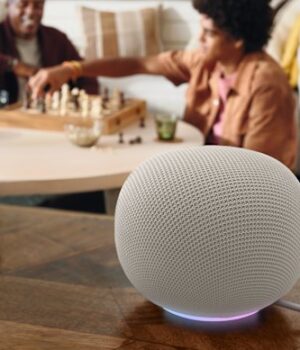
This $200 device is ball-shaped but with a flattened top, roughly the size of a large apple. It has touch controls for volume and play/pause; it is covered in a knit fabric; and it has a light ring at its base to show when it is listening, talking or thinking. It looks a lot like a halfway point between the old Nest Mini and Nest Audio, both of which it replaces. And sonically it’s right between them as well — weak bass, tinny highs, pretty good on mids and vocals — not something I’d want as my only speaker for music.
So why does it cost the same as a Nest Audio if it doesn’t sound as good? Well, the entire selling point of the new Home Speaker is smarts. Inside, it has the processors to run a version of Gemini locally, as well as a Thread router to help it co-ordinate with all of your smart home and Matter-compatible gear.
So it maintains the old promise of sitting at the centre of your connected home, directing traffic and taking your requests. And it still does that well. But it adds the idea that you’re not just calling out pre-baked phrases; you’re conversing with an LLM with reasoning capabilities that can help run your home.
Ask, and maybe receive
Gemini is a lot more talkative than the old Google Assistant, but that doesn’t automatically make it more useful. The first thing I asked was which services the new speaker could use to play audiobooks, but Gemini wouldn’t stop talking about audiobook services in general, offering to compare the features of Audible and Libro.fm, discuss options for purchasing audiobooks or subscribing to monthly credit systems, or recommend books to listen to.
It took me several minutes of back-and-forth conversation to get the speaker to admit it didn’t work with the services it was gushing about. I know the speaker can play audiobooks I own on Google Play Books (I tried it, and it works), but curiously, Gemini did not seem confident that was the case, telling me that Google Home speakers could experience playback issues with the service.
When you’re asking general information questions, the old Google Assistant would often read a summary of a website, as though it had performed a Google Search and was describing the first result.
By contrast, Gemini is effectively reading the AI overview that would now appear at the top of Google Search. In some cases, this gets you a succinct and conversational answer. In other cases, it gets you a lot of waffle, and it’s a lot more difficult to ascertain the source of the information you’re hearing.
You can ask follow-up questions, and Gemini will stay on topic and remember the context. But while this ends up feeling more like a conversation with a human who is very confident about their knowledge, sometimes what you actually want is a reliable fact directly from a trustworthy source. I never got that with Gemini, unless I was asking for simple maths or data.
The thing is, the old Google Assistant already did everything I needed it to do, and was relatively reliable.
If you’re talking to Gemini via its smartphone app, it will annoyingly end every response by prompting you to keep the conversation going. But with the Home Speaker, I noticed it was a bit more judicious about when to do that.
Sometimes it would simply answer my question and shut up, which is good. Other times, it would offer to dive deeper, and keep listening. In one instance I said, annoyed, “no, that’s enough”. It said, “OK, stopping Lounge TV”, and paused whatever the kids were watching at the other end of the house.
Not so smart home
The thing is, the old Google Assistant already did everything I needed it to do, and it was relatively reliable. When I added the new Home Speaker to my set-up, it activated Gemini instead on all of my Google speakers and displays, and I wouldn’t classify that as an upgrade.
Google will extol the virtues of having an agent that can understand what you want, without you needing to stick to a certain syntax. But the other side of that coin is a certain lack of consistency and predictability.
Google’s subscriptions explained
The service formerly known as Nest Aware is now Google Home Premium. It covers all smart home devices, including the Home Speaker but also doorbells, cameras and displays.
- Free: basic functionality. You can ask your speaker questions, control your smart home, and get media playback. Events captured by your cameras are only stored for a few hours.
- Standard, $15 per month: You can use Gemini Live on home speakers. You can talk to Gemini using the Google Home app to describe automations. Camera events stay stored for 30 days, and familiar face detection lets your devices tell you who’s at the door.
- Advanced, $30 per month: Recordings stay for 60 days, and they’re indexed so you can search through them just by asking for events you want to see. You can even say something to Gemini like “what happened in the house while I was gone over the weekend?”
Gemini is noticeably better at interpreting intent. I can ask for all lights in the house to turn off except the ones in the office, and it works it out. I can describe the kind of music I want, and the speakers I want it to come from, and in around a second Gemini will reply: “Got it. Playing low-fi beats to study to, on your office speakers.“ But the number of times it has given verbal confirmation and then done nothing has been way higher than it ever was with the regular Google Assistant.
In some cases, Gemini is not worse, just different. It applies more reasoning to some simple requests. So for example, asking for certain bands or songs with ambiguous names would sometimes have unexpected results with the old Google Assistant, but Gemini tends to ask for clarification every time. Did you mean the movie or the band? Did you mean the band or the album? The result is the same though; I try to remember to add “the band, on Spotify” to the end of my request next time.
The built-in AI hardware makes the Home Speaker faster in its responses, compared to my other devices which I guess are now running Gemini in the cloud. Regular requests like setting timers, asking for measurement conversions, adding items to lists and activating lights are quick and easy.
But I’ve struggled to find something useful Gemini can do that Google Assistant could not.
The marquee new feature for Gemini is its Live mode, which actually requires a subscription to use on the Home Speaker (though it comes with six months of free access). This works just like Gemini Live on smartphones; as though you’ve called your friend, who happens to be AI, for a chat.
Gemini is quick and natural, and it can react if you interrupt it or change the subject. But I’m not sure when I would use this. Gemini is good at researching and brainstorming, but it also lies and makes mistakes often enough that I prefer to get everything in text with the app rather than talking out loud.
Gemini Live also seems to have some teething troubles on the Home Speaker, as more than once it has simply stopped replying to me, or interrupted itself by summoning music that nobody asked for.
While it will surely get better over time, I suspect most users will prefer using their phone to paying $200 plus a monthly $15 subscription to use this speaker.
Get news and reviews on technology, gadgets and gaming in our Technology newsletter every Friday. Sign up here.