

SOURCE :- THE AGE NEWS
Istanbul: Alyona Sadovnikova first experienced Russia’s petrol shortages in mid-June, when she pulled into a station and was told it was serving only customers who had ration coupons.
“I was horrified: Are we in the Soviet Union now where you had to get coupons to buy sausage?” she said.
Just a few days later, Sadovnikova found herself waiting 18 hours to fill up in the city of Irkutsk, in eastern Siberia, almost 5000 kilometres from the Ukrainian border.
As Ukraine escalates its attacks on Russian oil infrastructure, including some deep into Russian territory, refineries across the country have been forced to shut down for lengthy repairs.
That has caused the kinds of fuel shortages that many Russian citizens have not seen in their lifetimes. They started in Russia-occupied Crimea in May and have since spread to mainland Russia and even Siberia.
The situation is so serious that Russian officials said last week that they were in talks to explore importing oil from other countries, a startling admission for the world’s third-largest oil producer. On Friday, authorities in the Black Sea city of Novorossiysk, home to Russia’s largest oil export terminal, said they were suspending fuel sales to individuals.
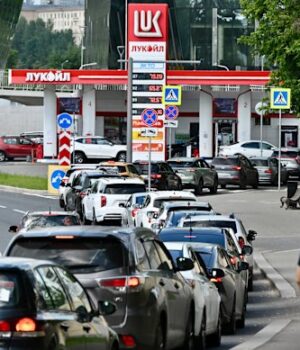
The long lines are one of the most vivid and tangible examples of how the war with Ukraine is affecting daily life in Russia, and a challenge for Russian President Vladimir Putin, who has gone to great lengths to tamp down any opposition to the war. Frustrations have run so deep that fistfights have broken out among exasperated motorists waiting for hours in line.
“Gasoline shortages are no longer merely an economic issue – it’s a test for the government’s ability to manage an acute crisis which strikes at the heart of day-to-day normalcy,” Ilya Grashchenkov, a Moscow-based political analyst, said in a research note.
Long lines at the pump have become a common sight, and crowdsourced websites have popped up to track supply at individual stations. Up to 20 per cent of the nation’s taxi drivers are choosing to stay at home, Russian newspaper Kommersant reported.
The densely populated regions around the Russian capital appeared to be most vulnerable to the shortages. The Moscow Oil Refinery and a major refinery in Tatarstan, about 1000 kilometres to the east of the capital, which account for 10 per cent of Russia’s total fuel capacity, have both reportedly shut down after Ukrainian attacks.
On Wednesday afternoon last week, dozens of motorists clogged the busy highway from Moscow to St Petersburg, forming a line to one of the few stations that still had petrol.
The sight is completely unfamiliar to Russians who grew up in a country of booming oil production.
An older generation that “saw empty shelves at grocery stores” during the fall of the Soviet Union is mentally more prepared, said Boris Nadezhdin, a 63-year-old opposition politician. “But for people in their 20s and 30s, this is a complete shock.”
Even though the government had subsidised oil companies to keep fuel affordable, prices have been rising. Service stations owned by state-owned Rosneft have kept prices low, but they attract long lines.
In Chechnya’s capital, Grozny, one customer, Said-Hasan, a 42-year-old man who asked that his last name be withheld for security reasons, said he took a short drive to the neighbouring Ingushetia region last week to get cheaper fuel, even though he could not get more than 30 litres because of rationing.
Smaller, independent stations in the south have been standing empty, marked with traffic cones, said Alexander, a 33-year-old professional driver who travels extensively around the Krasnodar and the Rostov regions. He also requested that his last name be withheld.
At least a third of the stations in Krasnodar, Russia’s third most populous region, have been shut, said Evgeny Pergun, the deputy governor there.
Some Russians have resorted to comic relief to cope. In one viral post, a Russian blogger imagined that users of a popular taxi-hailing app would soon be able to pick a horse among ride options.
Shortages appear to be particularly dire in eastern Siberia and the Far East.
Lines in the Irkutsk region have been so long that authorities promised to install portable toilets along highways to serve the motorists. Igor Kobzev, the local governor, declared a state of high alert – one notch away from the state of emergency – on Sunday.
Together with her husband and their 18-month-old baby, Sadovnikova joined the line at one station at 11pm on a recent Friday. She did not get served until 5pm the next day. They used the station’s toilets and shop for toileting and snacks. Other people in the line were supportive and shared food and toys with her son, she said.
“The whole thing was nerve-racking and exhausting,” Sadovnikova, 26, said. “We’re trying to save the gas and hoping there’ll be more supplies by the time we run out again.”
Sadovnikova said she found it annoying that officials across the country have been accusing Russians of panic-buying while all independent stations in her city had shut down.
Speaking at a conference on Wednesday, Russian Energy Minister Alexander Novak insisted that the country was merely dealing with “shortages at selected gas stations” that “quickly get fixed”.
Market data, however, paints a different picture.
By mid-June, Ukrainian drone strikes had knocked out about a third of Russia’s oil refining capacity – or some 2.2 million barrels a day – said Ronald Smith, founding partner at the Texas-based Emerging Markets Oil and Gas Consulting Partners. Other analysts pointed to a smaller decrease of about 25 per cent.
“Plugging that hole will likely require several large plants to get their gasoline production back up and running,” Smith said. “How long it takes to fix it, in reality, depends on what was hit to begin with.”
Russian authorities tend not to publicise the extent of the damage or the inconvenience to Russian consumers.
Putin, who typically avoids commenting on bad news, broke the silence on June 28 when he admitted in an interview with state TV that Russia was seeing “a certain deficit” of fuel “but not a critical one”.
The Ukrainian attacks sought to “drive a wedge in Russian society and force Russia to halt, even for a brief moment, the advance of our troops on the front line”, he said, after calling an ad hoc meeting on the fuel crisis.
Many Russians genuinely blame the government more broadly for the country’s woes, but seem to exempt Putin himself.
Nadezhdin, the opposition figure, said he thought that would change. He said he was increasingly seeing Russians “waking to the idea that it is exactly Putin who brought us to this with his policies”.
If Russians kept seeing Putin on TV delivering upbeat remarks about economic growth while they line up to get fuel, he said, “Suspicions will arise”.
This article originally appeared in The New York Times.
Get a note directly from our foreign correspondents on what’s making headlines around the world. Sign up for our weekly What in the World newsletter.