
Source : the age
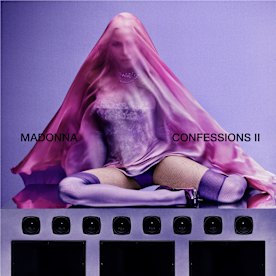
Madonna, Confessions II
★★★★
During a listening party for Madonna’s new album, producer Stuart Price revealed that he resurrected the studio microphone used on 2005’s Confessions on a Dance Floor, taping it together to record tracks for Confessions II. You couldn’t blame Price for reaching for a talisman; his first album with Madonna was a critical and commercial smash. But happily for the producer, his biggest client, and her millions of fans, the sequel is Madonna’s best record in 21 years.
Impressively, it’s no reheated version of the original. If the first record was inspired by disco acts such as ABBA, the Bee Gees and Cerrone, Confessions II draws from the Chicago, Detroit and New York house music Madonna was dancing to in the ’80s.
Built around a pulsing bass line that nods to the Giorgio Moroder-produced I Feel Love, opener I Feel So Free acts as a bridge between Confessions I and II. One Step Away goes deeper still, its echoing, watery synths invoking Lil Louis’ 1989 classic French Kiss.
While paying homage to the lineage, Price contemporises the tracks, loading the album’s harder mid-section with ravey breakdowns, vocoders and dubby EDM whomp. Attempts to expand Madonna’s appeal arrive in the form of zeitgeisty guests, including Sabrina Carpenter and Colombian reggaeton star Feid, but the album’s best collaboration is The Test, featuring the lovely vocals of Madonna’s eldest daughter, Lourdes (here, Lola Leon).
Leon reportedly suggested the song as a means of healing their relationship, and the results are stunning, as Madonna acknowledges “you didn’t ask for all the flashing lights” and Leon confesses “sometimes I wish I could multiply you but I know you are all around me”. A string of deeply personal ballads like this one close out the album, and while 16 tracks is probably two or three too many, there isn’t a genuine misstep among them.
Best of all might be Danceteria, a sashaying ode to the former Manhattan club where it all began for Madonna. À la Vogue, she name-drops celebrities in a spoken word sequence, this time trading Garbo and Monroe for Madonna’s own contemporaries. Among them, her one-time boyfriend Jean-Michel Basquiat, Nile Rodgers, the B-52s and her long-time bestie Debi Mazar – a who’s who of ’80s New York nightlife that Madonna was at the centre of, forging a glamorous history of her own.
After a series of misfires in the past two decades, it’s delightful to hear Madonna reconnecting with her roots on Confessions II and reminding us of who she is: the unsurpassed queen of pop. Of course, she’s still dancing. Annabel Ross
Ten Part Invention, Time Is Moved
★★★★
Someone’s been tinkering under the bonnet of the band I once called the “Rolls-Royce of Australian jazz”. With a few spark plugs changed, it’s purring again – and roaring when the accelerator’s depressed.
In the 20 years since Sydney’s 10-piece Ten Part Invention last recorded, their fearless leader, John Pochee, died. Half the band are now newbies – which means the other half, remarkably, have been on board since its 1986 inception. Pochee would be thrilled that the project lives on and, appropriately, they begin this double-album with Andrew Robson’s Hymn for John. “Feeling the love” has become a frightful cliché, but here it’s palpable.
Crucially, the band’s spirit is intact. The compositions, including Miroslav Bukovsky’s wryly titled Nostalgia (isn’t what it used to be), come from the members, and there’s still a sense of 10 distinctive musical personalities digging in the same sandpit, rather than a well-drilled big band going through its paces. The warmth of original bassist Steve Elphick’s sound is also central to the band’s character, and new pianist Kevin Hunt slides effortlessly in beside him, as does drummer Rease Cameron, while the seven exceptional horn players ensure the music’s character is in constant flux. John Shand
Sienna Spiro, Visitor
★★★★
Every generation needs its own bold, soulful British balladeer – a powerful, captivating woman who bridges the chasm between pop and blues with towering anthems that capture your imagination and break your heart. Boomers had Dusty Springfield, Gen X had Kate Bush, Millennials had Adele, and Gen Z just found theirs: Sienna Spiro.
After her breakout hit Die on This Hill blew up on TikTok, Spiro follows up with her debut record, Visitor. It’s a profoundly felt, achingly performed collection of piano-laden laments, delivered with the assuredness and patience of an artist far beyond her 20 years.
Spiro brings clarity to the murky depths of the soul. On The Visitor and We’re Not in Love, she reflects on the heartbreak of relationships where one person gives more and loves more, that painful and dangerous power imbalance that sends your whole life off-kilter. Pure is a poignant meditation on living up to self-imposed expectations of greatness. Great Expectation and He’s Not My Baby, I’m His channel Amy Winehouse, intoxicating vocals and sardonic lyrics crooned from a smoky jazz bar between defiant drags of a menthol.
You Stole the Show is the best power ballad since Someone Like You. One to belt out in your car, where no one else can hear you straining to nail that gargantuan chorus. Heaven help the brave people who try to tackle this one at karaoke. Tom W. Clarke
To read more from Spectrum, visit our page here.
 John Shand has written about music and theatre since 1981 in more than 30 publications, including for Fairfax Media since 1993. He is also a playwright, author, poet, librettist, drummer and winner of the 2017 Walkley Arts Journalism AwardConnect via X.