

Source : the age
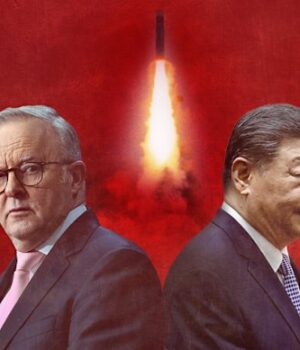
China’s intercontinental ballistic missile launch was an impressive display of firepower that appears to have landed on target, in international waters near the tiny island nations of Tuvalu and Nauru.
But the military flex is already looking like a diplomatic misfire. The risk for Beijing is that it boosts, rather than undermines, Australia’s efforts to cement itself as the region’s security partner of choice as the nations compete for influence in the Pacific.
In terms of global sentiment, Chinese President Xi Jinping has benefited greatly from Donald Trump’s moves to gut international aid funding, impose sweeping tariffs and launch a reckless war in Iran that disrupted global oil supplies.
A global study released last month by the Copenhagen-based Alliance of Democracies Foundation found respondents in 65 countries rated the US the biggest threat to the world. Just one country – Japan – rated China as the world’s biggest threat.
Firing a nuclear-capable warhead across thousands of kilometres in the Pacific – with just two hours’ notice – as Fiji sealed a military alliance with Australia, is a reminder of a more alarming, less appealing side of China. Despite Beijing’s insistence that the launch was a “routine” test, it is widely perceived in the region as a provocative and unsettling act. It will do nothing to boost China’s appeal in the Pacific, which prides itself on being a peaceful, nuclear-free zone.
This was clear on Tuesday, when Solomon Islands Prime Minister Matthew Wale stood beside Anthony Albanese at a press conference in Honiara on Tuesday.
“China is a good friend of Solomon Islands, but this is not something a friend does. This is not good in our region,” Wale said.
Noting he had registered a strong complaint with China’s ambassador, he added: “Be our friend, but don’t threaten us.”
Wale has proposed a Pacific-wide security pact that would, by definition, exclude China. Rather than deterred by the missile launch, he sounded emboldened, saying it provides “further evidence for the need for a regional platform so that the region can speak as one”.
It’s a remarkable turnaround from 2022, when the mercurial Solomons leader Manasseh Sogavare signed a security pact with Beijing that set off panic in Canberra.
The US also conducts long-range missile launches in the Pacific, as Wale noted with disapproval. But it at least has established processes in place and commonly gives days (rather than hours) of notice.
As for Australia, while it will never possess the military or economic might of China or the US, it has its own cards to play in the Pacific. And it has been doing so cleverly since Labor’s return to power in 2022. Back then, Beijing was on the march after striking its deal with the Solomons and looking to seal a sweeping 10-nation Pacific security and economic pact.
But it pushed too hard, too fast, and the deal did not get off the ground. Instead, in the years since, Australia has been locking in security deals across the Pacific and notching up victories on the diplomatic scoreboard.
A breakthrough 2023 deal with Tuvalu granted Australia a veto over defence or security agreements with China in exchange for permanent residency in Australia for 280 Tuvaluans a year. That has been followed by similar pacts with Nauru and Vanuatu plus full-blown alliances with Papua New Guinea and now Fiji. Treaties with the Solomons and Tonga are in the works.
The Albanese government’s relentless and methodical work in this space is likely to be its defining foreign policy legacy. It has been a textbook example of soft power, leveraging Australia’s attractiveness as a destination for Pacific Islanders to live and work, plus a shared love of sport (PNG’s entry into the National Rugby League laid the groundwork for a military alliance months later).
Australian officials know they can never rest easy. China will continue to try to establish a foothold in the region, including through bribes and other forms of economic largesse. As opposition defence spokesman James Paterson spelled out on Tuesday, if China was able to establish a single naval port in the Pacific that would be a strategic disaster for Australia.
But, at least for now, Australia has the momentum. As it lobs missiles into the Pacific while trying to win hearts and minds, Beijing would be wise to remember that being friendly can be more powerful than being fearsome.
Cut through the noise of federal politics with news, views and expert analysis. Subscribers can sign up to our weekly Inside Politics newsletter.
 Matthew Knott is the foreign affairs and national security correspondent for The Sydney Morning Herald and The Age.Connect via X, Facebook or email.